

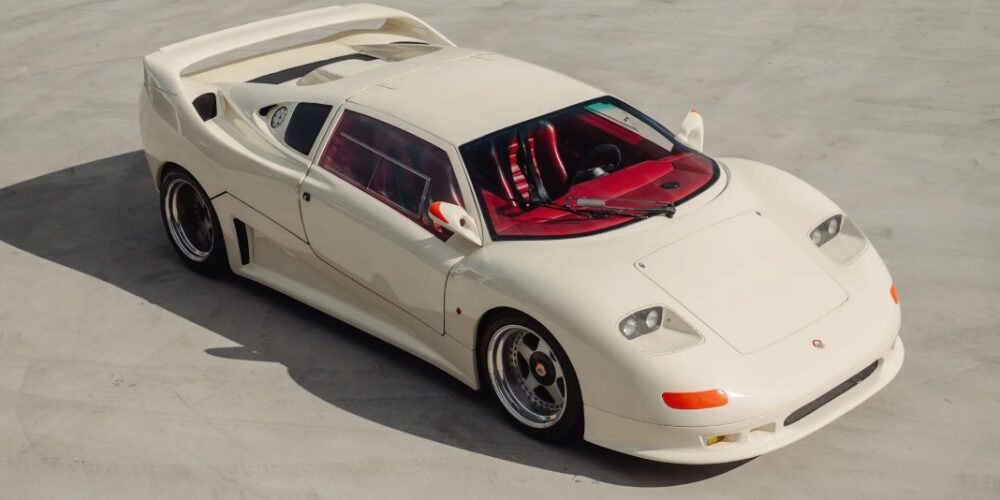
Almost two years ago to the day, I was gently frying beneath the Chantilly Arts & Elegance sun in the judging enclosure when I heard the immortal words: “What the hell is one of those?” from a fellow hat-and-blazer wearer. Cue a fair amount of head-scratching about exactly what an MCA Centenaire was. There were two of them in the Carlo Chiti celebration class, and when one subsequently appeared on the winners’ rostrum there were more than a few raised eyebrows.
Of course, I knew what it was. Not because I’d seen one in real life before that weekend, let alone driven one. No, it was because one of my prized childhood models was a metallic blue Bburago MCA Centenaire. And suddenly, there was the full-sized version sitting in front of me. For those of you who didn’t spend your formative years admiring an admittedly quite shonky diecast model, the Centenaire is one of the stranger supercar stories of the 1990s. And it’s particularly pertinent again now, because Broad Arrow has consigned the first example built to its Zoute Concours Auction in a few weeks’ time.
The late 1980s was not short of people who thought the world needed another supercar. Ferrari had the F40, Lamborghini was preparing the Diablo and Porsche was still selling the 959 to those wealthy and well connected enough to acquire one. Around the edges were Cizeta, Vector, Isdera and Schuppan, plus a whole supporting cast of people with a composite mould, somebody else’s engine and a business plan that looked considerably better while the Japanese asset bubble was still inflating. Into all that came a supercar from Monaco.
The MCA Centenaire was the work of Fulvio Maria Ballabio, an Italian racing driver and engineer whose career had stretched from Formula 2 and Formula 3000 to CART and sports cars. He had raced seriously, too, finishing fifth overall at Le Mans in 1986 aboard an Obermaier Porsche 956, and by the middle of the 1980s he had started putting together the operation that would become Monte Carlo Automobile. The idea was fairly simple. Monaco had motor sport history, money, glamour and a population for whom a Ferrari was closer to everyday transport than an aspirational object. What it did not have was a supercar of its own, and the Centenaire was supposed to fix that.
Its name marked the 1990 centenary of the organisation that became the Automobile Club de Monaco, founded in 1890, but Ballabio was not planning a one-off birthday present. As many as 100 cars were envisaged. The engineering team he assembled was formidable. Carlo Chiti became technical director; by then his CV included Ferrari Formula 1 cars, ATS, Autodelta, Alfa Romeo sports prototypes and Motori Moderni. Former Alfa Romeo sporting director Pier Luigi Corbari was also involved, Marcel Zunnino came from AGS, and Ciro and Ivano Barletta were among the other experienced competition hands associated with the programme.
The man most closely connected with the Centenaire’s structure was Guglielmo Bellasi. He had raced, built Formula 1 cars under his own name and developed considerable expertise in lightweight structures and composites. He and Ballabio spent around five years developing the Centenaire, and Bellasi’s operation at Biandrate, near Novara, is credited with producing both the carbonfibre monocoque and the carbonfibre bodywork.
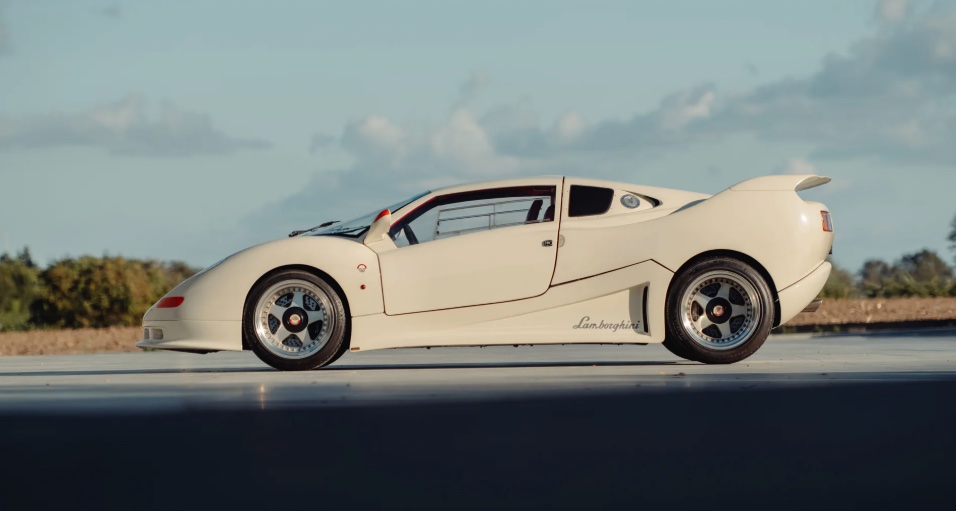
That was serious stuff in 1990: Ferrari’s F40 still used a tubular-steel chassis reinforced with composite materials, while full-carbon structures remained largely the preserve of Formula 1 and specialist racing machinery. The Centenaire used a carbon central tub, double wishbones, twin spring and damper units plus four-piston ventilated Brembo brakes.
MCA later made some fairly ambitious claims for the Centenaire’s place in carbonfibre history. Exactly who got there first depends on how you define ‘production’, because the Jaguar XJR-15 was being developed at much the same time and was officially announced in November 1990. Whatever trophy you want to award for being first, though, MCA was working with an all-carbon central structure extraordinarily early, and with a fraction of Jaguar’s resources.
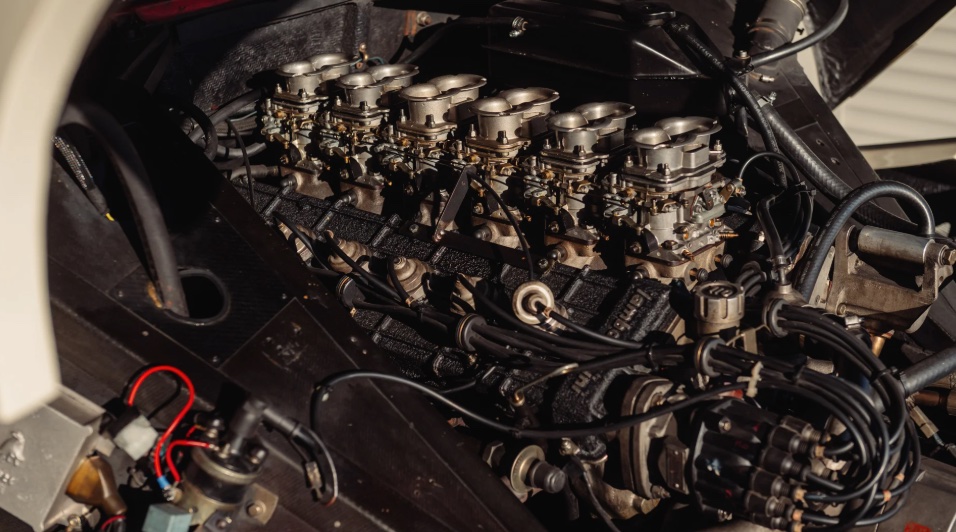
For the engine, Ballabio went to Lamborghini. An agreement signed in 1990 gave MCA access to Sant’Agata’s 5167cc V12, essentially the Countach 5000 QV unit. Broad Arrow’s car uses that engine, quoted at 455PS and driving through a ZF six-speed manual gearbox. Specification was not exactly fixed in stone, however. Road & Track was referring to a 492bhp Lamborghini-engined Centenaire by 1992, by which point MCA was already developing the car into something rather different.
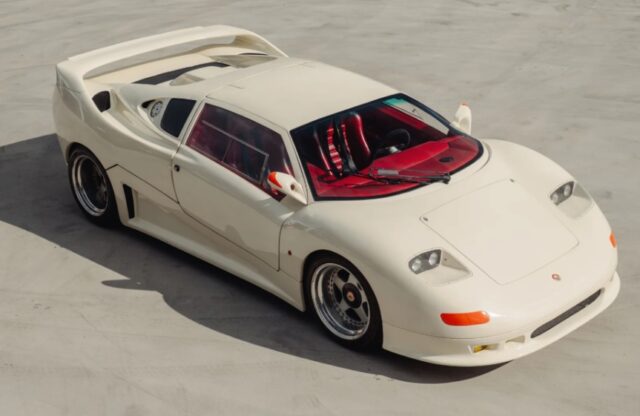
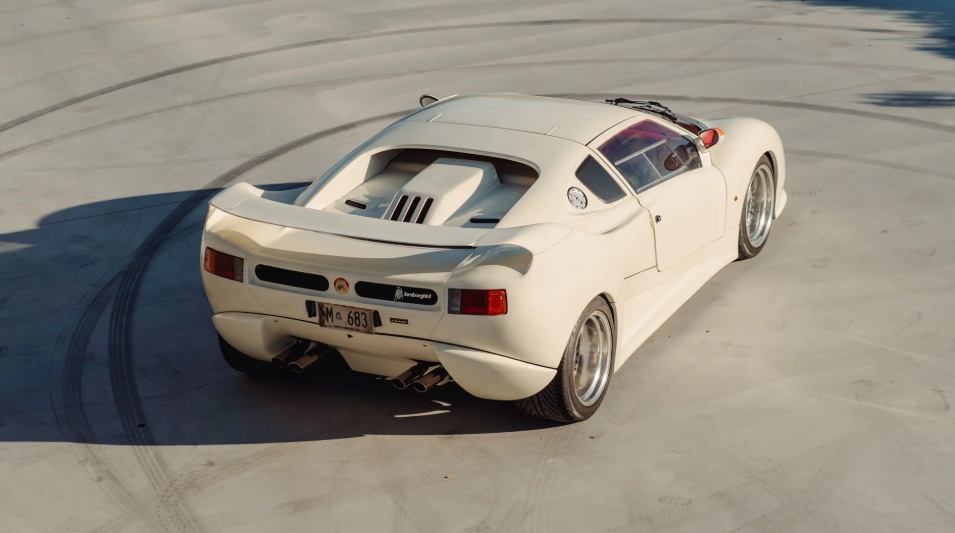
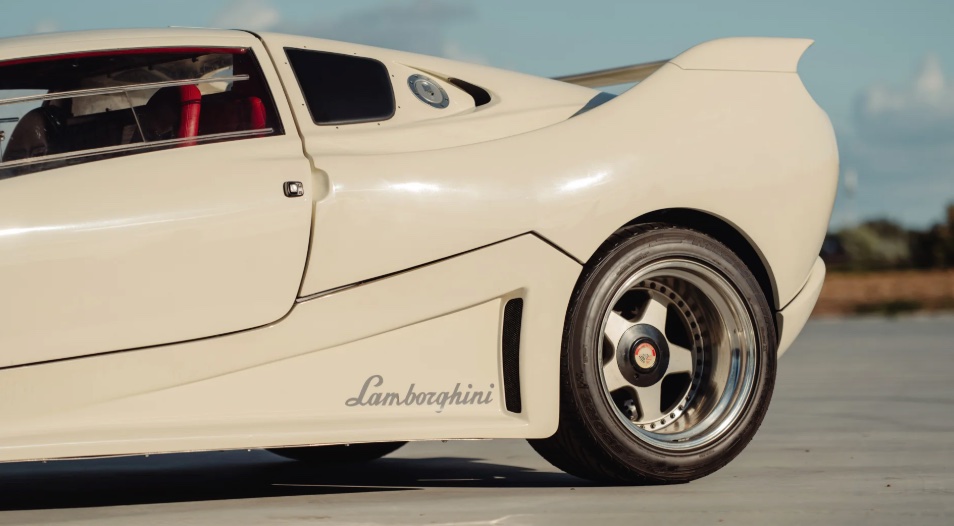
The styling is equally difficult to pin to one person in the traditional Italian-supercar fashion. There was no Gandini, Giugiaro or Pininfarina credit attached to it, and the available evidence points instead towards the shape emerging from Ballabio and Bellasi’s work, with Bellasi responsible for turning it into composite reality. It certainly looks memorable. The nose is extraordinarily low, the glasshouse looks almost dropped onto the centre of the car and the rear bodywork stretches away behind it, wrapped around huge haunches and an abrupt tail. As a child I thought the Bburago version looked completely outrageous; in the metal, the proportions are stranger still.
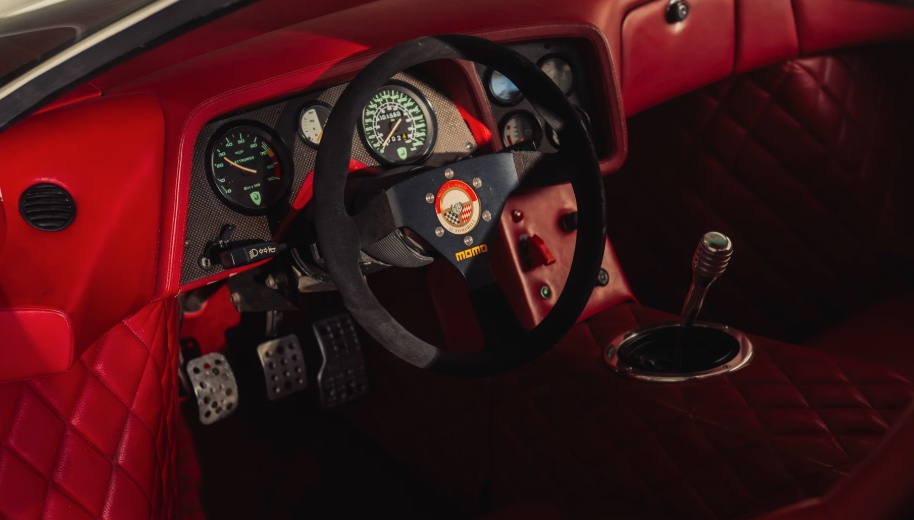
The Centenaire was unveiled in Monaco in May 1990 and presented to the Grimaldi family. The first example was finished in Ivory White with a red leather interior, a deliberate nod to Monaco’s national colours; that is the same car now being offered by Broad Arrow. Unfortunately, it also appeared just as the late-1980s exotic-car frenzy was beginning to collapse. The proposed run of 100 cars disappeared. Road & Track referred in 1992 to five Centenaires having covered thousands of development miles, although Broad Arrow now describes only three as Lamborghini-powered cars in the original specification; the remaining chassis were absorbed into the development programme.
By 1992 the construction had evolved significantly – the next stage was the Monte Carlo GTB. Road & Track described a carbonfibre central tub made by Pienfei in Italy, with steel subframes at either end carrying the suspension and drivetrain, and substantial aluminium reinforcement around the attachment points. The suspension retained upper and lower A-arms but used adjustable Koni dampers, coil springs and anti-roll bars, while the brakes were cross-drilled and ventilated with Brembo calipers.
The body had changed, too. The GTB’s carbon panels were credited to Castagna, a famous old coachbuilding name Ballabio revived partly because his grandfather had worked for the original firm. The Lamborghini engine was also on borrowed time.
Chiti initially looked at a 7.0-litre V12 proposal, but when that came to nothing he developed something considerably more exotic: a 4.0-litre twin-turbo V12, four valves per cylinder, Magneti Marelli management and a Garrett turbocharger serving each bank. MCA was talking about 720bhp and a kerbweight somewhere around the 1000kg mark. It would have been quite something. But it, er, wasn’t.
Road & Track sent 1961 Formula 1 World Champion Phil Hill to Monaco to find out. The GTB arrived late from Modena, Chiti plugged in a laptop and the V12 started, but there was one small problem: the engine would not run properly once the computer was disconnected because the Marelli mapping was unfinished. Hill’s intended blast along the Grande Corniche consequently became rather less dramatic than expected, coasting down a hill instead.
Undeterred, by 1993 ambitions had reached Le Mans. The project had become associated with a Georgian concern and the car reappeared as the MiG M100. Early testing still used Lamborghini power, and MCA-related accounts later claimed speeds of up to 354km/h on the Mulsanne Straight. For the race itself the specification became more adventurous again. The Lamborghini V12 was replaced by a 3.5-litre twin-turbo Motori Moderni unit derived from Chiti’s Formula 1 work and producing around 600bhp. It was connected to a Porsche gearbox that had not exactly been designed with 600bhp in mind.
The inevitable problems followed. Drivetrain movement made gear selection difficult, clutch and engine trouble took up most of practice and the car completed only one flying lap – a 5min 59.15sec effort. The MiG M100 failed to qualify. It did at least race later that year. Ballabio, Guido Daccò and Giampiero Consonni took an M100 to the Vallelunga Six Hours and reached the finish, classified 23rd.
Even after that the basic Centenaire idea refused to disappear. Aixam-Mega acquired Monte-Carlo Automobile in 1996 and reworked the concept into the Mega Monte Carlo, with revised bodywork and Mercedes-Benz V12 power. Production was once again discussed; production once again remained extremely limited.
The car now coming to Broad Arrow’s Zoute Concours Auction on October 9, 2026 is the one that started all of this. Chassis EL 0002 GB began life, according to documentation accompanying the car, as chassis 001, the first Centenaire built. It was used for development, testing and presentation duties before being redesignated EL0002. It was also the only example originally finished in Ivory White with red leather. Once MCA had finished using it, the car remained at Lamborghini in Sant’Agata for around ten years before being given to Ballabio in the early 2000s.
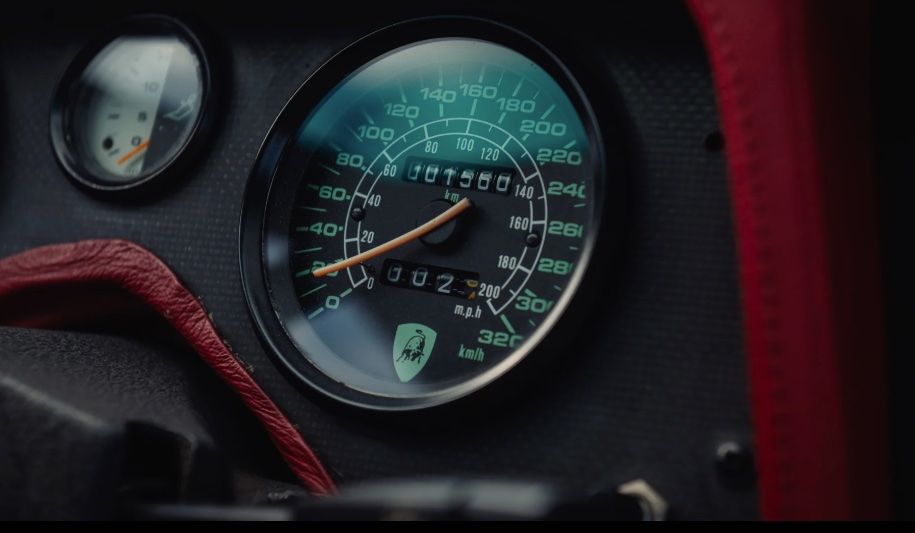
It was painted blue in around 2007 and shown at Rétromobile alongside the Lamborghini Pregunta, then bought by its current owner in France in 2014. Around two years later Établissements Lecoq restored the body and returned it to its original Ivory White, while the red leather interior was retained. The odometer now shows 1560km, although Broad Arrow points out that it probably covered rather more than that during its development life before the odometer was reset. Its estimate is €900,000 to €1.2 million.
Reflecting on what we now know of the collapse of the Asian market boom and the parlous finances of even the biggest names in the business at the time, such as Ferrari and Porsche, the fact that the whole MCA Centenaire project did not quite work out commercially is hardly surprising. What’s more surprising is how much of it did.
More details can be found here.