


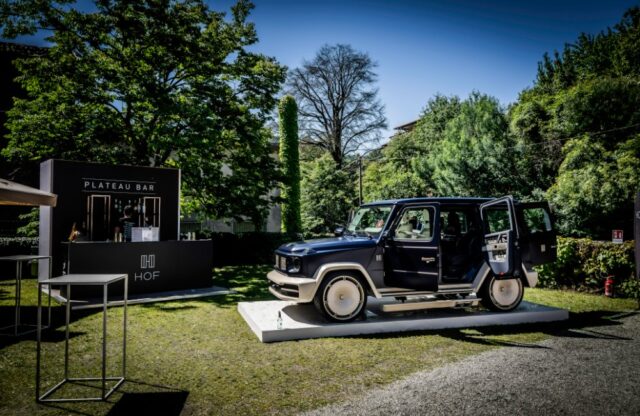
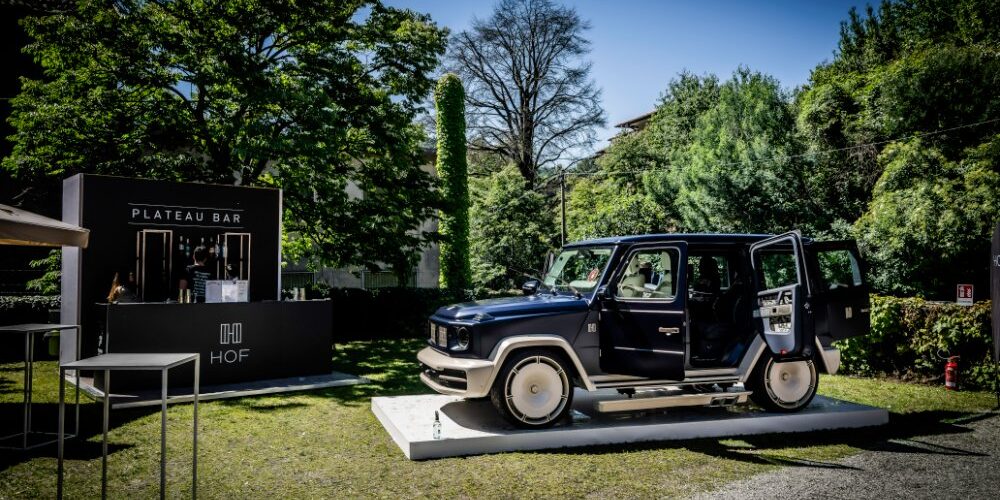
HOF has revealed Kinsō at FuoriConcorso on Lake Como, the first model in its Spring/Summer 2027 collection and the opening car in what the German firm describes as its Car Couture programme.
The company, based in Sindelfingen, presents itself as an automotive maison rather than a conventional tuner or coachbuilder. Its approach is seasonal, with limited-edition cars and matching accessories developed as a single body of work. In the case of Kinsō, that means a Mercedes G-Class-based vehicle with a two-tone exterior, heavily reworked cabin, specific HOF bodywork and coordinated range of luggage, clothing and accessories using the same materials and colour palette.
Kinsō is available to order now, with first deliveries scheduled for autumn 2026. Pricing is on application, and production will be limited by the available build slots within the Spring/Summer 2027 collection rather than by a fixed published number. The standard base vehicle is the Mercedes-AMG G 63, although HOF says alternative engine variants can be selected by the client during personal consultation.
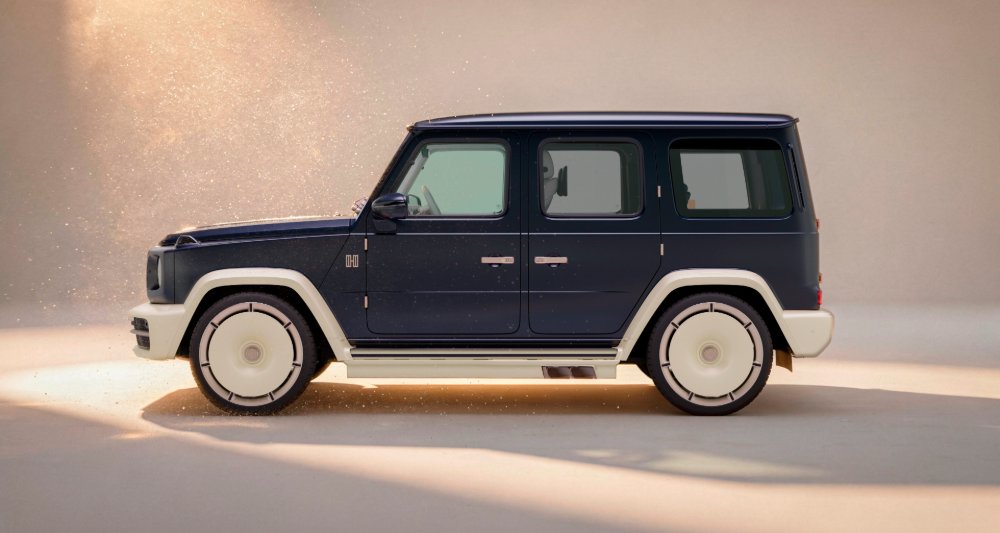
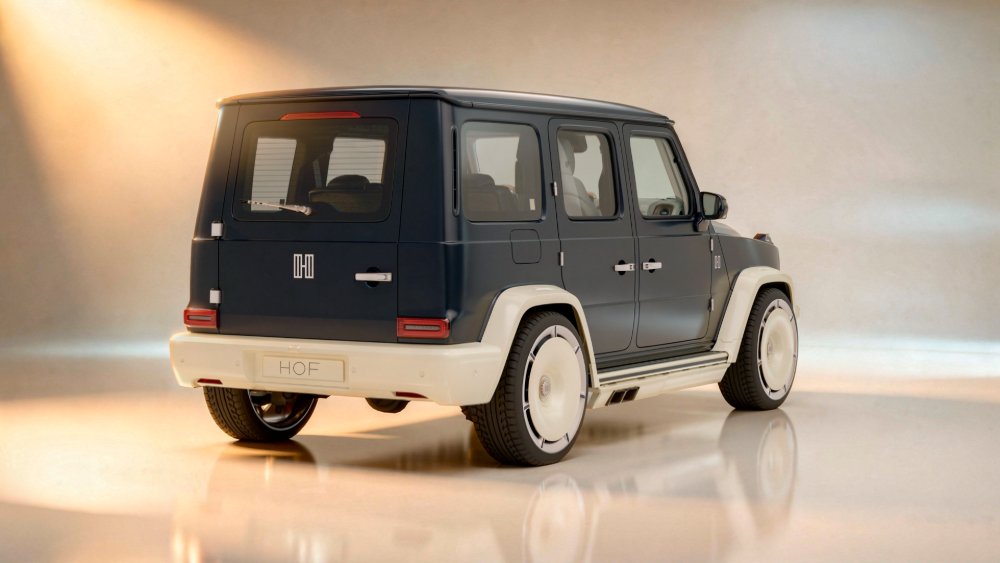
The Kinsō also debuts HOF’s permanent G-Class design language, which the company says will form the basis for future HOF collections. The idea is to create a consistent exterior framework that can carry different seasonal treatments without being redesigned each time. The HOF bodykit includes a redesigned front grille, front bumper, wheelarch extensions, rear bumper and electric running boards with integrated exhaust outlets. The whole kit is produced in carbonfibre by HOF. Depending on the collection, the carbon can be fully painted, as on Kinsō, or left visible. A cleaned rear section is available as an option, intended to bring the back of the vehicle in line with the smoothed treatment applied elsewhere.
One of the more involved exterior changes is the removal of the G-Class side-protection strips. HOF says these are laser-cut from the bodywork, after which the panels are closed and finished by hand at its atelier. The result is a cleaner, more uninterrupted version of the G-Class’s familiar upright form. HOF describes this as preparing the “canvas” before applying the collection-specific design treatment; in practical terms, it is a substantial smoothing of the G-Class body sides.
Kinsō is finished in a three-tone satin colour scheme: Aizome Blue and Kinari Crème, with Silk Gold as the accent colour. The car will also be offered in an inverted version of the same palette, with the two main colours reversed and Silk Gold retained as the linking detail.
The version shown at FuoriConcorso is presented in HOF’s Luxurious variant, which is intended to be the more restrained interpretation of the company’s G-Class design. The forthcoming Ma composition will use the same variant, while Honō will introduce the Sport version of the HOF G design language. Kinsō also uses 24-inch HOF Disc Wheels, finished in white with a Silk Gold ring accent.
HOF has also fitted Kinsō with coach doors, one of the company’s signature conversions. These are not standard across all HOF builds, but are reserved for selected collections. The system uses HOF’s own dual-hinge integration. The company says the conversion is engineered around safety, structural integrity and durability, and is completed at its atelier. The idea is to change the way the cabin presents itself when opened, particularly as the rear of Kinsō has been reworked around individual luxury seating rather than the standard G-Class bench. The electric running boards incorporate integrated exhaust outlets, while the carbonfibre exterior parts can be specified either painted or exposed depending on the chosen collection.
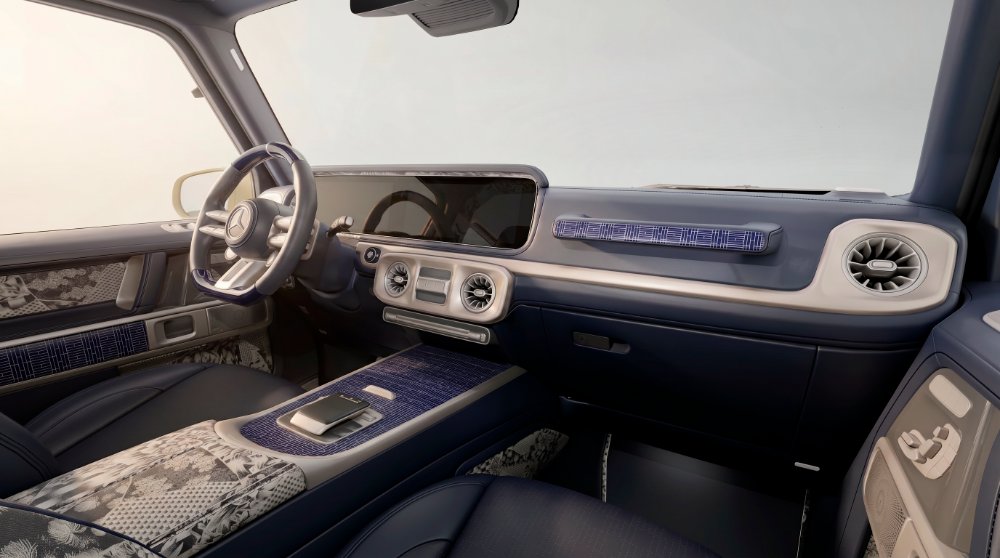
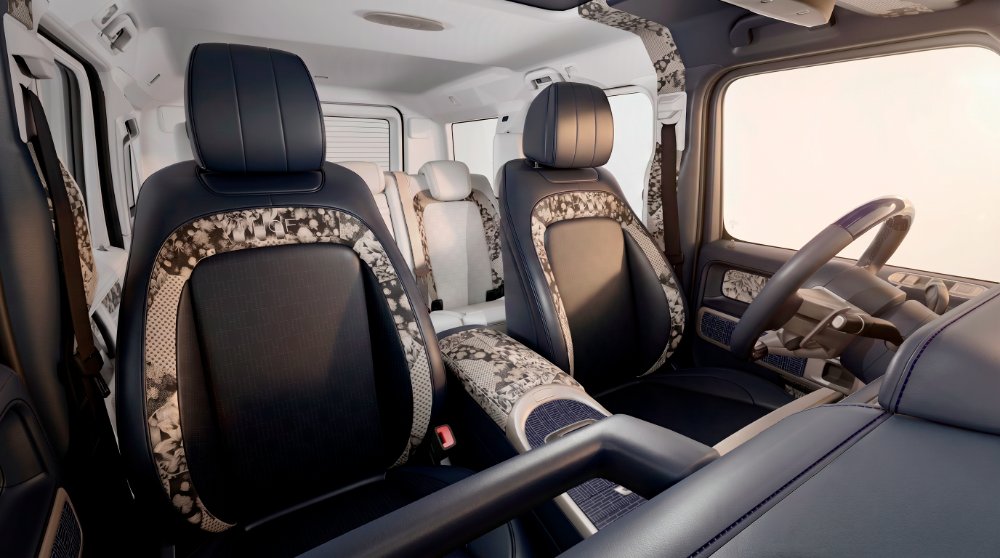
The interior is divided into two colour environments. The front of the cabin is finished in Aizome Blue, while the rear is trimmed in Kinari Crème. This front-rear division is the main interior gesture of Kinsō and is specific to this composition. At the rear, the standard bench is replaced by individual seats and a centre console, moving the layout closer to a luxury saloon than a conventional SUV. This also works with the coach-door conversion, which opens up the rear cabin more dramatically than the standard door arrangement.
Botanical jacquard inserts are used on the seats, door panels and headlining. HOF also uses vegetable-tanned leather, selected for its ability to develop patina, along with hand-placed botanical embroidery that is intended to be visible only at close range. A recurring H-pattern appears throughout the cabin, embossed into leather, woven into textile and etched into metal. The pattern is also used across the wider vehicle-and-accessory programme. HOF says every Kinsō is completed by hand at Atelier HOF in Sindelfingen. The work includes leather, textile and metal finishing, with features such as safety handles cut from a single piece of leather and hand-finished surface transitions between jacquard, stitched leather and embossed trim.
HOF’s Car Couture idea extends beyond the vehicle itself. Every collection car includes one accessory from the season as part of the delivery, and Kinsō’s associated wardrobe uses the same Aizome Blue, Kinari Crème, Silk Gold and botanical jacquard as the vehicle. The range includes a Weekender, Doctor’s Bag, men’s and women’s jackets, driving gloves and silk scarves. These can be ordered individually or as a coordinated set around the car.
Magneto met up with HOF at FuoriConcorso to get a greater idea into the thinking behind this approach to coachbuilding collectables, with head of brand Pascal Staud. HOF is actually a 40-year-old brand, but it was brought back to life a couple of years ago by Ferdinand Peter.
“He is someone who has been in the luxury market for the past ten years, selling all kinds of different brands to ultra-high-net-worth clients,” Staud explains. “There was always a desire to get something ‘more unique’ and more special. Even some of the cars that were unique were not special enough for them. When we met, we talked about it, and the category that is actually doing that very successfully is fashion, because every season there is a new collection. You get an understanding of that collection, and you can go into the store and appreciate it. Maybe it’s this collection, or the next collection, that makes you happy and that you want to buy. We brought this idea into the automotive world and call it Car Couture – it’s just the combination of the two.”
Staud aims to have two collection per year. “It’s a curated car, so the entire car that you see is as it is. There is mostly a variant to it, so the car you see behind me is fully like that. You can only buy it like that; you can’t say: ‘I like it, but I want blue and yellow.’ It is as it is,” he says.
“There is, however, a flipped version, where the majority part is in beige rather than blue. That solves two things that we believe in. The first is that you simply love the car or not. You buy it as it is, so you know you want exactly that car. And, as we only produce it until the next season comes out, it is always limited. We will have, from every collection car, a maximum of ten to 20 cars, because then the next season is coming and we won’t redo it.”

That approach allows HOFs to experiment with different topics and themes. “We defined the brand topic this season as Japan meets Paris for a simple reason: at the core of the brand is craftsmanship, and there are only a few nations in the world that have as deep a history in craftsmanship as Japan,” Staud says. “In the car, we have a special fabric influenced by how the Japanese have made these botanical fabrics for hundreds of years, and then we created the car around this.”
The car’s design was produced in collaboration with Etienne Salomé, an ex-Bugatti designer who, for example, designed La Voiture Noire. “The brief was to create something with more of a quiet-luxury approach, going away from what other brands do under the word ‘tuning’: making it wilder, bigger and more intensive. We went in exactly the opposite direction, to reduce the car,” Staud explains. “We made the cubic shape of the G-Class even more reduced by deleting the side-protection elements that are so unique to the G-Class. That makes it, at first appearance, even more monolithic. Then we thought about how to make a car that people could understand as being very close to a couture fashion piece. I’m going on thin territory here, because if we had a real fashion person here, they would say couture is a very specific word. But for us in the automotive world, we see this as a term for something that is so creatively made.”
The colour choice is directly derived from the Japan-meets-Paris approach. “There is a colour in Japan called Aizome Blue; it is basically an indigo colour. That is one colour, and we thought about how to create it. Matt or satin colours also have this quiet-luxury approach. So there are now three colours in this car: the blue, the beige and this Silk Gold element that brings it together,” Staud says.
Each car takes six months to build from the moment the owner delivers his or her G-Class; the conversion costs €486,000. “The two elements that are very intensive are deleting the side-protection elements and doing the suicide doors, which are exclusively developed by HOF. That needs a minimum of three months of pure production time,” Staud says.
Then there’s the suicide doors at the rear. “We wanted to have a car that has, at the back, not one element to hold the door, but two. That means we really have to work into the structure of the car, implement these two elements and clean the other side of the car. So it is quite an intensive process to do it right.”
The new car doesn’t have any engine tuning – unlike the first HOF creation, a tribute to Sir Lewis Hamilton that debuted in 2024. However, all things are possible. “We say the G63 is the base car. You can go for something where we go to around 800bhp; that is something you can order, but we won’t focus on that,” Staud says.

The future could conceivably see a move away from the G-Class. “We have had a lot of requests from clients who understand the concept and see it on other cars. Time will bring it; we are most definitely not a G-Class company, that is for sure,” Staud says. “We will also focus on more variants, but we are very happy to have a starting point with the G-Class.”
The next collaboration is already in the planning stage. “One interesting collaboration that we’re planning with a music producer, which we think is a very interesting territory – music as a whole,” Staud explains.
However, although the releases are limited in specification changes, bespoke commissions are possible. “We noticed people still come and say: ‘I have some very special ideas.’ I always say it like this: you either drive the story, which is what we do, or you are the story,” Staud says.
“A lot of existing clients have very definite ideas about what they want to do as an interpretation. We want to answer that demand with what we call the Meet the Designer approach. This means they explain who they are, what they are interested in and what materials they like, and we prepare a unique collection for them. It is a capsule collection for their individual wish, and that is how we respond if somebody does not want to wait until the next seasons to see if something is there. They can go that path and have their very individual selection, which is limited only to them.”
More details on HOF can be found here.