

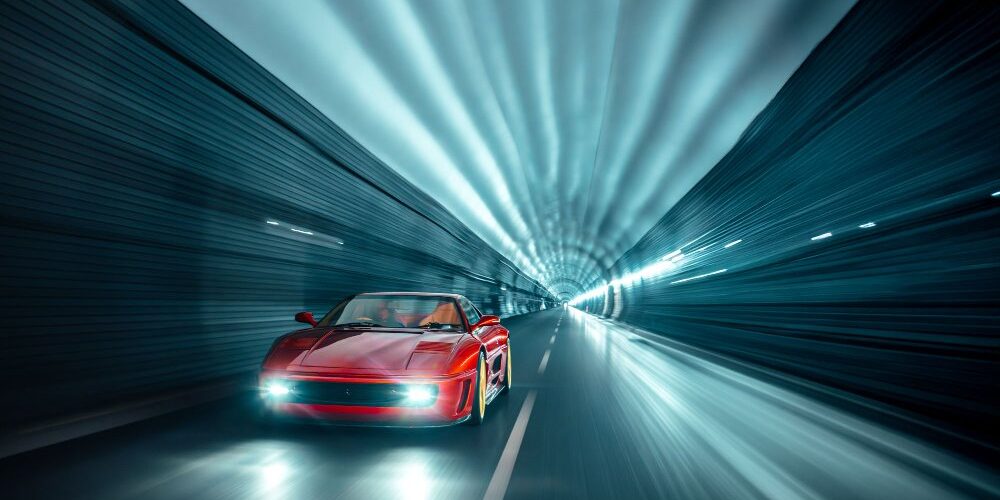
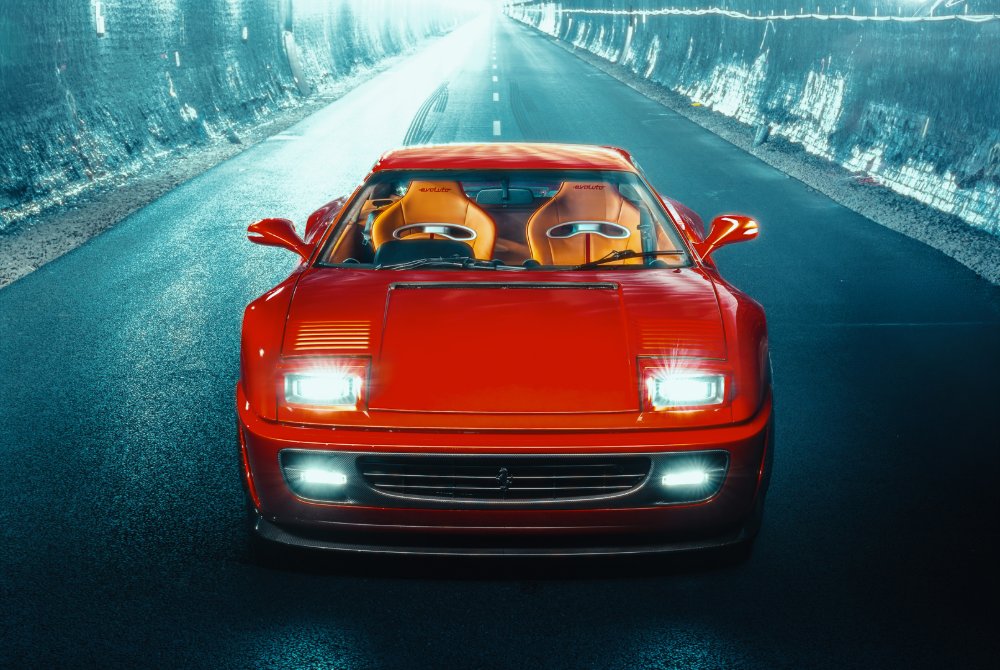
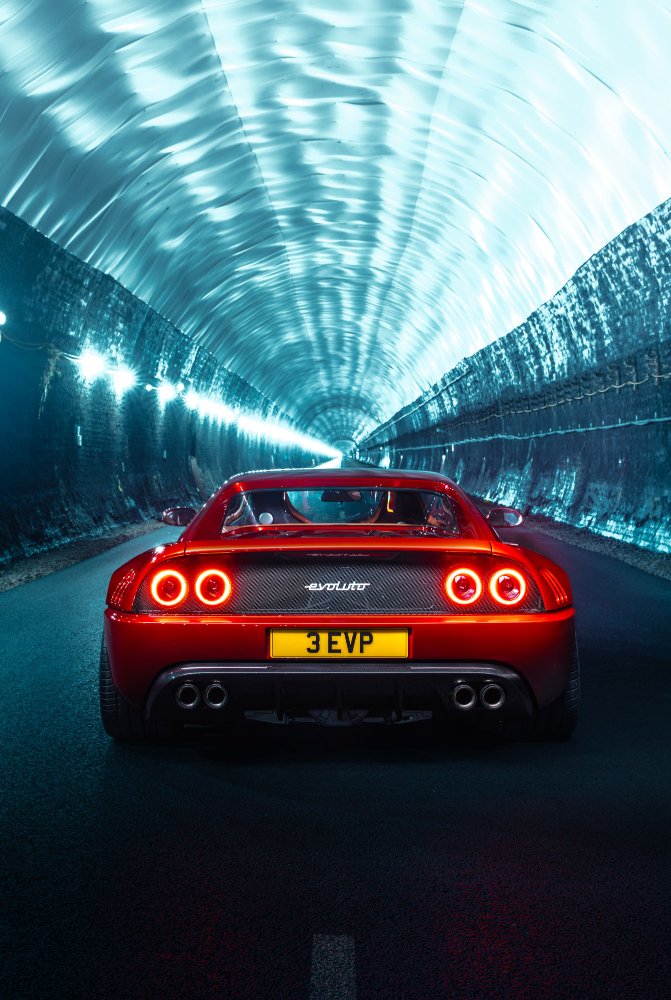
The Evoluto 355 has now reached production readiness – and the finished car will be on display at ModaMiami 2026.
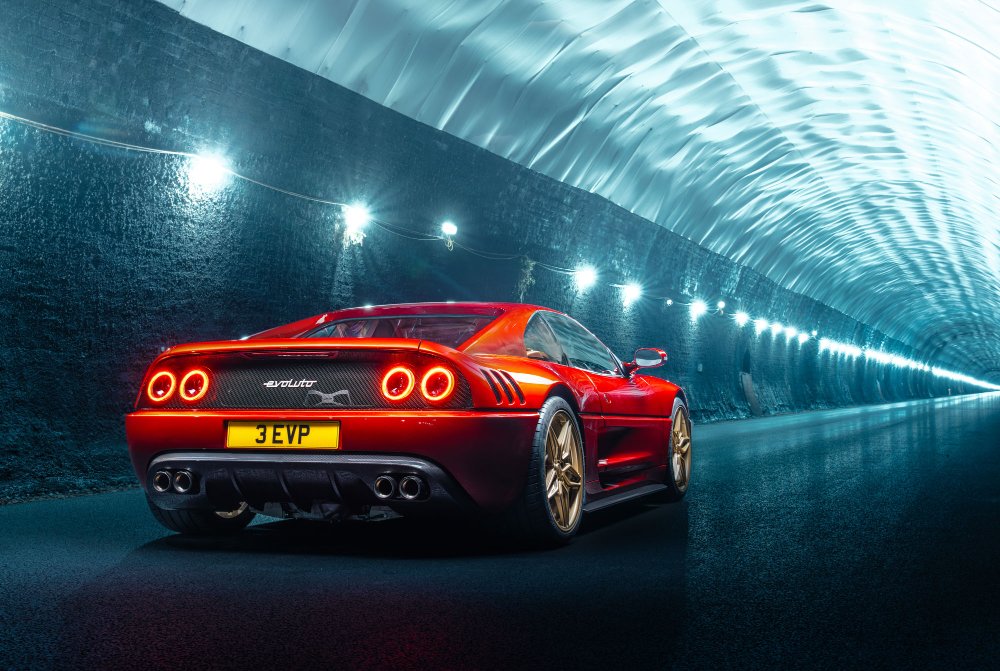
Magneto first got an in-depth look at the project at Goodwood Festival of Speed 2024 (you can read the article here). This is a restomod that’s prompted a lot of controversy – as did the 550 Maranello-based Touring Superleggera Veloce12 revealed the same year.
Engineered, designed and built under the DRVN Automotive umbrella, in those 18 months the Evoluto 355 completed 5000 miles of on-track testing and 10,000 miles of engine testing, and it is due to complete its final 20,000-mile durability testing sign-off ahead of deliveries in the latter part of this year. Its creator aims to support a 20,000-mile, two-year warranty.
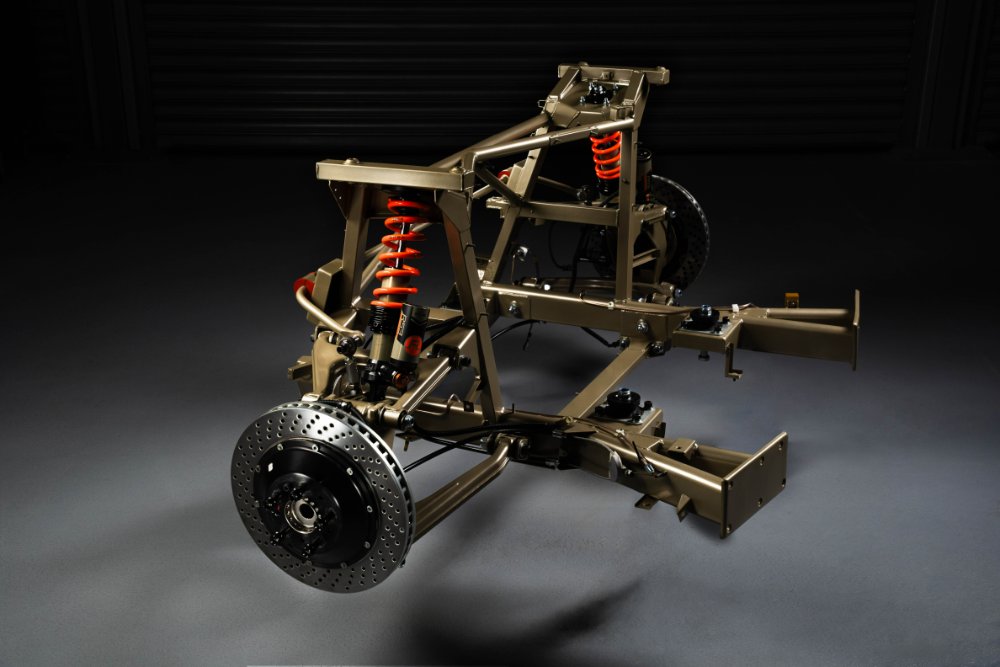
The engineering revisions for the Evoluto 355 centre on an extensively redeveloped chassis. Both axles have been broadened – by 77mm at the front and 66mm at the rear – giving the car a visibly wider footprint plus claimed increase in lateral stability. To complement this change, the suspension has been redesigned throughout. New upper and lower wishbones, uprights, wheel bearings and anti-roll bar links have been specified and manufactured, replacing the original assemblies rather than modifying them.
Evoluto has also repositioned the chassis hardpoints to establish geometry suited to modern wheel and tyre specifications. The upper and lower balljoint centres have been relocated to achieve controlled scrub-radius behaviour and a stable castor curve across the full sweep of suspension travel.
Attention has also been given to camber-gain characteristics during compression and steering, ensuring more consistent tyre contact under dynamic load. The motion ratio between damper and wheel travel has been recalculated; the dampers are R53 ST46 units. There are also newly designed, lighter roll-bar mountings and associated arms.
Due to the No Longer Available (NLA) status of original wheel-bearing assemblies and driveshafts, among other items, Evoluto has redesigned these components for better durability, maintenance and reduced mass. The revised wheel-bearing assemblies remove more than 1kg from each corner, and incorporate widely available sealed cartridge bearings, allowing individual elements to be replaced independently rather than requiring complete unit changes.
The driveshaft assemblies have also been redeveloped: lightweight tripod CV joints, drawing on contemporary motor sport practice, are combined with bar shafts machined from 300M (BS S155) high-strength steel alloy. Each shaft has been extended by 39mm to suit the broader track width; 2kg of mass has been removed from each side.
In addition to the aforementioned dampers, the entire suspension system has been reworked with R53 Suspension. It features bespoke three-way adjustable dampers featuring external reservoirs, with an internal design was developed using computational fluid dynamics.
The steering architecture has also been comprehensively revised, with the principal change being the adoption of a quicker steering rack. Lock-to-lock travel has been reduced from 3.25 turns to 2.0, and is paired with a newly developed electro-hydraulic power-steering system, engineered to provide consistent assistance across varying speeds and load conditions.
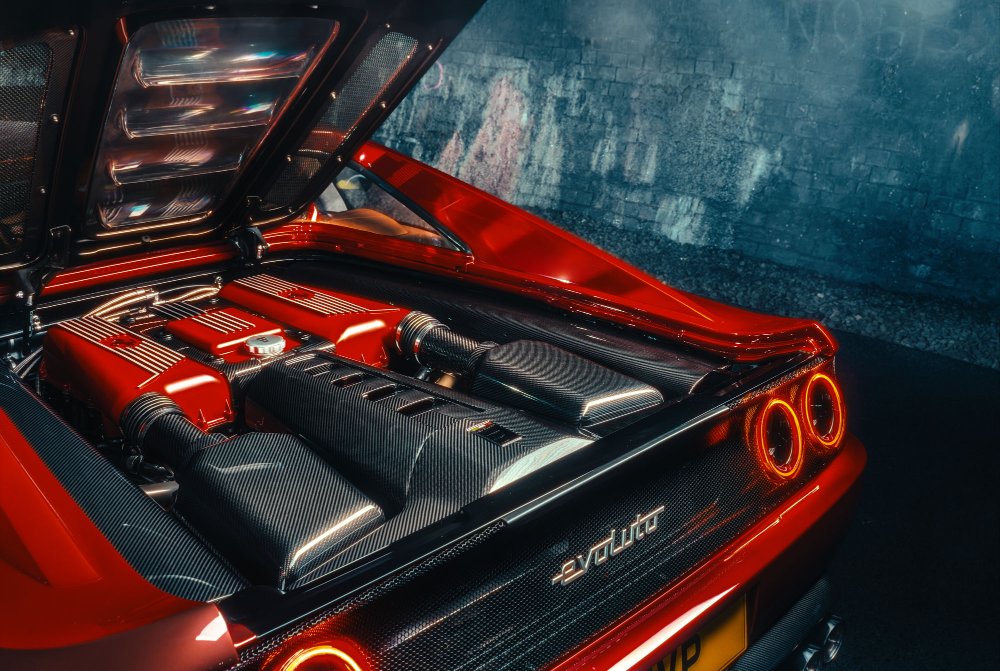
The Evoluto 355’s revised 3.5-litre V8 produces 414bhp at 8000rpm and 273lb ft of torque, while maintaining an 8000rpm ceiling. Internal components have been reworked to lower rotational inertia and improve throttle reaction, complemented by bespoke camshaft profiles, carefully ported cylinder heads and a newly developed stainless-steel exhaust system.
A 3.7-litre engine is also available, offering 473bhp at 9000rpm and 295lb ft of torque via more aggressive high-lift camshafts and an optimised valvetrain and fuelling system, alongside strengthened engine internals. The exhaust is a custom-designed stainless-steel system, but a titanium option is available.
The braking system consists of cross-drilled and vented discs (380mm front, 355mm rear) with six-piston monoblock Brembo calipers up front and four-piston two-piece Brembo calipers at the back. They sit under bespoke 19in alloy wheels clad in Michelin Pilot Sport 4S tyres – 235/35/R19 up front and 295/30/R19 at the rear. Multi-piece forged or magnesium wheels are available as options.
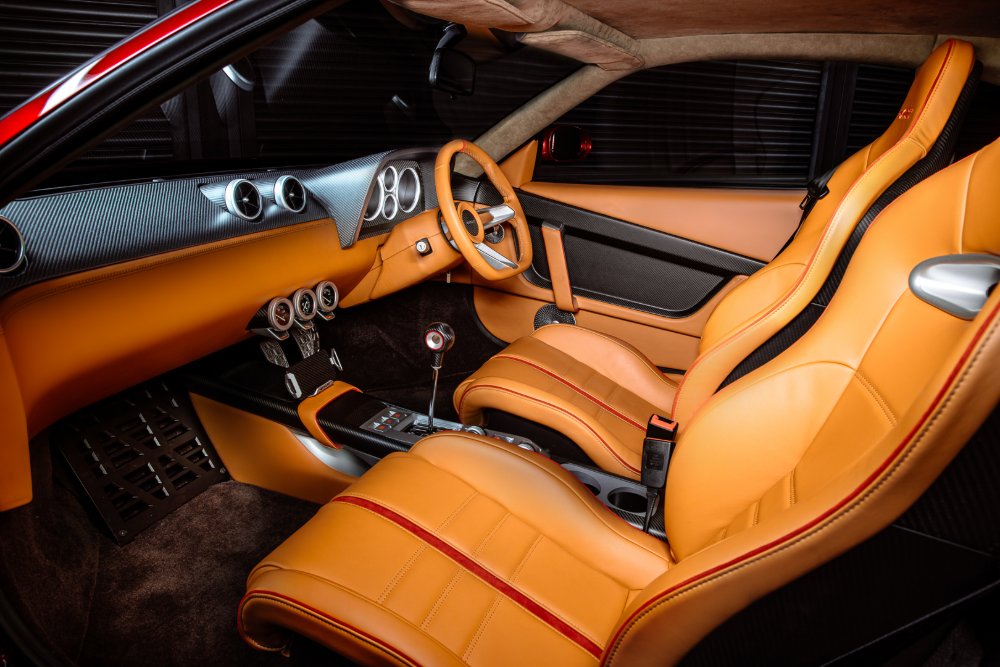
The interior has been reworked under the direction of DRVN’s head of design, Wayne Burgess, and his team. Carbonfibre construction is employed extensively to reduce mass, increase torsional rigidity within the cabin structure and preserve structural integrity. Instrumentation is analogue, with metal-machined dials, and – thankfully – physical controls have been retained in place of screen-based interfaces.
Surfaces may be finished in a wide range of materials, colours and treatments, including fully bespoke executions where required. Machined-metal components feature prominently, including speaker grilles milled from solid billets. Illuminated controls for climate, infotainment and auxiliary systems have been introduced, and there’s also a revised steering wheel and reconfigured instrument binnacle.
The Evoluto 355’s electrical architecture has been completely redeveloped, with a dedicated powertrain ECU accompanied by lightweight vehicle-control systems. Evoluto says the network has been structured to avoid the layered software integration common in contemporary performance vehicles, focusing instead on defined functional control, operational safety and electrical resilience. Auxiliary systems are electrically driven and supplied directly by the battery, preventing parasitic load on the engine.
A new power-distribution module replaces conventional fuse-box arrangements, introducing updated circuit protection and load-management strategies to improve fault tolerance and serviceability. Approximately 90 percent of the wiring harness has been replaced with newly specified looms.
The HVAC system has also been revised, and converted to a fully electric configuration. Heating and cooling functions are battery-powered, although user interaction remains via physical rotary controls.
More details on the Evoluto 355 can be found here.