

How do you bridge the technology and brand perception gap between your last car, a revival series of a 60-year-old icon, and the imminent introduction of an all-new carbonfibre-bodied V12-engined hypercar? Well, if you’re Bizzarrini, you dig into your design archive, pull out an unrealised concept from the 1960s, and then build it in carbonfibre, blending in modern luxury and current technology. The Bizzarrini 5300 Aperta Lusso’s heritage meets modernity; contemporary driving feel wrapped in 1960s elegance.
The story goes that when Giotto Bizzarrini and Giorgetto Giugiaro dreamt up the Iso Grifo A3C, which later became the Bizzarrini 5300 GT, the pair also wanted to create an open-top version.
Together they’re said to have envisaged a version with a removable roof panel and a structural arch behind the seats, which would be lighter and more elegant than a conventional folding hood. The design was first seen in 1962, in a prototype by Giugiaro while working for Bertone. The Bizzarrini company was focused on racing at the time, though, and the open-top design was never brought to life. It has remained in the archives ever since.
In recent years, Bizzarrini has been reborn, building ‘Nuova Classica’ Continuation cars and working on the new Giugiaro-designed modern ‘Giotto’ hypercar. With the initial 5300 GT Corsa Revival Continuations now sold out, Bizzarrini has made that original open-top vision a production reality – and here it is.

Just a day after the 5300 Aperta Lusso’s first shakedown test we were delighted to share driving duties with its generous owner on a 300km road trip from Turin up into the Swiss Alps. Our full drive story features in Issue 31 of Magneto (pre-order from mid-July).
As you’d expect, given the deep ties between the two companies, GFG Style – the famous father-and-son pairing of Giorgetto and Fabrizio Giugiaro – was responsible for the intoxicating lines and detail design of the new car. Although in Fabrizio’s own words: “The design was pretty well resolved to begin with.”
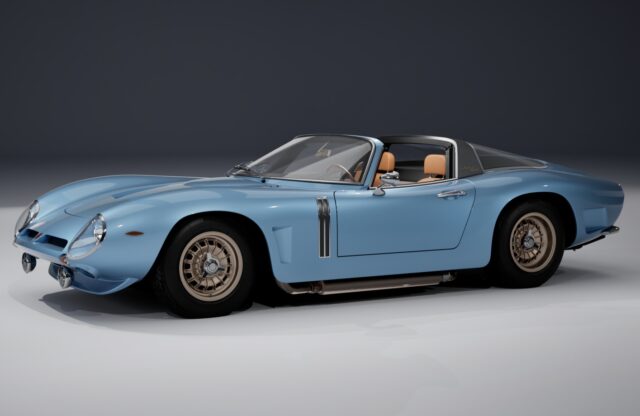
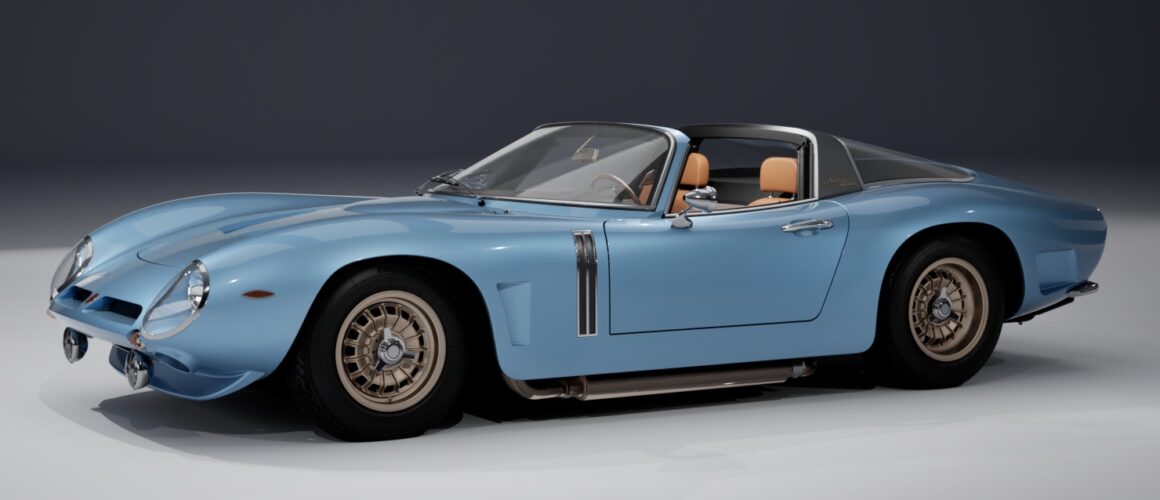
The 5300 Aperta Lusso is a thing of beauty; long and low, with ‘coke-bottle’ hips and beautifully bulging front fenders, both rewardingly on permanent display from the driver’s seat in the side mirrors and through the windscreen, respectively. It’s the rear three-quarter view that’ll have most hooked, though. The way the roofline flows almost seamlessly from the targa-style arch, accentuated by its dark contrast colour, first into the wraparound rear glass and then into the boot lid area, is a study in automotive beauty.
With this model being the first all-new production Bizzarrini since the 1960s, the company says that, initially, just ten owner-commissioned units will be built, although it is possible that “further commissioning slots will be available”. This first one, basically a fully developed hand-built prototype, is the La Dolce Vita commission. It represents its owner’s desire for a car that offers the polar opposite of today’s digital driving; an engaging, completely analogue experience, perfectly suited for those long, relaxed lakeside drives and Italian Riviera getaways.

To assist in that process, the car is fitted with many modern conveniences, hidden away so at first glance the Aperta looks just as it would have had it been built 60 years ago. It has air-con, frameless windows and modern weather sealing, an adjustable steering column, plus MagSafe charging and a high-end sound system discreetly integrated into the cockpit. And it all works pretty seamlessly. Despite the hot weather and motorway speeds during our drive, the cabin remained cool and quiet enough for easy conversation, even at Italian Autostrada speeds.

The interior also combines classic Italian styling with modern materials: seats and door panels trimmed in leather; the instrument panel sculpted from a single piece of European maple featuring a Riva-boat-like hand-painted pinstripes; and the gearknob crafted in Italian tortoiseshell inlaid with gold details to create the Bizzarrini logo. The exterior is finished in a bespoke metallic blue incorporating a gold fleck. The bespoke colour, named Azzurro Gaia in honour of the owner’s daughter, was inspired by the waters of the Ligurian Sea.

Under that paint, the Aperta Lusso is actually built around a single-piece carbonfibre composite body, one of the largest of its type in the world, using a semi-monocoque bonded chassis. Bizzarrini’s engineers incorporated a steel reinforcement assembly around the transmission tunnel along with a cross-body bar. With this, the Aperta’s torsional rigidity surpasses that of the original 1960s coupé, providing noticeable stiffness around the switchbacks of the Gotthard Pass. The two roof panels are also carbonfibre, light enough to be removed and stowed in the luggage compartment by one person.

The mechanicals are mostly pure 1960s Bizzarrini, engineered to the same design as the 1965 Le Mans class-winning car. Double-wishbone suspension (with with Koni ‘red’ adjustable dampers valved specifically for the Aperta Lusso), cast-magnesium Campagnolo centre-lock wheels, and ventilated discs all round, with inboard rear discs and no servo assistance. Steering, though, is rack and pinion, rather than the original’s steering box, with discreet electrohydraulic power assistance that reduces above 40mph.

The front-mid engine is the same Chevrolet 5.3-litre small-block V8 as was used in the original, developing more than 400bhp and fed by modern fuel injection rather than the Weber 40DCOEs of the GT Corsa Revival. Satisfyingly, at first glance, the injection system is styled to match the look of the Webers. The V8 drives through a Tremec TKX five-speed manual transmission and limited-slip differential, although a six-speed manual is available as an option. The finishing touch is a valved exhaust hand-fabricated in high-nickel alloy Inconel. Even with catalytic converters in place, it offers a suitably Bizzarrini-like burble.
As mentioned earlier, Aperta Lusso production is initially limited to ten bespoke commissions. The cars are expected to be completed during 2027, with further production slots possible after that, according to demand. There’s more information on the Bizzarrini website – or read our exclusive drive story in Issue 31 of Magneto, available for pre-order from mid-July.