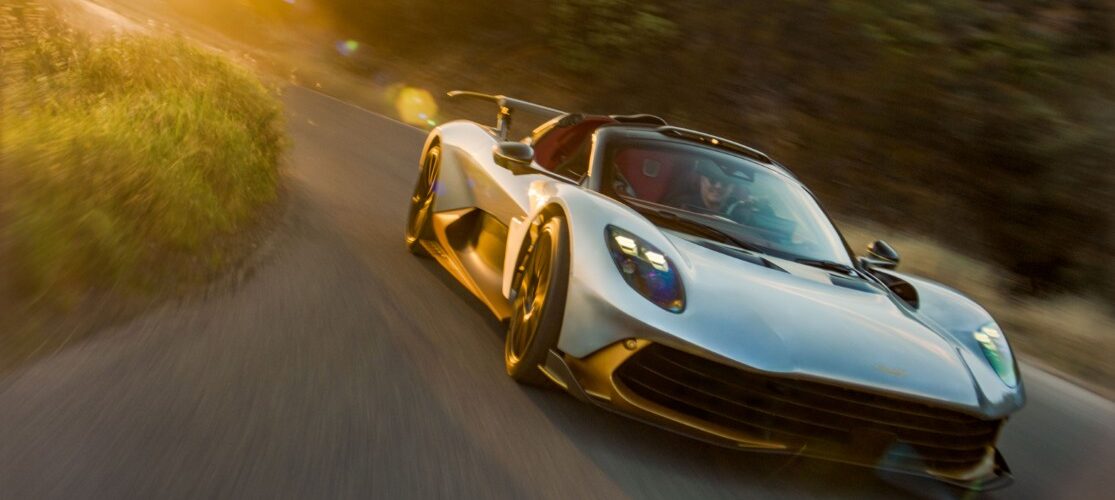
Aston Martin has revealed the Valhalla Spider, an open-top version of its 1064bhp plug-in hybrid supercar. Aston Martin expects around one in four Valhallas to be specified as Spiders, with total production limited to 999 cars. The marque hasn’t yet confirmed pricing, but customers should expect a premium over the coupé’s roughly £850,000 tag. Deliveries start in Q3 2027.
The Spider is just as potent as its coupé stablemate, and it can reach its electronically limited 217mph top speed with the roof removed. That makes it the fastest open-air Aston Martin has ever built, beating even the V12-powered Valkyrie Spider hypercar, which tops out at just over 205mph without the roof off.
With a top fitted, the Valhalla Spider’s maximum speed depends on which roof you choose. The standard removable fabric top can be stowed in the Spider but limits the car to 124mph. The optional carbonfibre hard-top, which is standard in the US, carries no such penalty. Aston Martin also supplies a rain cover to protect the interior when the car is parked.
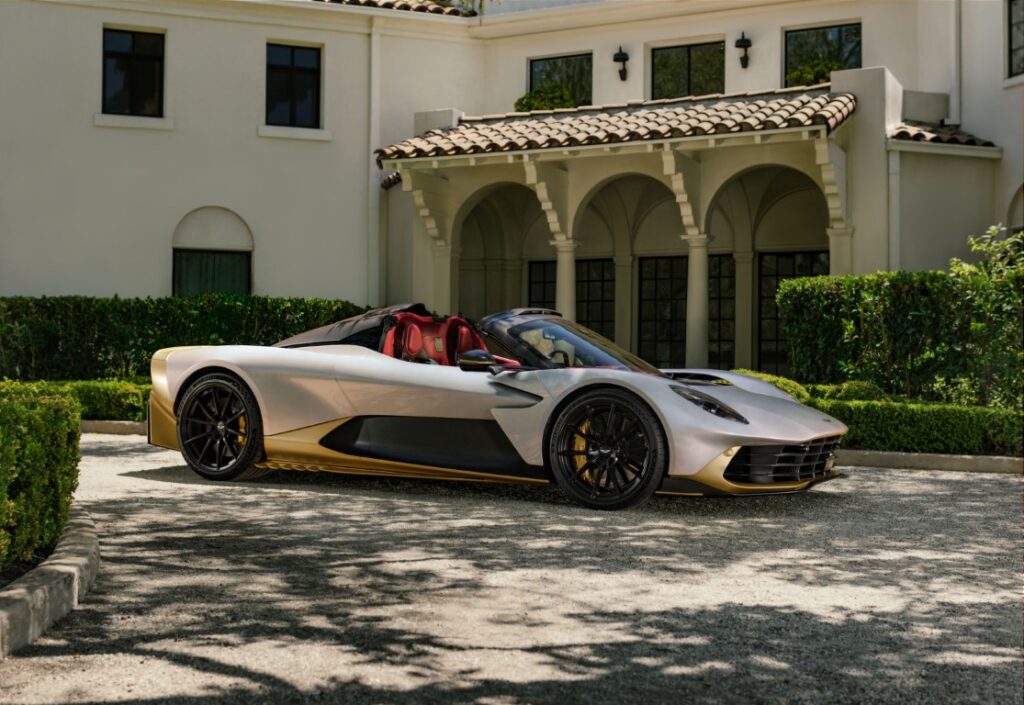
Transforming the Valhalla coupé into an open-top supercar created myriad engineering challenges, chief among them being keeping the roof-mounted snorkel fed. The snorkel supplies fresh air to the turbochargers and charge-air coolers sitting above the V8.
Without a roof, the air coming off the windscreen tends to lift up and over the car rather than funnelling into the intake. “The car doesn’t work unless you feed that snorkel,” Andrew Kay from the Valhalla programme team told Magneto at a private preview ahead of the Spider’s reveal. “That was probably the biggest challenge we’ve faced.”
Aston Martin’s solution is a wind deflector that clips to the top of the windscreen. It is shaped to lift air over the occupants’ heads while channelling cooling air down into the snorkel, which has been reprofiled and raised 35mm for the Spider.
“When you’re in the car, you can actually feel the shape of the airflow,” said Kay. The result is a snorkel that draws in slightly more air than the coupé’s. When the roof is fitted, the deflector folds into three and neatly stows within the car.
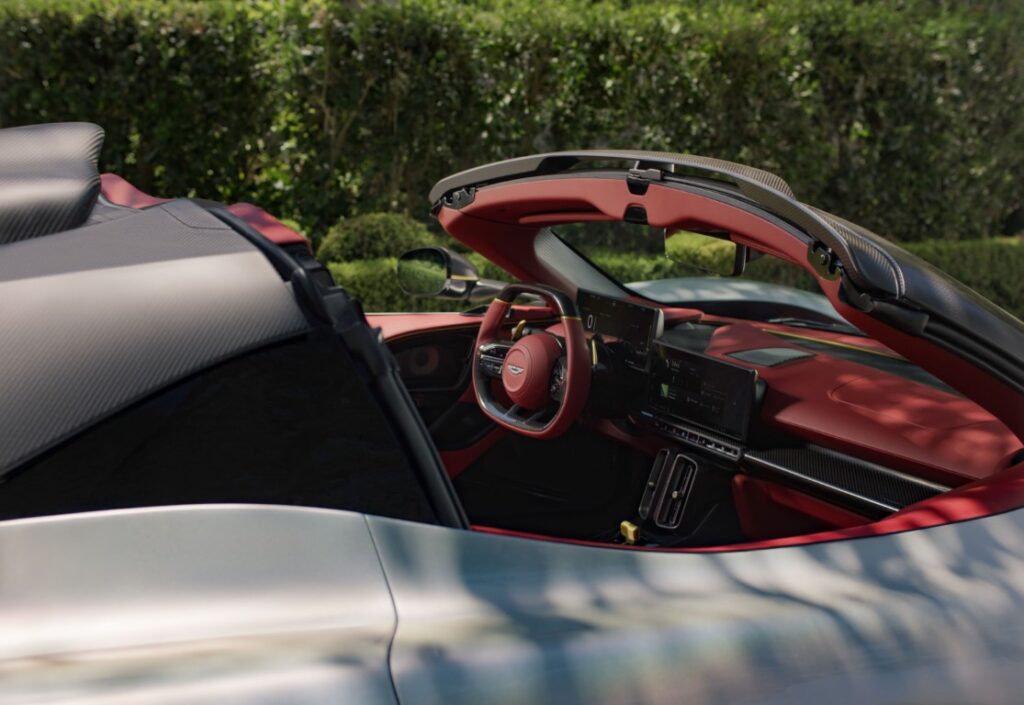
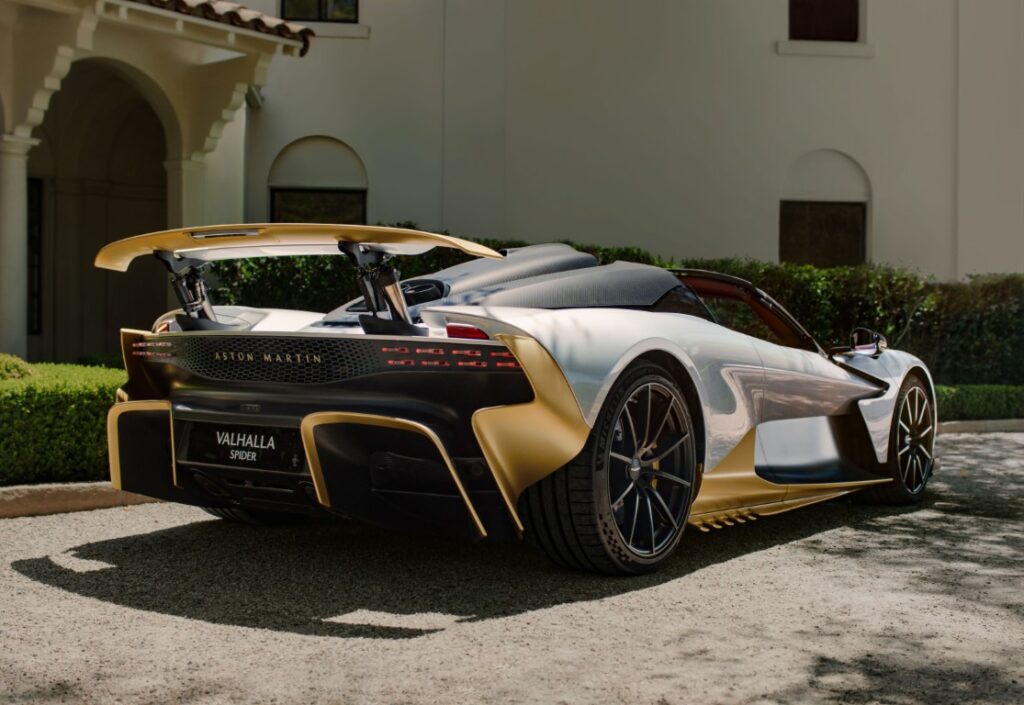
The Spider also required a recalibration of the coupé’s active aerodynamics and stability-control systems. The car detects whether the roof is fitted and aerodynamically rebalances itself accordingly. With the roof off, the airflow over the rear is messier, depriving the rear wing of the clean air it needs to generate downforce. To compensate, the front aero is dialled back to keep the balance consistent. The clip-in wind deflector helps here, too, pulling air down through the centre of the car so the flow reattaches to the rear more quickly.
“Generally, we aim for a 40:60 aero balance front to rear, which is the same as the weight distribution, because you want the car to still feel natural,” said Kay. The full 600kg-plus of downforce is only available with a roof fitted.
Underpinning the Aston Martin Valhalla Spider is the coupé’s carbonfibre tub, which was so stiff to begin with that it needed only minimal changes. The marque didn’t have to add heavy bracing to the sills or transmission tunnel, and the resin-transfer-moulded lower section is unchanged. Only the upper structure has been redesigned to suit the new roofline.
Aston Martin won’t be drawn on stiffness figures, but Kay said the penalty is minimal. “There’s always a small change when you take the roof off; that’s just physics,” he explained. “But the great thing about a carbon tub is that it doesn’t really make a great deal of difference.”
Not needing extra bracing also helps keep weight down, and Kay put the real-world increase at less than 20kg. The Spider’s 1680kg dry weight is 25kg more than the coupé’s, but Kay explained that’s partly because not all of the coupé’s lightweight options are offered on the Spider.
Aston Martin has also used the Spider as an opportunity to address some of the criticisms levelled at the Valhalla coupé. The carbonfibre dihedral doors are now frameless and, while the hinge line is unchanged, revised kinematics make them easier to open. The top edge of the door glass has also been raised by approximately 20mm, making ingress and egress easier with the roof fitted.
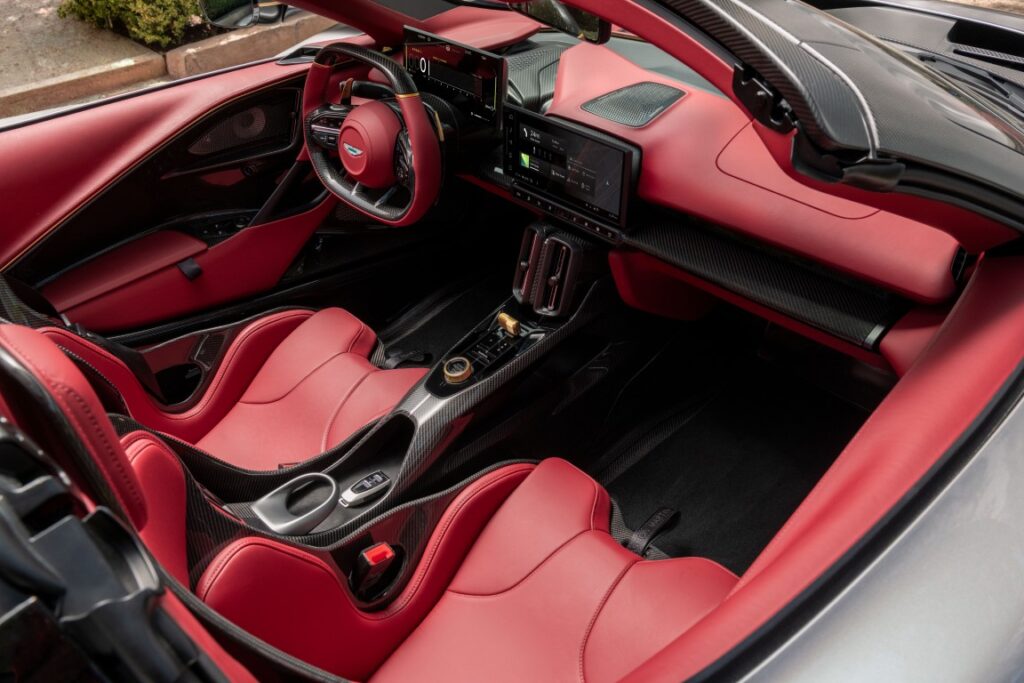
Inside, new carbonfibre Touring seats are standard. Some coupé owners found the original seat’s side bolsters awkward to clamber over, and larger drivers found these dug into their hips, so the Touring seat’s bolsters are cut much lower. The original seat remains available at no extra cost.
The Aston Martin Valhalla Spider also has more storage than the coupé. The manufacturer found unused space in the sills, between the ducts feeding the engine and transmission oil coolers, and turned it into compartments that house the deflector, first-aid kit and warning triangle.
The plug-in hybrid powertrain is identical to the coupé’s. The majority of the power comes from a 4.0-litre twin-turbocharged flat-plane-crank V8 that sends 817bhp to the rear wheels via an eight-speed dual-clutch transmission with an integrated e-motor. Two more e-motors power the front wheels, providing all-wheel drive and torque vectoring with no mechanical link between the axles. Combined output is 1064bhp and 811lb ft, and Aston Martin predicts the Spider will cover 0-62mph in 2.5 seconds.
The Aston Martin Valhalla Spider will make its public debut at the Concours at Wynn Las Vegas on October 30, 2026. The order book is now open and the marque is already hosting private viewings with clients.
Click here for more.