

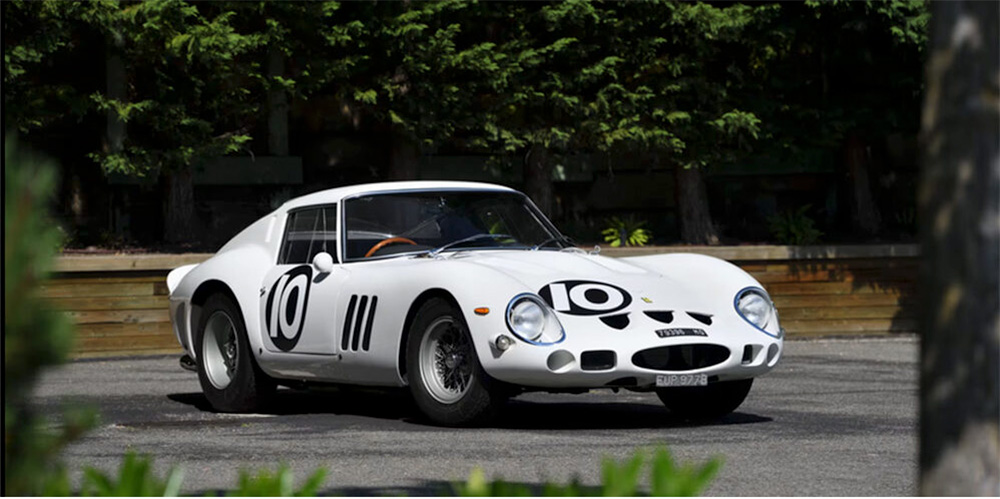
Mecum’s 250 GTO result at its Kissimmee 2026 sale provides an interesting marker for the breed, and Enzo-era Ferraris in general, as Nathan Chadwick writes.
Mecum’s 250 GTO sold for $38.5 million in Florida, which places it at number five on the list of the most expensive cars ever sold at auction – ahead of chassis 3851 GT. That car was first ordered by Jo Schlesser and won the Tour de France, but co-driver Henri Oreiller was killed in it at Montlhéry shortly afterwards. It was rebuilt and used in hillclimbs by Paolo Colombo, and then later sold to Ernesto Prinoth for circuit racing.
It remained with Fabrizio Violati until 2010, before being sold at Bonhams’ Monterey sale in 2014 for $38.115m. At the time that result was seen as a little disappointing, with the general view that its fatal history held it back. However, $38.115m in 2014 is now $51m-$52m, which puts a different complexion on Mecum’s 250 GTO.
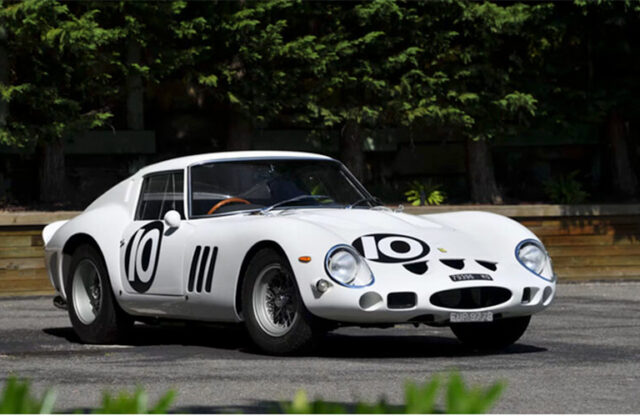
As we reported here, Mecum opened the bidding at $50m, just shy of the $51.705m achieved by 250 GTO/330 LM chassis 3765 via RM Sotheby’s in November 2023. After getting no sniffs, Mecum dropped to as low as $25m before finding its feet at around $31m-$32m, with the final $35m hammer bid taking nearly ten minutes. With fees, it all added up to $38.5m. There certainly wasn’t a bidding frenzy – which we should have expected. After all, the car had been available via private (but very public) brokerage for a couple of years with little interest.
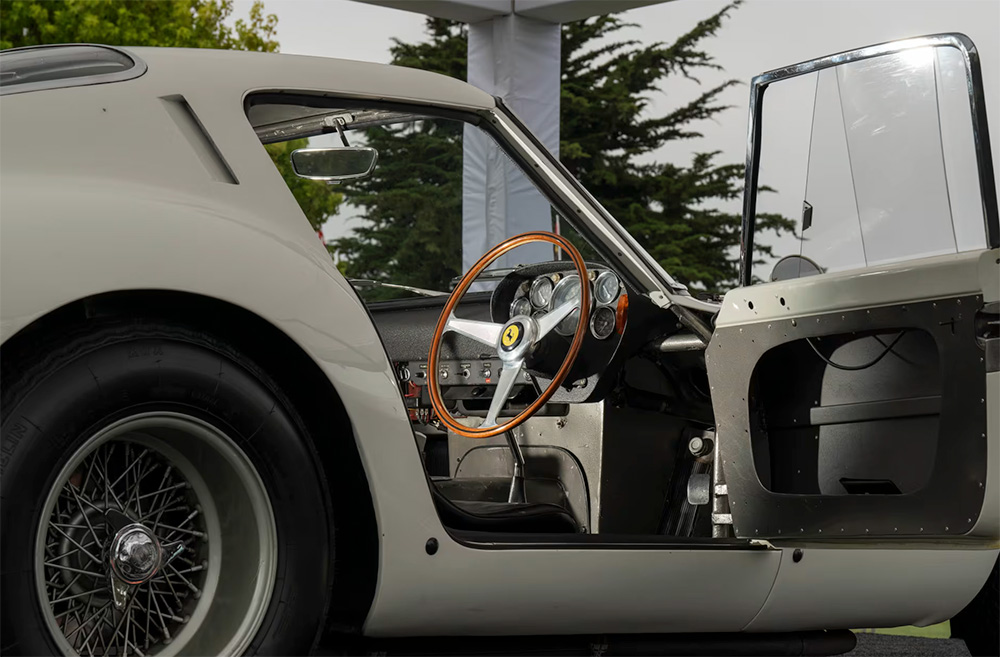
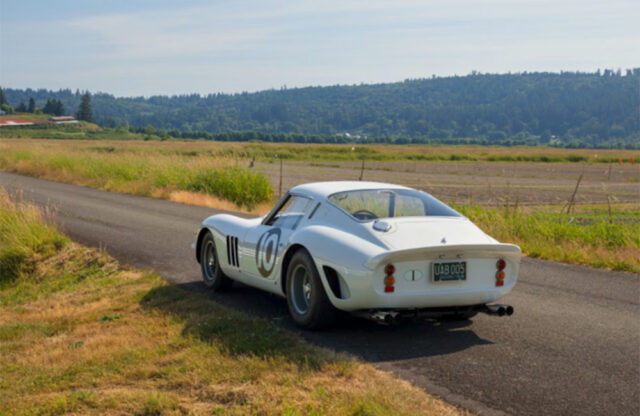
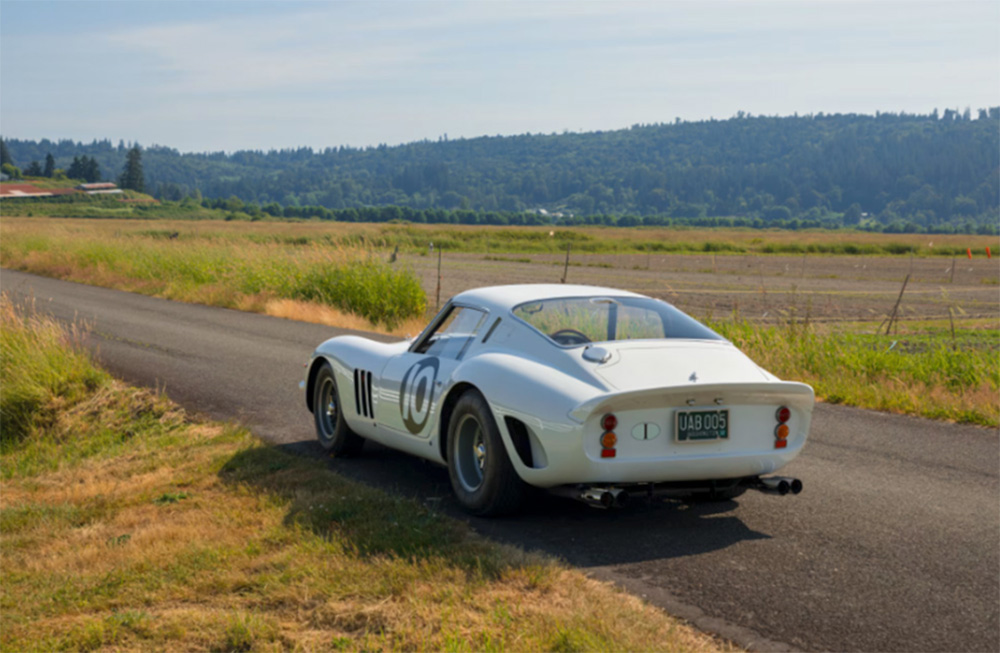
Now, $38.5m is not an insignificant amount of money, but there is a view that the result for Mecum’s 250 GTO is somewhat disappointing – it sold for well under Hagerty’s ‘fair’ value of $47.85m, but reflects the growing change in emphasis in the collector car market. All this despite the Mecum’s 250 GTO having a fascinating story – first owned and then raced by John Coombs’ team, then given to Jaguar for technical analysis, it had seen the likes of Graham Hill and Roy Salvadori get behind the wheel. It was also the only 250 GTO to leave Ferrari painted white. More details are here.
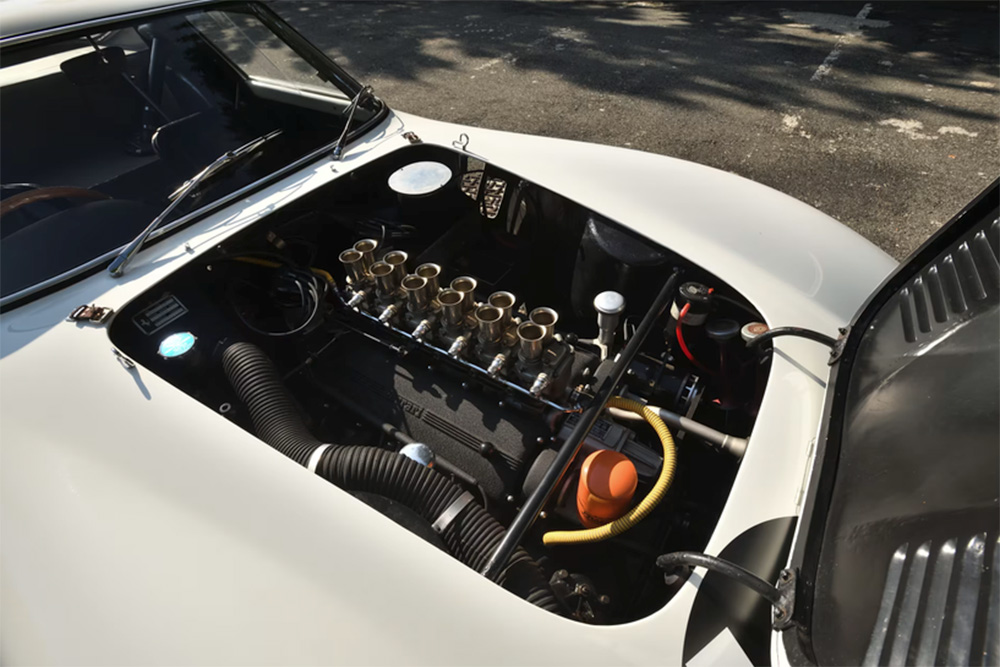
However, as Hagerty’s John Mayhead notes: “The car’s replacement engine, exclusively British period race history, right-hand-drive layout, unusual white paintwork and relative lack of restoration may have put off some US bidders. I say ‘relative’, because the car crashed out at Silverstone in 1963 and had to be significantly repaired at the time – although, as they were racing cars, many 250 GTOs have also suffered racing damage.”
We’ve previously reported in a scaling back of Ferrari values – although the brand clearly has cachet, as evidenced by the record-breaking results in Kissimmee for the Bachman Collection cars, there are some stark realities about the 250 GTO. The 18-year-old of 1962 will now be around 82, so those who saw it racing and were suitably inspired, and have the means to own such a Ferrari, are dwindling. Indeed, we’ve seen large collections come up for sale in Europe and provide disappointing results. From our conversation with Cavallino’s Luigi Orlandini in Magneto 28, we know that the desirable cars of today’s collector’s youth are more likely to be Testarossas, 288 GTOs, F40s and F50s.
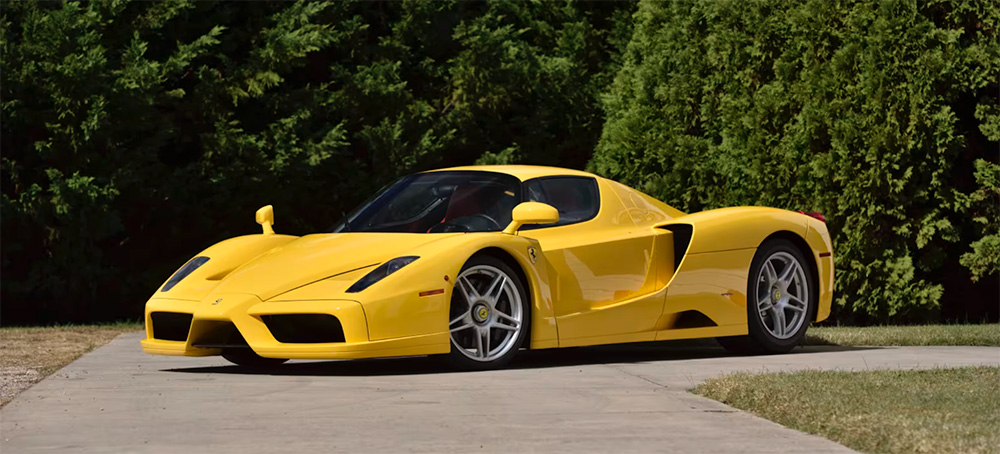
Also, as it turns out, increasingly 2000s-on cars. At Kissimmee, Mecum saw the record for a Ferrari Enzo tumble not once but twice. The above example sold for $17.8m, which you could put down to it being a rare colour – but with 11 yellow US cars, it perhaps wasn’t that rare, in the same way we’ve seen uncommon hues inflate values at Monterey in 2025. Further proof of that came with the $11m spent on a red Enzo from the same collection – that was more than twice the previous record by itself.
Elsewhere, a 550 Barchetta sold for $1.265m, a 430 Scuderia 16M went for $1.98m and a 360 Challenge Stradale – in green, somewhat atypical for the Bachman collection – went for $1.55m.
It’s notable that all these cars, bar the 430 Scuderia 16M, have had their naysayers over the years; for the 550 Barchetta it was the roof (now sorted via the aftermarket), and the early paddleshift gearboxes (Enzo and 360 Challenge Stradale). While manual ‘boxes are preferred by collectors and boutique hypercar buyers alike, it appears that these early paddleshift-only cars are not as unlikeable as they seem. I’ve driven many such systems, and in an era of fully automatic EVs and ICE cars, and super-quick DCTs, there’s a mechanical, physical nature to the shifts that still requires some finesse to operate well. And downshifting a 360 Challenge Stradale on the paddles, hearing its flat-plane V8 soar, soon makes you forget about your bored clutch foot.
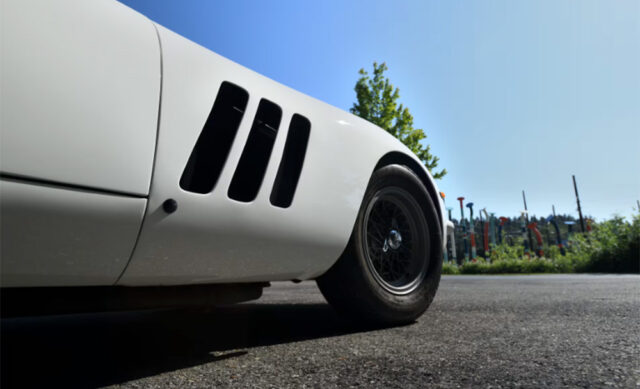
But what’s the future for the 250 GTO? It’s unlikely that the $80m believed to have been paid privately for chassis 4153 GT, featured in Magneto issue 17, will be bettered, given the prevailing wind for Enzo-era cars. The thoughts then turn to what could be the 250 GTO of the future.
The McLaren F1 has long been touted, but with 106 built maybe only the rarest variants might stand a chance – perhaps the one-of-five LM, or one-of-three GTR. Or maybe there’s an answer from Ferrari itself – the one-of-three F50 GT?
For more on Mecum’s 250 GTO, click here.