

Often frustrating, sometimes cold, sometimes surprisingly warm, and occasionally very exciting and emotional. That was the Bluebird K7 Festival for you in a nutshell – a full week of attempts to run Donald Campbell’s famous but fatal hydroplane at speed on Coniston Water, the five-and-a-half mile-long lake on which Campbell died attempting to beat the world Water Speed Record in K7.
More than anything, the Festival – which took place on May 11-17, 2026 – proved how difficult it must have been for Campbell to attempt the record. That he achieved an estimated 328mph at one point seems miraculous – but of course it ended in tragedy when K7 flipped at around 300mph on January 4, 1967. A few sections of K7 plus Campbell’s lucky mascot Mr Whoppit were recovered in the days after the accident, but Campbell perished, aged just 45, and the holder of eight world Land and Water Speed Records.
It wasn’t until 1996 that the location of Bluebird K7 was discovered. In 2001, a diving team led by Bill Smith recovered K7 and Campbell’s body. Campbell was subsequently buried at Coniston Cemetery. The restoration of K7, much debated, was undertaken by Bill Smith’s team – but as the work neared completion, a bitter ownership dispute commenced, which finally resulted in Coniston’s Ruskin Museum taking possession of the completed K7.
There were many at the Festival who still remember the day that their hero, Donald Campbell, died. As one spectator put it at Coniston: “There weren’t many heroes in England back then, it was all about Stirling Moss and Donald Campbell,” and it was notable that a large proportion of the audience at Coniston for the K7 Festival were in their 60s and over.
There were also plenty who were much younger, though. Hundreds of spectators arrived every day from all over the UK and some from overseas. Most were aware that it was always going to be touch and go that Bluebird K7 would be able to run, but a series of technical issues and delays, initial poor communication from the organisers and bad weather meant that, for many, it was a frustrating wait.
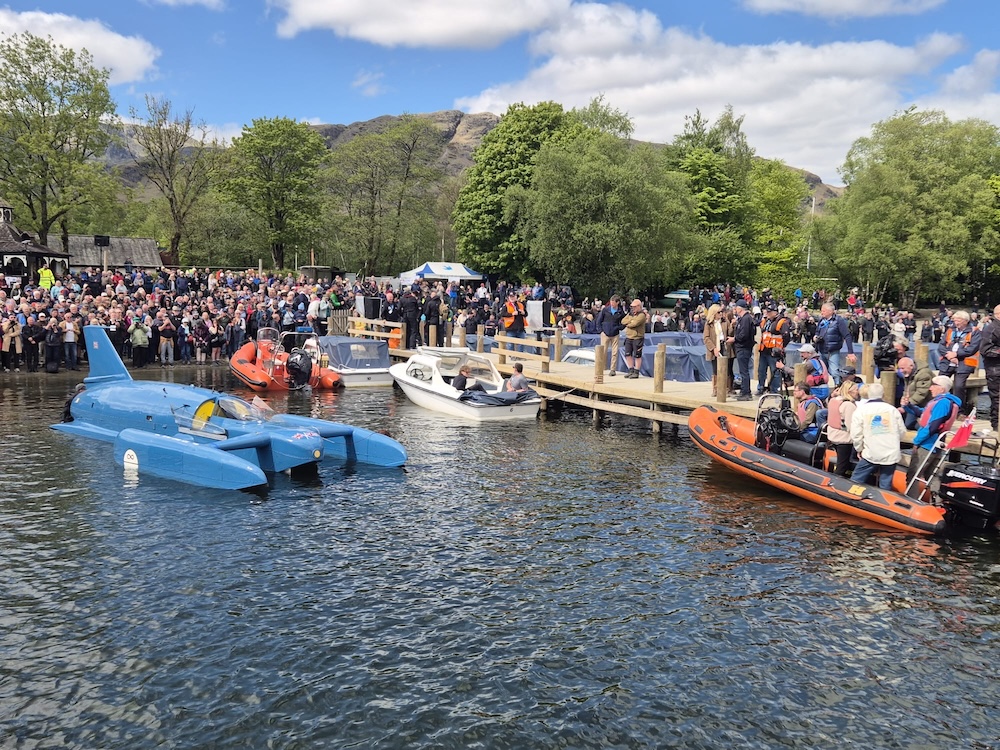
The Festival started with a poignant one-minute’s silence in remembrance of Donald Campbell. Then began the efforts to run K7. The biggest challenge was that its Bristol Orpheus jet engine can’t be started until it’s way out on the water, for safety reasons. To move it the few hundred metres from its temporary marquee workshop on the lakeside, down to the jetty and then manoeuvre it into the water usually took the best part of an hour. Then it would have to be towed out to a pontoon in the middle of the lake, where the engine could be fired up and final checks could take place – and if there were any problems, it would have to be shut down, towed back in, go through the laborious process of taking it out of the water and up the slipway, and then the problem addressed.
This happened on a number of occasions, often for minor issues that the team wouldn’t have been able to foresee.
In the meantime, Blue Bird K3, the 1937 hydroplane powerboat of Donald’s father Sir Malcolm Campbell, was able to be demonstrated at times. This was the craft that achieved 130.91mph in 1938. At the time it was fitted with a Rolls-Royce R racing engine, but since restoration it has used a less highly strung Rolls-Royce Meteor engine, the unsupercharged version of the famous Meteor.
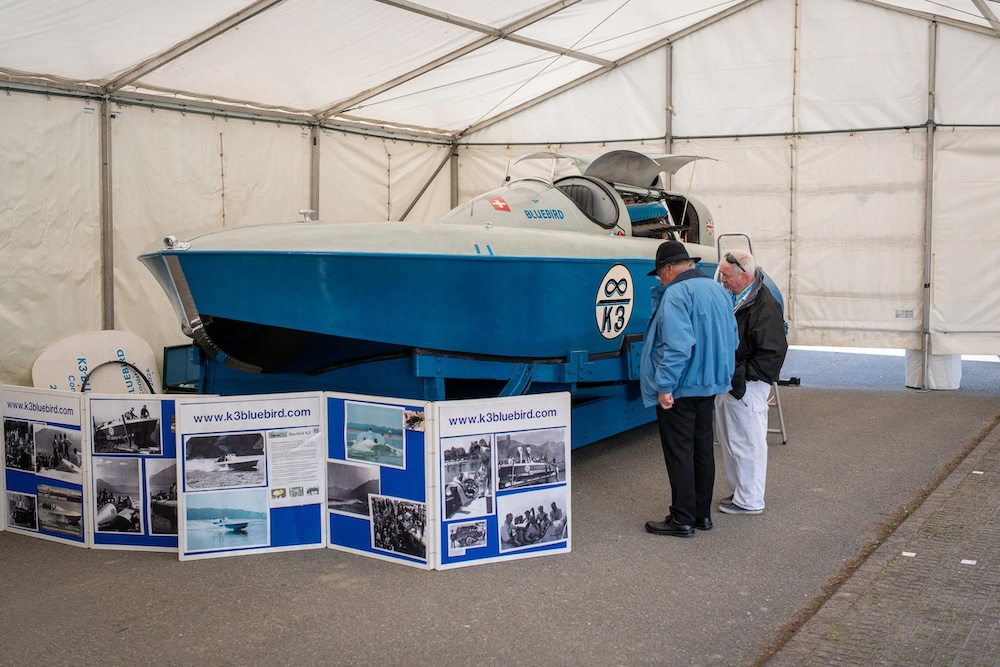
On Coniston, K3 was restricted to 45mph for safety reasons, but it still looked and sounded evocative on the water. On completion of one its runs, its experienced pilot exclaimed that Malcolm Campbell “must have been mad” to exceed 100mph, explaining that it’s an “absolute brute” with very little steering due to its relatively tiny rudder.
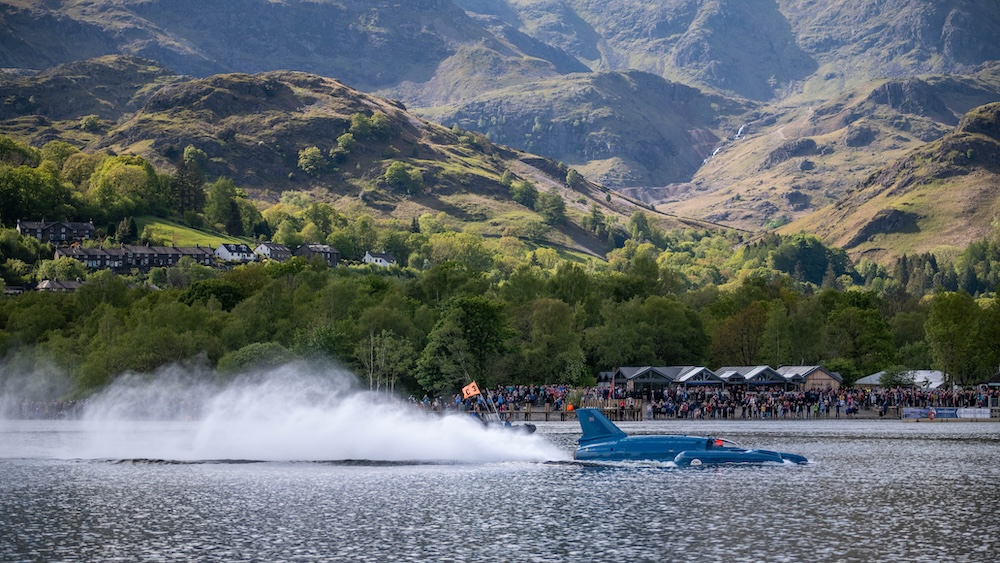
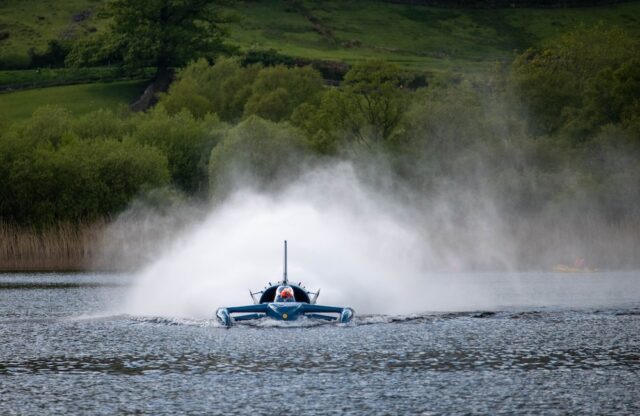
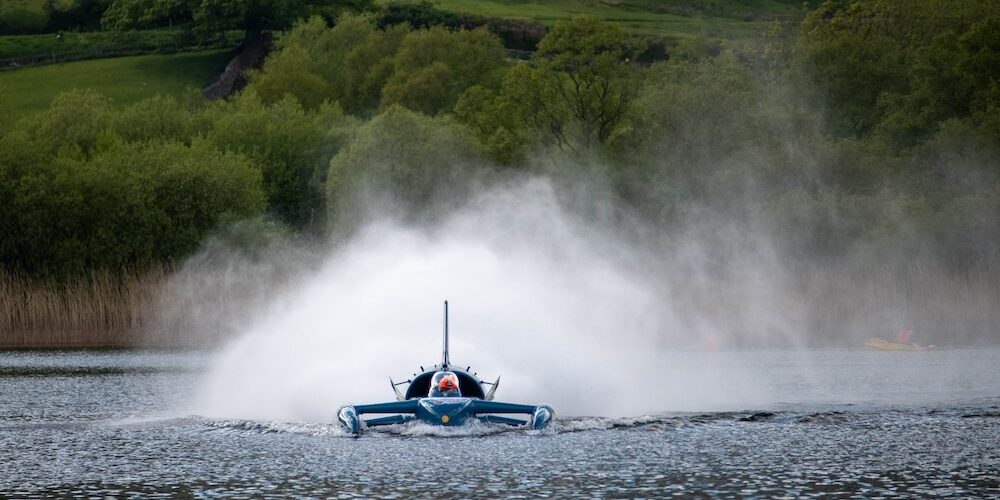
Meanwhile, there were several attempts to run K7. Even with the initial low-speed passes, it looked spectacular with the plume kicked up by the jet engine. Higher speeds weren’t initially possible due to what was found to be a fuel-pump issue. Finally, on the Friday afternoon, the conditions were right for a higher-speed run, and pilot Dave Warby achieved around 100mph, with K7 getting ‘on the plane’, skimming across the water surface as intended. It was a truly special moment.
Sadly, that was the only time K7 was able to run at high speed. Technical issues again on the Saturday thwarted attempts. Then, on the Sunday, when all looked set for another fast run, there were initially other craft on the water despite a ban, then another technical issue. At last, K7 was brought back down to the water for another run – just as the wind started to kick up white-topped waves on the surface of Coniston Water. The crowd waited patiently through the afternoon, but it was never deemed safe to run K7 again that day.
Disappointing? Yes. But it was also incredibly exciting and evocative to see both K3 and K7 in the water. Gina Campbell, daughter of Donald, and Don Wales, nephew to Donald and grandson of Malcolm, were both present to talk to visitors, and the atmosphere was mostly one of respect and stoic patience. Donald Campbell, who based his record-attempt team at Pier Cottage just a few hundred metres from the site of today’s K7 Festival, would have appreciated it.
The Ruskin Museum at Coniston, where Bluebird K7 is based, hasn’t ruled out K7 being demonstrated on the lake again, but it acknowledges that with the technical difficulty of running it, the safety aspects and the importance of preserving K7, it’s probably unlikely. So, despite the ups and downs, it feels like a privilege to have been there.