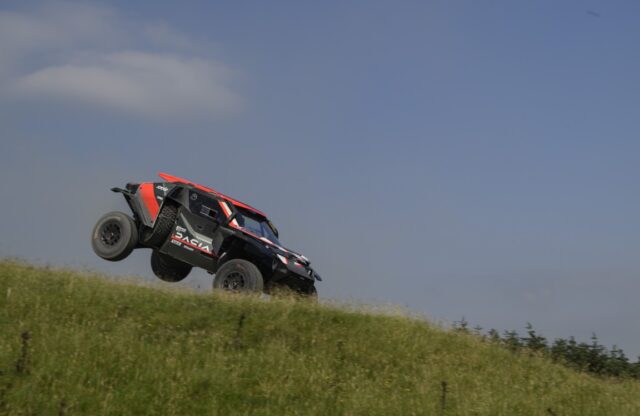
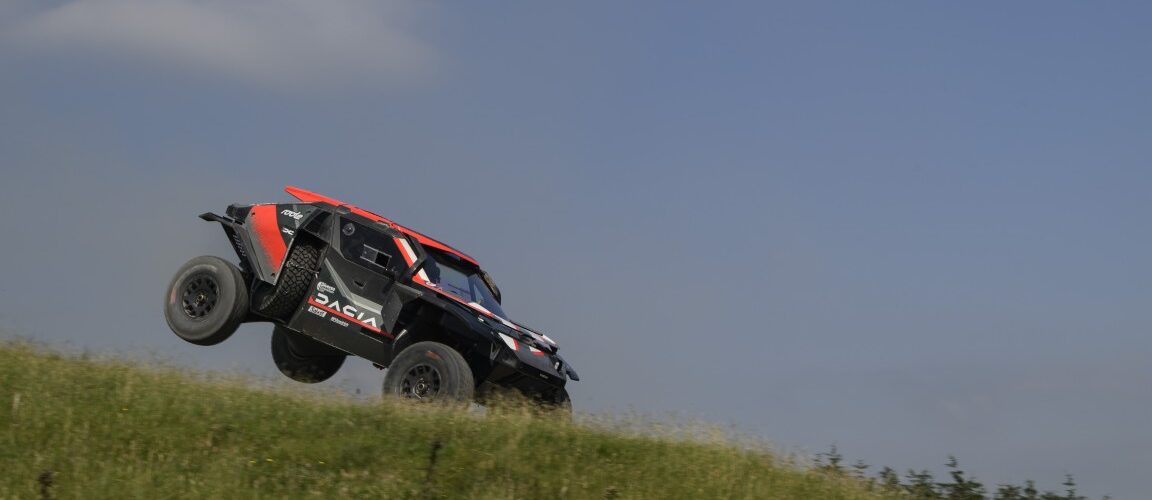
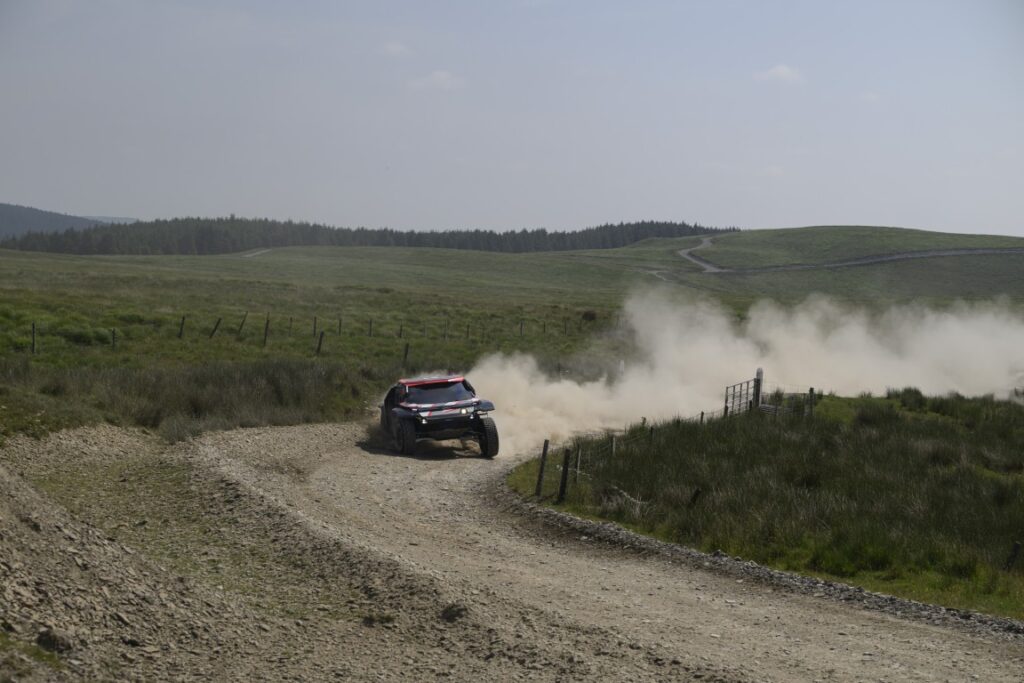
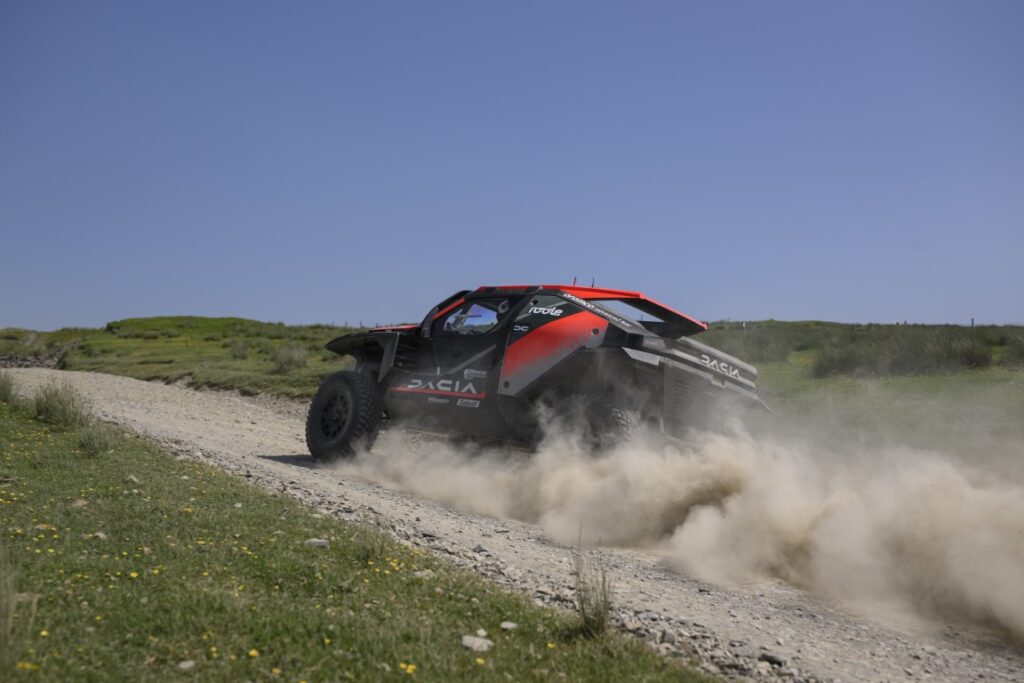
From base camp, amid the khaki green service trucks, someone comments that the vehicle kicking up dust on the high gravel tracks in the distance looks just like one of those classic Tamiya remote-control buggies. It moves in the same way, he says, with surreally rapid manoeuvres: a burst of forward motion, a flick to the side, a slide, a wheelspin, an exuberant jump. The soundtrack echoing off the hills gives it away, though; it’s just as mechanical and raucous as you would expect from a machine capable of winning the Dakar Rally.
This feature first appeared in Magneto 31.
Just minutes ago it was me in that very vehicle, grinning like an idiot: after 18 months of PR- and management-bothering – having first visited the team in late 2024 – Magneto has gatecrashed a rare UK test session of the Dacia Sandrider. Better still, we have reigning World Rally-Raid Champion Lucas Moraes in the driver’s seat for a series of hot laps on the famed Sweet Lamb Motorsport Complex rally stages in the dramatic hills of Mid Wales.
The team’s time is precious, though, and we don’t want to get in the way, so before the day got properly into gear I had been shooed out to sample the off-roading capabilities of the four-wheel-drive version of the Dacia Bigster (impressive, in case you’re wondering) in among the 20 miles of off-road tracks, while a multitude of technicians fussed around the Sandrider.
At exactly 10:55am, I’m hurried into a race suit and helmet, and ushered urgently to the car – if indeed this Prodrive-engineered Dakar monster can be called a car. It’s left-hand drive, so I’m firmly steered towards the right-hand door; there’s no time for anyone but Lucas to drive, as disappointing as that might be. I haven’t even mentioned that the last time I was at Sweet Lamb I put a Land Rover Defender on its side, either.
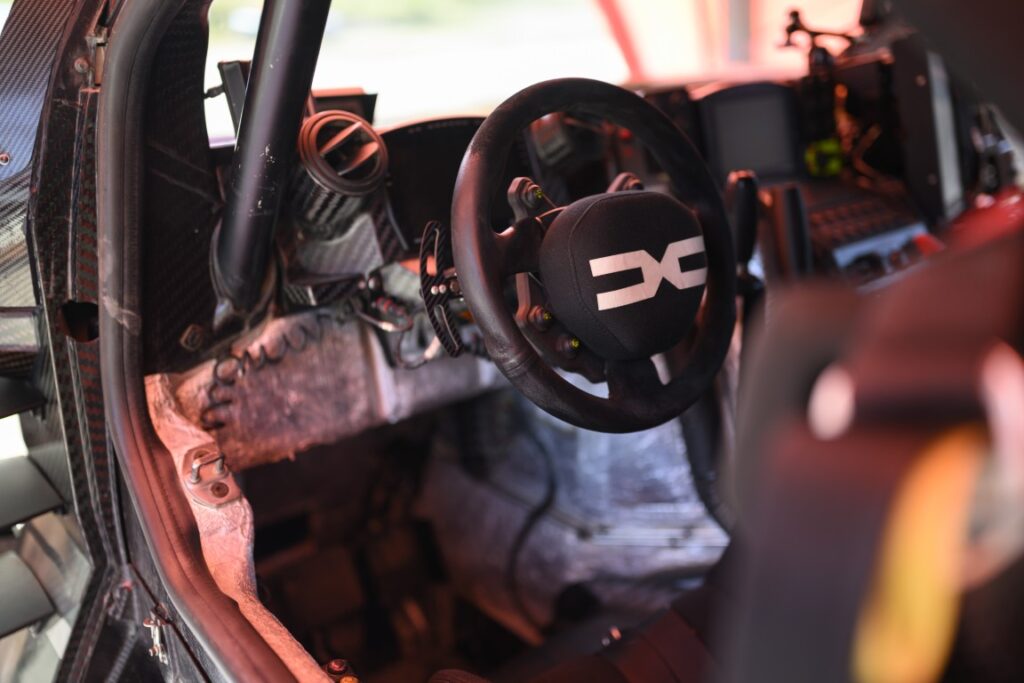
There’s a technique to getting into the high cabin of the Sandrider. Right hand around the front bar of the roll cage, right foot into a small slot in the carbonfibre bodywork, then hoist up, manoeuvre left leg into place and drop into the seat while using hands to pull right leg in.
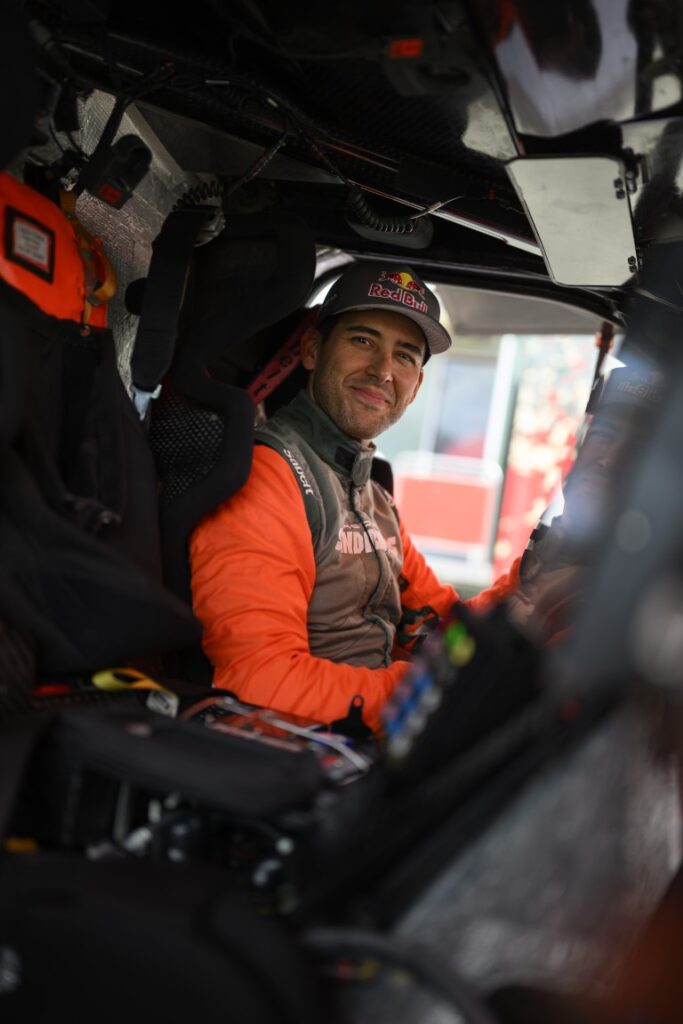
Lucas jumps in with a grin, making it look far easier. He’s had a wild ride, not just literally in the FIA World Rally-Raid Championship but in terms of his career, too. Having won his home Brazilian rally championship three times, and the South American Mitsubishi Cup on a couple of occasions before that, he achieved his dream of competing in the Dakar Rally in 2023 – and finished third. That was with Toyota; after three years he switched to the Dacia Sandriders team, which is how I come to be sitting alongside him as he carefully runs through the pre-start checks.
There’s not much room in this cockpit, but the array of instruments and switches wouldn’t look out of place in an aircraft. In front of me there’s a large screen for navigation. Between me and Lucas a smaller screen flicks continually through a bewildering range of parameters, which I’m still trying to fathom out when a technician leans in and yanks on the straps of my harness, pinning me back into the seat. I know from past experience that when the straps need to be that tight, it’s going to be a wild ride.
Moraes flicks more switches and presses the starter button. There’s a brief, high-pitched whirr of the starter, a deep boom from the exhaust as the V6 behind us fires into life and then it’s idling high, with the soundtrack a mix of exhaust, harshly whirring engine internals and the jet engine-like background of cooling fans. It sounds mechanical and harsh, but not as loud as I expect. There’s a reason for that, which I’ll come to later.
Lucas pulls the huge sequential gearlever back and the Sandrider clunks into first. He slips the clutch and this Mad Max creation lurches forward, erratically at first until the engine picks up, and we burble out of the makeshift paddock, quite literally heading for the hills. Moraes accelerates hard up the steep, narrow gravel track and then backs off, pushing me back in the seat and then throwing me forward, despite that tightly fitted harness. He does the same again, and again, then steers violently from side to side, grabbing the massive hydraulic handbrake lever momentarily as well, to ensure that engine, transmission, brakes and tyres are warmed up. The straight-cut gears of the transmission whine, even more so on the overrun, and there’s a solid, almost brutal clunk on every change of the sequential ratios.
We pull up alongside one of the Dacia crew, who explains to Lucas where the undulating, rather fearsome track goes. With helmet on and intercom buzzing, I think I hear him tell Lucas that it’s just “left, left, left, left again” above the sound of the engine, and I realise that this is Moraes’ first time on the track. Oh…
Lucas says something like: “I’ll take it easy on the first lap.” Then he pulls back on the gearlever, feeds in the clutch and immediately we are accelerating hard up the hill and onto a blind crest, which we fly over at speed – and remember we’re not on a race circuit, we’re on the side of a mountain – and onto a short straight, with a large drop to one side and rocks to the other.
“I think it was left?” shouts Lucas, and as I agree with an unhelpful “err…” he flicks the Sandrider into the sharp downhill corner and we’re immediately sideways, stones battering the underside. Then left again, sideways again, slithering one way and another, and then at some point on one of the vaguely straight straights hitting two bumps at high speed and gaining a bit of air before gunning it round another left, hesitating momentarily – “was it this left?” – and blasting back up the hill to where we started.
“OK?” asks Lucas at the top. Well if I wasn’t it would be a bit late, but I’m loving it and just shout something like “it’s brilliant” before we’re up and running again, this time even faster.
Moraes launches the Sandrider over the first blind crest without lifting and takes the left even more sideways. He’s banging through the gears, flicking the Sandrider from side to side with the smallest of movements to the steering wheel while dancing his feet across the three pedals and occasionally grabbing at the handbrake quickly to aid the sharper turns.
I’m sure I should be scared witless, because this would feel like lunacy to anyone who didn’t know the car’s or the driver’s history, but (I promise this isn’t bravado) I’m enjoying every minute of it. After a few more equally exhilarating laps, Moraes heads back down the hill and along an access road to allow the Sandrider to cool.
“Doing the Dakar or a world championship round it’s crucial to be very focused, because in the dust it really can be dangerous,” he says. “You have to focus and have a lot of patience to understand that, OK, you are catching the car in front, but if you try to push too much – and maybe you are out of the roadbook trying to catch them – then you can easily hit something.”
I’m a little sweaty, shaken and stirred from our hot and every aspect of the rally to give us a good grounding on how to approach it”. The team then “cherry-picked the key components” and, in 2020, developed the eco-fuel-powered Prodrive Hunter, designed to optimise FIA Rally-Raid regulations for an attempt on the Dakar.
On its debut in 2021 the Hunter achieved the best position for a new car in the Dakar’s premier Ultimate T1+ class, and three successive podiums followed between 2022 and 2024 with Sébastien Loeb and the Prodrive-run BRX team. It’s also had success with independent customer outfits, including in the hands of the ‘King of Rally-Raid’, Nasser Al-Attiyah, when he secured the 2024 drivers’ FIA World Rally-Raid Championship. The vehicle spawned the 600bhp road-legal Hunter Hypercar, which is another story altogether.
So the Dacia Sandrider is just a remodelled Hunter? Definitely not. Its exterior styling was by the Dacia design team, with echoes of its 2022 Manifesto SUV concept car, and under the skin it’s a significant evolution from the Hunter. Paul Howarth again: “We’ve maximised all cockpit positioning and engine positioning within the wheelbase for a very well balanced car. The mass of the car is the fuel cell at 500 litres of fuel, then the crew is the next mass, and then the engine and transmission is the next mass.”
The regulations for the Ultimate T1+ class state that the car may be based on a spaceframe chassis but the engine must come from, or be derived from, a production model. Only one unit per car per rally is allowed, and driving aids such as traction control or ABS are banned.
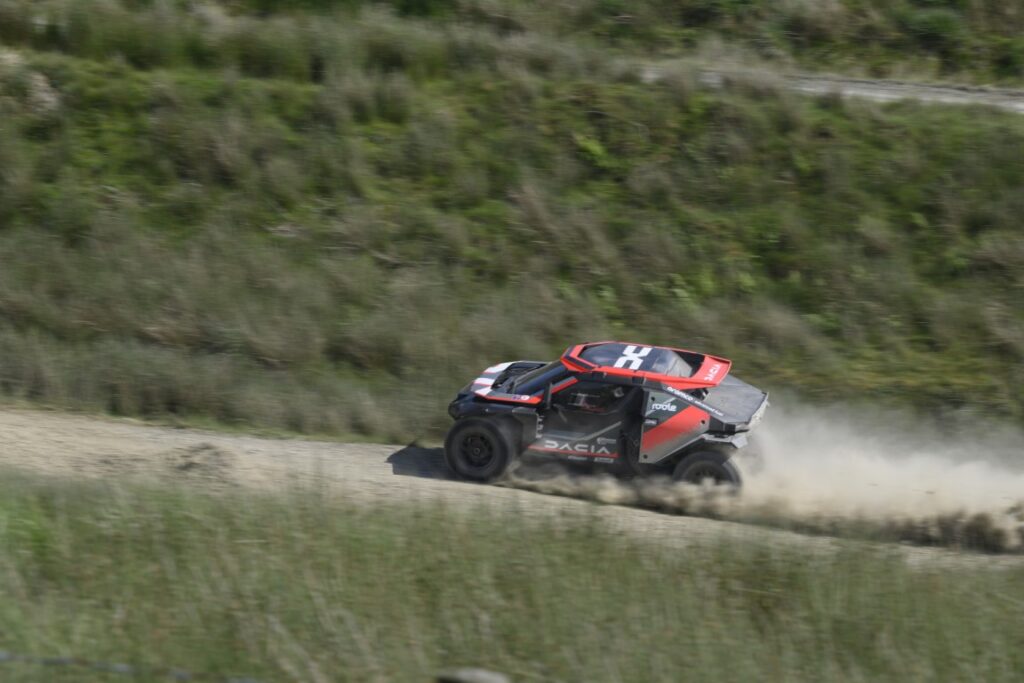
Sure enough, the Sandrider uses a tubular spaceframe, carbonfibre bodywork and a twin-turbo, fuel-injected 3.0-litre V6 that you’d find in a Nissan 400Z or Infiniti G50, restricted by the regulations to 360bhp at 5000rpm and 539Nm at 4250rpm. It runs through a six-speed sequential 4×4 transmission, as specified by the regulations.
Of all these engineering achievements, arguably the most significant is the shock-absorbing seat developed by Prodrive for the Sandrider. It’s so effective it will be adopted by all teams for 2027.
“Everyone says the Acropolis [World Rally Championship event] is rough, but it’s nothing compared to when you go down a dry river bed in Saudi, for example,” says Paul. “The biggest difference compared with a WRC car is durability: to win Dakar, you don’t want to come in at night and pull the car to bits, then send it out on a 600km loop. The Dakar covers the full distance plus more of the whole year’s World Rally Championship, to put it in perspective.”
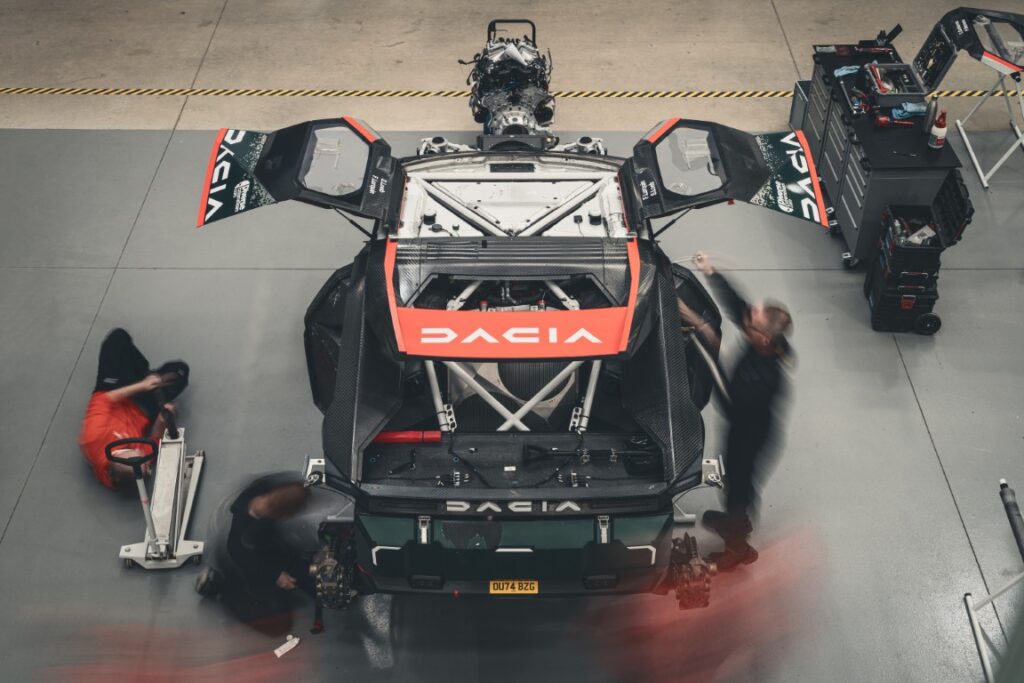
What was fascinating to see on our workshop visit in 2024 was the attention to detail that Prodrive brought to the project. A few examples: every bolt head is the same size for ease of use; there are magnets on the body to hold those bolts during maintenance – they can’t be dropped in the sand; and every component is designed to be replaced quickly, even in a sandstorm. Brakes and suspension take minutes, the rear differential is 25 minutes, the gearbox 30 minutes…
Has it worked? The Sandrider debuted in the October 2024 Rallye du Maroc Rally-Raid round, where the three cars finished first (Al-Attiyah), second (Loeb) and 82nd (Cristina Gutiérrez). But after that incredible start, the Dakar in January 2025 proved tougher: Al-Attiyah finished fourth but Loeb was controversially disqualified due to apparent roll-cage structural damage after flipping his car, and Gutiérrez’s Sandrider suffered a technical fault and didn’t finish. The year improved, but the cars just missed out on a championship win, instead finishing second and fourth.
In this year’s Dakar, four cars were fielded. This time, the dream came true: Al-Attiyah won, while Loeb finished fourth, our man Lucas was seventh and Gutiérrez 11th. At time of writing, two more rallies in, with two to go, the Sandriders are first, second and seventh in the championship. Dacia has proved a point and accelerated the brand’s standing; this’ll be the last year it competes.
Prodrive, meanwhile, may add another world championship to its achievements. Will that be enough, with all that development and tech sat ready for another season? Unlikely, we suspect. For now, though, we are going to savour the memory of one of the wilder Magneto rides and continue to brush the dust from our clothing…
Thanks to Prodrive at www.prodrive.com and the Dacia Sandriders team at www.dacia.co.uk.