

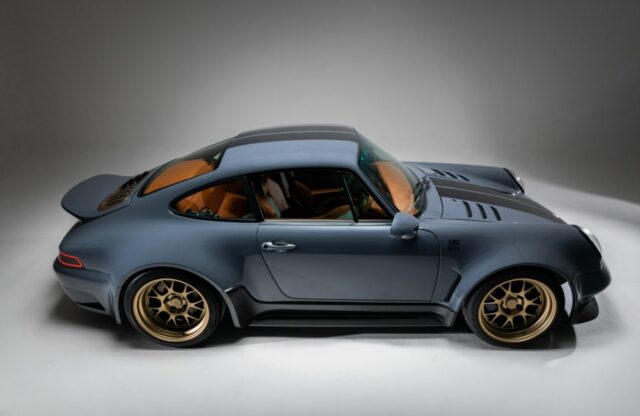
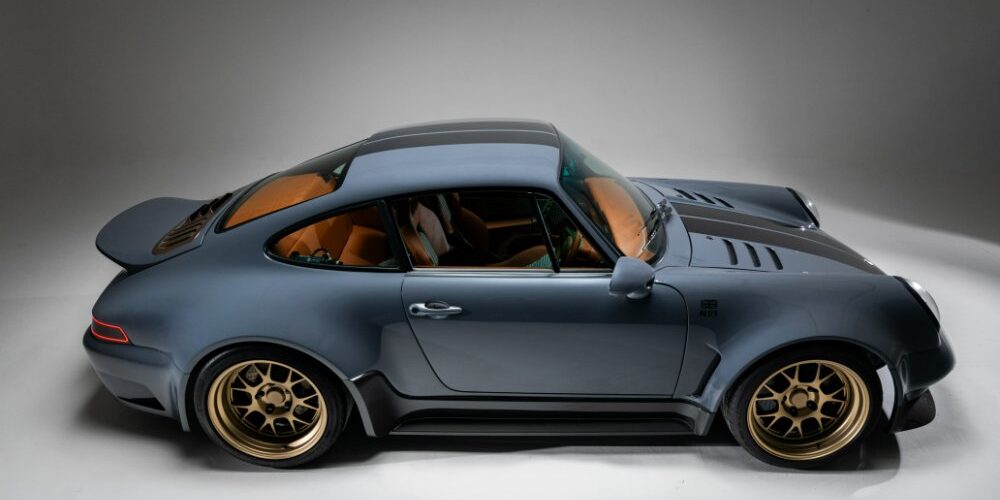
Tedson Motors sits in a crowded corner of the classic Porsche world, but the Croatian company is not trying to out-Singer Singer, or out-Gunther Gunther Werks. Where most restomod 911 programmes either backdate a later car to an earlier look, or chase an outright reimagining, Tedson Motors positions its Daydream as something more nuanced: an evolutionary ‘what if’ based on the 964, as though Porsche had simply kept developing that silhouette into the present day. It is an approach that places Tedson Motors alongside established names such as Singer and Gunther Werks as well as Ruf, but with a noticeably different design and engineering agenda.
We spoke to Tedson Motors founder Goran Turkic about how the project came to be, why he resisted following an existing playbook and what he thinks the future holds for Tedson Motors and the wider restomod scene.
“Ever since graduating in physics, I spent years in several different industries,” Turkic recalls. “I spent some time in venture capital, evaluating business plans as a tech guy, and I had my own company in the high-energy space and in real estate. At age 40, which was exactly ten years ago, I did some brainstorming and evaluation of my own: Where am I in life and what’s going on?”
It is a familiar moment for anyone who has reached that milestone. For Turkic, it coincided with a book that reframed how he thought about work and fulfilment. “Just before I did that exercise, I read the Japanese book Ikigai, which talks about understanding yourself and finding something you are meant to do. If you work on something you love and you’re meant to do, it’s not really work, it’s living every day to your fullest. That book got me thinking about everything. Even though I enjoyed my work before as an entrepreneur, I always felt a certain emptiness because I was never 100 percent triggered by what I was doing.”
The conclusion came quickly – cars had always been the constant thread, even if life had pulled Turkic elsewhere. “I have been a big car fan since my earliest childhood. I started thinking about cars and drawing them at the age of four,” he says. “It’s part of my history that I pushed off to the side and forgot about, until my mother said she kept all these notebooks of my drawings.”
Growing up in what was then Yugoslavia, now Croatia, steered his education in a more conventional direction. “We were a relatively conservative, minimalistic country, where there were not a lot of options when it comes to schooling. So I took the mathematics, physics, engineering path. I’m sure, had we had the opportunity to study automotive design, I would probably have ventured into that.”
In 1993 Turkic moved to the US, finishing high school and then university at the University of California, Irvine. It was a formative change of scene. California’s car culture put supercars into daily view, not as distant posters but as real objects moving through traffic.
He also found himself close to collectors and enthusiasts – while studying, he worked multiple jobs to cover non-resident tuition, including tutoring maths and physics and running a personal-fitness practice. “Over time, I generated a nice following of relatively wealthy families,” he says. “Most of those had beautiful car parks with a lot of beautiful things. Relatively early in life, I was exposed to a lifestyle that I never had but would love to have, and some of those people I treat as my mentors.”
He returned to Croatia in 2003 with a stronger sense of what he wanted from life and, eventually, from cars. The 911 became the focal point. “My brother bought one in California early on in the 1990s, a 1974 911 Targa,” he says. “I had friends with older cars, and for some reason I started looking at older 911s.”
By then, Singer Vehicle Design had begun to redefine what the restomod concept could be. Turkic admired what Rob Dickinson had created, but he was equally clear that simply repeating it held little appeal. “All my life I have always loved making something that’s no longer useful or good, useful and good again,” he says. “I love restoring things, putting things back to use, giving them another life. I think Singer did a great thing because those cars were not very valuable at the time.”
His point is not revisionist, it is contextual. “We always have to look at things from the perspective of when it was happening,” he continues. “Rob started doing this when those cars were roughly around $30k and they were turning into rust buckets. They were relatively insignificant, people didn’t care much about them. Now you get comments online like, ‘Stop chopping up nice 911s, preserve them as they are, they’re valuable as they are.’ Yes, it’s true, but at the same time, they weren’t.”
As the movement grew, he watched other firms replicate Singer’s formula. “What Singer did was very original, and then many others came in and replicated it very blindly, almost exactly,” he says. “That’s not something I was willing to do, even though I would enjoy being part of the industry.”
In 2016 Turkic decided to pursue his dream, spending four years researching, driving, performing restorations of his own and scoping out the market – not just in the restomod space, but also in the coachbuilding realm.
“I understand why coachbuilding has developed the way it has, and it will continue,” he says. “Collectors and discerning buyers want bespoke products. They want products tailored to their needs, not just cosmetically but technically and mechanically. Everybody is different, and the fact we give them the time to make their wishes and desires come true, to make a one-to-one car, makes this a great industry.”
That philosophy shaped Tedson Motors’ development approach. In 2020 Turkic scanned a 964, converted it into an electronic file and spent a year honing his vision. In early 2021 Tedson Motors appeared on social media with high-quality renderings, and the response was immediate. “I started seeing people following me, including collectors and significant car companies,” he says. “They started inquiring whether it actually existed. I also saw comments like, ‘Oh this is another render that’s never going to come to fruition,’ which only gave me fuel.”
The first Tedson Motors prototype debuted at Top Marques Monaco in May 2022. For Turkic, the fact it happened at all, on his terms, matters. “I’ve done this on my own, without external help, without parents, friends, investors, banks or EU funds,” he says. “It’s been me, myself and I. It’s probably the hardest way to do it, but at the same time I’m proud of it.”
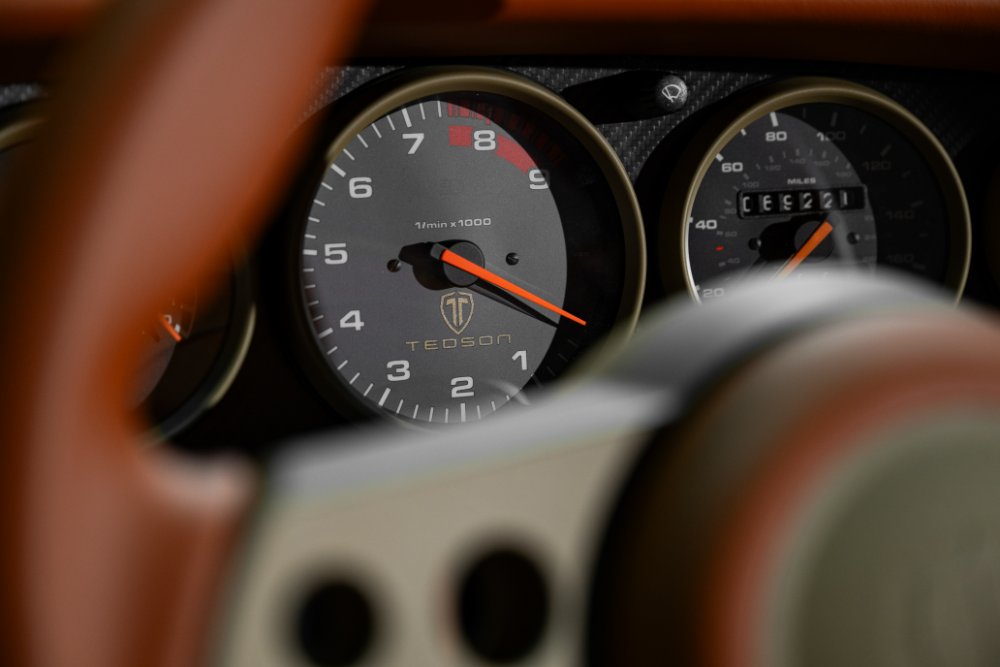
Tedson Motors currently offers two 911 projects, the Daydream Coupé and the Daydream Targa, both based on the 964. In positioning terms, Turkic frames the Daydream as an evolutionary product, rather than a period-correct homage – it’s much like Mercedes-Benz’s approach to the G-Class.
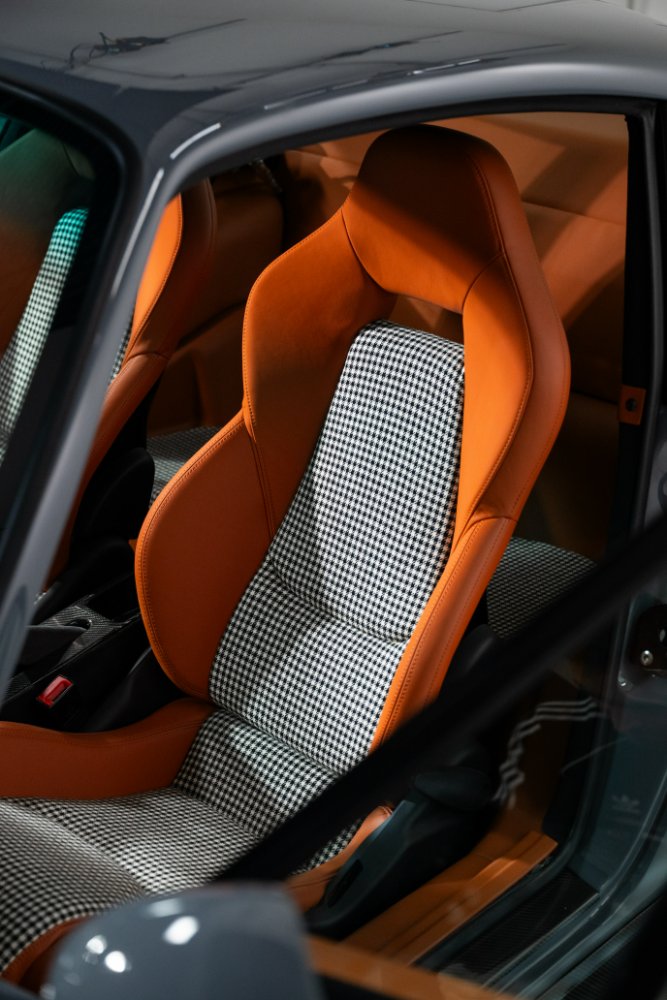
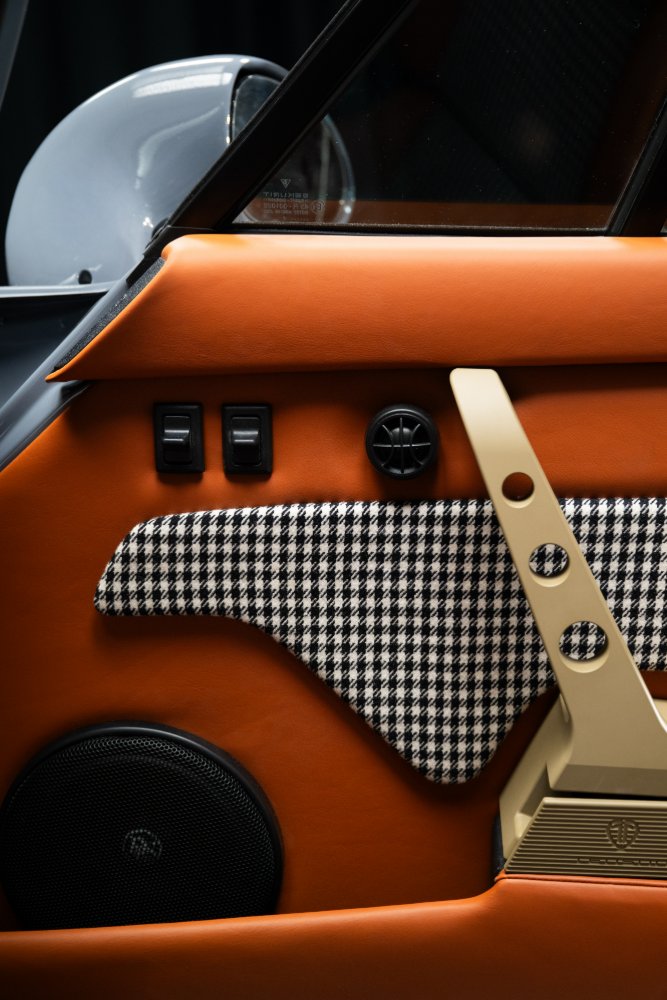
“It’s an evolution of a 964 in every aspect. The car is wider, more aggressive, with better aerodynamics. We greatly enhance the interior using premium materials and aerospace-grade aluminium that is milled from a single piece. It’s very expensive to do, but we can anodise it or ceramic coat it to any finish and colour,” he says.
“We bring in things such as standalone ECUs, PDMs… there’s pretty much nothing we cannot do. Every single car, even though we have a base offer for the Daydream, we always discuss what the buyer really wants. Do they want us to use a PDM and set up traction control? Do they want a puristic feel with just standalone rear-wheel drive and handle it all themselves? There are so many variables – and we view it as our responsibility as a coachbuilder to give those options, because that’s why they come to us.”
Turkic says Tedson Motors clients are usually well past their ‘first special car’. They tend to arrive with a garage that already includes Ferraris, Porsches and Lamborghinis. “They say, ‘I want to build this car for myself,’ so they come to one of us four,” he says. “We actually have clients looking to do builds with every single one of the four, saying, ‘Let me do it my own way.’”
Tedson Motors tries to formalise that sense of ownership with a naming tradition. “We have a policy where we name every commission and it becomes personal,” he says. “People share stories. The car that went to New Jersey is called the Gulf Blue Dream Edition because the gentleman was infatuated with Le Mans and Steve McQueen’s car, the 917.”
Another example is more idiosyncratic. “An American celebrity and a great guy, Michael Strahan, he went to space with Jeff Bezos and the guys. He was the biggest among them, so they called him the Giant Astronaut,” Turkic says. “We asked what to call the commission, and he said, ‘The Giant Astronaut.’ He’s also the only guy for whom the New York Giants developed a special commemorative badge, so we put that on the side of the fender.”
This brings us to the car Magneto saw at the recent Rétromobile Paris – the first right-hand-drive Tedson car. “It’s the first car in the UK, so we said let’s call it UK Number One. We made a little logo with the English flag and put it on the fender,” Turkic recalls.“We include the client and tell part of their story through design, materials, logos, insignias and liveries. We also consider the financial aspect. When we do shows, we prefer to feature client cars than demo cars, because we want to help clients create provenance which affects value and creates stories. It gives depth, so you don’t just see metal and carbon, you see a story.”
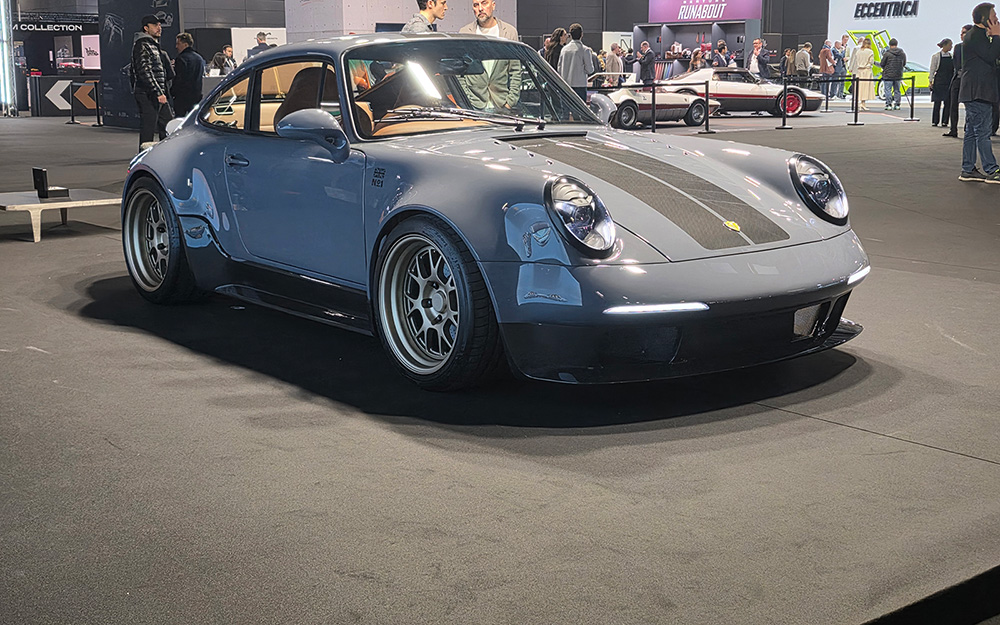
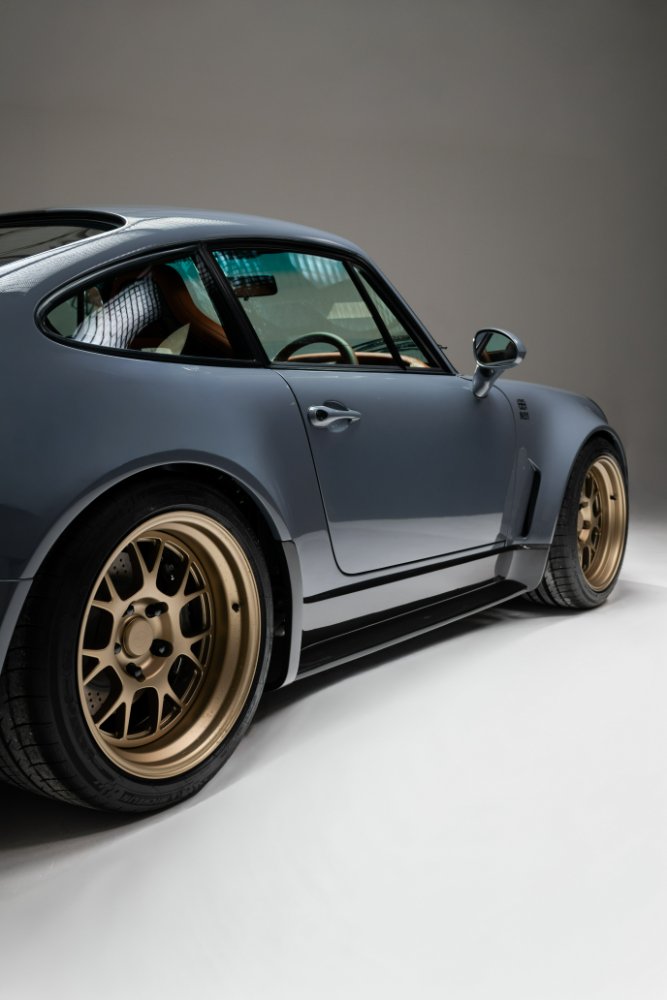
The first thing you notice about a Daydream in profile is its stance. Tedson Motors has pushed hard on track width and geometry, taking cues from later motor sport-derived 911s. “The old cars had a staggered set-up where the rear track width was much greater than the front,” Turkic explains. “It had benefits, but it also created oversteer and lack of stability in corners. On newer cars, on RSR cars, on GT1 cars, that has changed. They try to attain a square track, sometimes even with the front track wider than the rear.”
He continues: “To widen the track, we did a couple of things. On a 964 and 993, on the bridge, you have two holes for the narrow body and for the wide body. We use the outer holes, so we gain three centimetres on each side, six centimetres total, and the rest we handle with wheel offset. To get where we wanted, we initially went to very high width. Our first demo started with 11s and 13s. Then I said, OK, let’s achieve the grip, the stance and the track width, then work backwards and retain it while reducing the wheel as much as possible, because you’re thinking about rotating mass. Now we’re at 9.5 and 11.5, and we run two set-ups: 265/35 R18 front and 315/30 R18 rear. We also run an almost unobtainable set-up in Europe, what they call a ‘wiper’ set-up: 275/35 R18 front and 335/30 R18 rear. With 9.5s and 11.5s, those are the smallest sizes that allow us to fit that big rubber.”
The car is much lighter thanks to extensive use of carbonfibre in the body, and as such there’s a much lower centre of gravity. Tedson Motors pairs the widened geometry with a pro-active JRZ set-up and uprights from the GT2 generation. “We work with the GT2 generation, the uprights, for slightly different geometry, and they’re sturdier,” Turkic says. “The original wheelhubs are very thin, probably developed to be as light as possible.”
He argues that, at the extremes of width and capability, conventional solutions are not sufficient. “You can set up a KW suspension like a V3 and it’s good, but on extreme widths it doesn’t work, you need something stronger,” he says. “The JRZs come with 18 bars of pressure, so it’s sturdier and pressurised.”
For the customer, the benefit is not only ultimate performance, but usability. The system also allows adjustment on the move. “I’ve experienced it first-hand,” Turkic laughs. “You enter Manhattan with potholes, you set it to soft, you absorb it without damage. You get out on an open road, you stiffen it up.”
Beyond the dampers, Tedson Motors uses ClubSport-specification bushings, thicker anti-roll bars and supporting arms to match the performance intent. On the limited-slip differential, the approach is consistent with the company’s wider philosophy: it depends on the client. “Some want standard, some want a 40:60,” he says. “What I see most right now is the Wavetrac; it’s seamless and it works differently. It’s a great option.”
Tedson Motors is developing a supercharged option producing 460bhp and 500Nm, which Turkic describes as being close to the upper limit of drivability. Yet he is almost evangelical in warning against the horsepower trap.
“People fall into a trap of thinking the more power, the better,” he says. “They always ask, ‘How many horsepower?’ and want bigger volume, bigger power. But it’s not always like that. Me being a physicist, I can appreciate we have to talk power and weight. There’s also torque: a lot of people talk power when they really mean torque.”
He frames the 3.8 and 4.0 debate as a real-world usage question. “You can take a 3.8 and a 4.0, and the numbers are not much different up to 6000rpm,” he says. “The extra 30, 40, 50bhp is at high revs, because these are motor sport engines built for track and high rpm. At low revs they can be uncomfortable, with light flywheels and clutch systems, and it becomes jittery in stop and go traffic.”
Heat management, he adds, is where theory becomes reality. “With big bore volume and bigger combustion, this means bigger temperatures,” he says. “Then you induce thermal problems, heat soak.”
Tedson Motors has learned, sometimes the hard way, that customers do not always use the car in the way they imagined. Turkic recalls one particular conversation. “A client once told me, ‘The engine behaves great, I drove it yesterday in 110 degree heat in…’ – I’m not going to mention the city – ‘in large traffic for an hour and a half, and the car didn’t overheat,’ and he sends me two thumbs up,” he says. “I’m thinking, great for you, but it’s a matter of time.”
His analogy is pointed. “That’s like taking a racehorse and letting little children ride it,” he says. “If you want a car to drive around downtown from block to block at 110 degrees, tell us and we build an engine for that. But you don’t take this jittery 4.0-litre engine to do that.”
The takeaway is central to how Tedson Motors sells: engines are specified around the owner, not the headline figure. “The reason we have options is to show we can do everything, but we want to build the best product for the client,” Turkic says. “The UK car, the gentleman said he will use it on weekends, get out of London, once or twice a year do rallies for five, six, seven days, drive to Switzerland and the Alps. We know exactly what environment we’re building for.”
For that use case, he argues, the car’s fundamentals do the work. “In that environment, the car will be on par with any latest supercar because of short wheelbase, torque, suspension, low centre of gravity and power-to-weight ratio.”
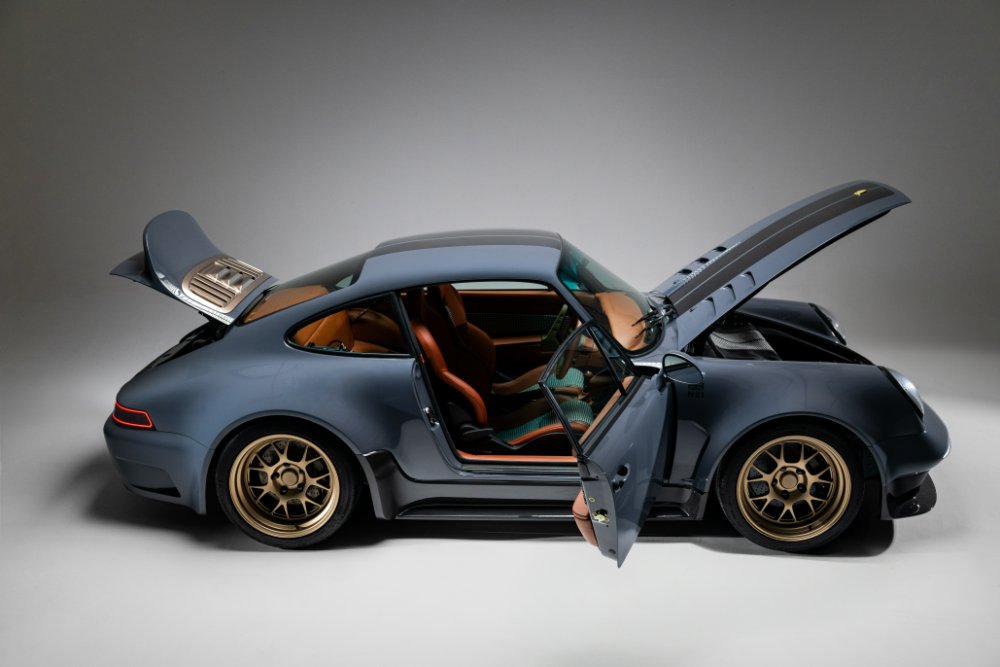
Turkic remains convinced the 3.8 naturally aspirated engine is the sweet spot for most. “350 to 360bhp, plenty of torque, beautiful sound, revving to 7600rpm, no thermal issues, good stop-and-go behaviour, low-end torque, high-end power,” he says. “For guys who want more but want to avoid the 4.0, I developed the supercharged engine.”
Why supercharging? Because, in normal driving, it behaves like a conventional engine until asked to deliver. “The compressor doesn’t create boost and it behaves normally,” he says. “It doesn’t spend more gas, doesn’t have huge combustion, doesn’t have high pressures and temperatures.”
The system is based on the Eaton M90, but Tedson Motors has redesigned the intake, shrouds, cooling and internals to support the boost. “We lowered compression from stock and did other changes – oil pump, lubrication, temperature control, different rockers, camshafts and pistons,” Goran says. “We developed something we can warranty, with plenty of power and plenty of pleasure for the buyer.”
Several reimagined cars use carbonfibre to reinforce the chassis, such as the Ferrari 550 Maranello-based Touring Superleggera Veloce12, as well as the Singer DLS. Tedson Motors does not describe its approach as carbon reinforcing the chassis, but it is still aggressive in structural work.
Instead, the company strips away what it considers superfluous, including the roof sheet metal and rear wings, then returns to an old motor sport solution. “We start with stitch welding,” Turkic says. “Many brands have analysed it and concluded stitch welding doesn’t greatly increase rigidity, but we still do it. We weld for three or four inches, then nothing, then three or four inches.”
The objective is not only torsional rigidity, he argues, but overall strength. “It’s not only rigidity. If you fly off and land, you want every part to have more strength,” he says. “We also use braces and what I call hidden roll bars.”
He contrasts this with approaches that retain the original rain rails, particularly where carbon roofs are inserts rather than full replacements. “On a Singer Classic and Gunther, carbon roofs are usually carbon inserts and original rain rails remain,” he says. “If you want an exposed carbon roof, you notice that next to the windscreen it’s not carbon because sheet metal is still there.”
Tedson Motors removes the roof sheet metal and the rain rails. “We make a true roof that goes under the front and rear windscreen,” Turkic explains. “Underneath we fit three hidden roll bars. It’s three-millimetre bent sheet metal, bent the other direction, giving more structural rigidity and more gluing surface for the carbonfibre roof. We use special flexible glues that can flex with the loads and car movement.”
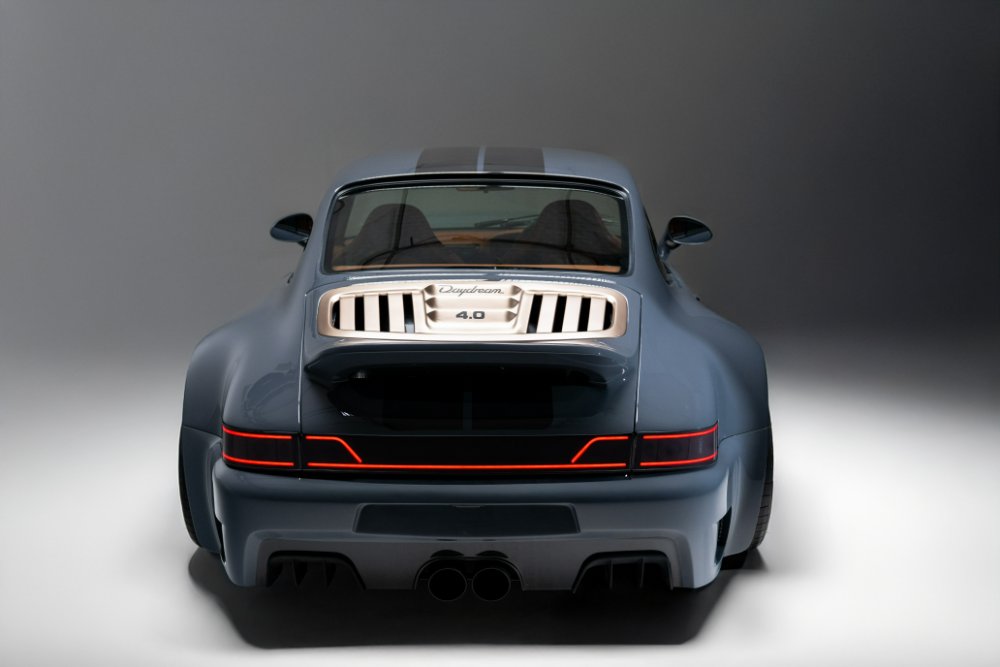
Among enthusiasts, lighting is one of the easiest tells in the restomod world. It is also one of the hardest areas to do properly, because it combines design, packaging, legality and reliability. For Tedson Motors, it became the most punishing part of the project.
“An old friend says many great things in life happen because people freshly enter an industry and don’t know enough,” Turkic laughs. “If they knew everything waiting behind the corner, they wouldn’t do it.”
Initially, the Daydream retained the 964’s upright lights, but Turkic felt the proportions no longer worked once the car’s stance and aggression evolved. “I looked at it and said, it doesn’t work with this aggression and width,” he recalls. “To make the car work, I need to change the angle and make every line work.”
The decision led to a cascade of consequences. “The next morning, we took 15 degrees and cut the fender under a 15 degree slant,” he says. “Now you can’t position the original light. You have a bigger ellipse, a new geometry. I told myself, OK, great, now we need to design our own headlights. A Pandora’s box opens.”
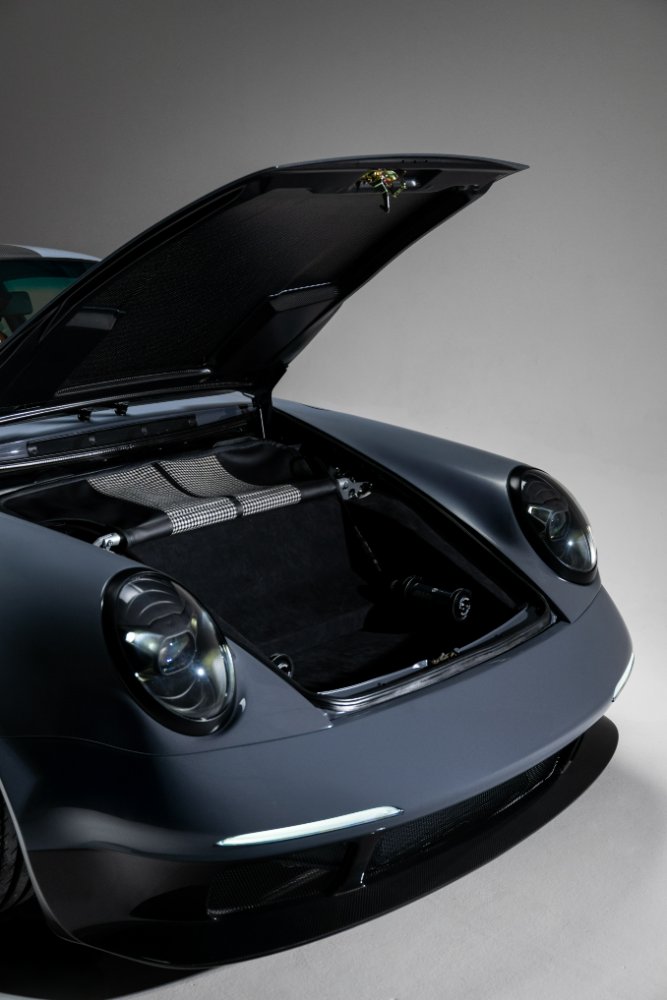
Tedson Motors chose to reference modern Porsche cues while building a proprietary unit. “The internals are Hella,” he explains. “Everything else is produced by us, 13 different pieces. We can customise every single piece. Outer bezel carbon, upper piece red, aluminium, anodised aluminium, anything. We can create a jewellery piece.”
Then there is the part most people never think about until it goes wrong: sealing. “It was difficult to design, but the hardest part is making a car not leak,” he says. “It’s like real estate – hydro insulation is the biggest challenge; how to make the lamp not fog, not get wetness inside.”
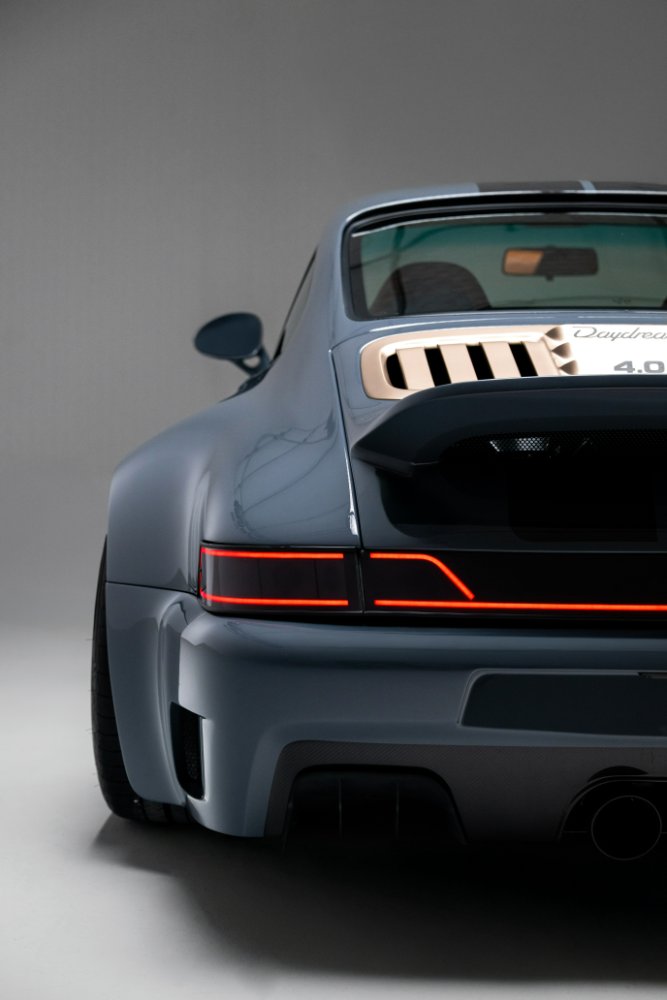
He made the same call at the rear. “Even though I had the original geometry, I said we need LED lights,” Turkic says. “I looked at what’s on the market and said I can’t justify the price point and uniqueness if we buy off-the-shelf lights. We had to do it ourselves. Lights caused us so much headache, trial and error, but finally we got them.”
Drivetrain configuration can be a sensitive subject for 911 purists, but Turkic is pragmatic. “Porsche purists always talk about rear-wheel drive, but I actually like four-wheel-drive 911s,” he says. “It gives you better 0-62mph starts, better road handling, more predictability. The weight penalty is offset by stability and capability.”
He acknowledges trade-offs between systems. “The systems differ between 964 and 993, and I like both,” he says. “The 993 has a weight advantage, but the 964 has performance advantage, basically being a 959 system. It’s harder to service and heavier.”
Tedson Motors is preparing a four-wheel-drive 964 demo car for the season with a supercharged engine and LSDs front and rear. “It will be extremely capable, I can’t wait to show what we can do,” Turkic says.
His rule of thumb is simple. “If you want to drift and slide, and lose the rear easily but still control it, I like rear-wheel drive on a narrow body,” he says. “If you have a wide body, four-wheel drive can be handy, especially with massive power increases. You need stability and safety as power increases.”
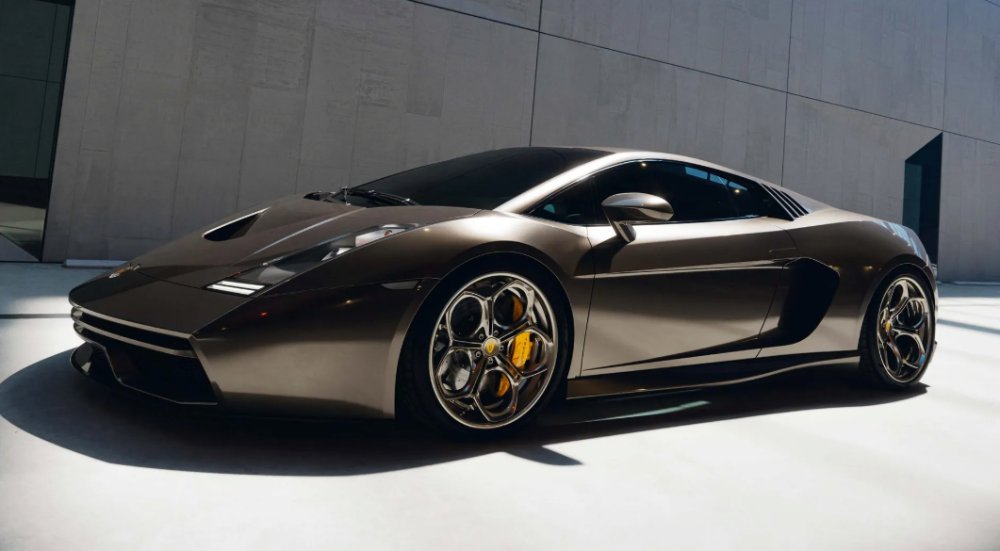
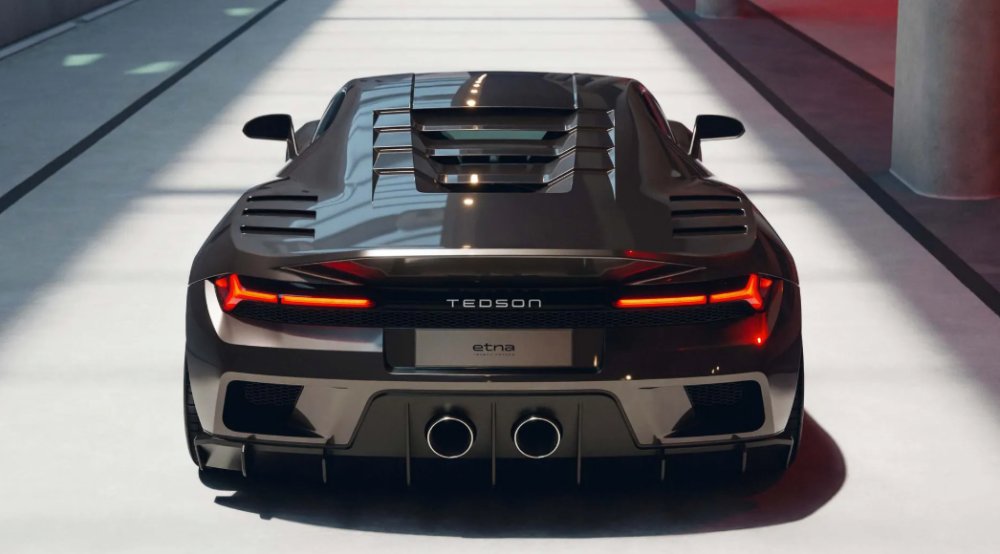
That thinking leads directly to the next Tedson Motors project, the Etna, based on the Lamborghini Gallardo. “At one point I was ready to turn all our Etnas into rear-wheel drive, but we concluded it’s not a good idea – too many people will get hurt,” Turkic says. “If you increase power, you need to increase stability and safety, and that’s where four-wheel drive helps.”
The Etna also represents something else: a broader design canvas. “I wanted another diametrically different task, to reimagine an Italian exotic car, which would give us more room for design interpretation and flair,” he says. The spark came from sound. “There’s a video of Lewis Hamilton being interviewed at a race track, and he freezes and goes, ‘Oh my God, the V10,’” Turkic says. “It’s basically saying the greatest era of Formula 1 was the V10 – the ferocity and sound. I said, OK, that’s it, we’re going to do the V10. The focus is a street car,, but we want collectors to get as close to an F1 V10 feeling as they can on the road. That was the premise;. Lamborghini had the V10, and I wanted the proper engine and construction.”
He considered first- and second-generation Gallardos. Choosing the later car would have been cheaper due to R8 aftermarket support, but it would have compromised what mattered. “I wanted a true Lamborghini engine, the iconic one; even firing, the sound, resonance, energy,” he says. “At the same time, I wanted Audi’s aluminium space frame. If we take a V10 to the next stage, we need a frame to support additional power.”
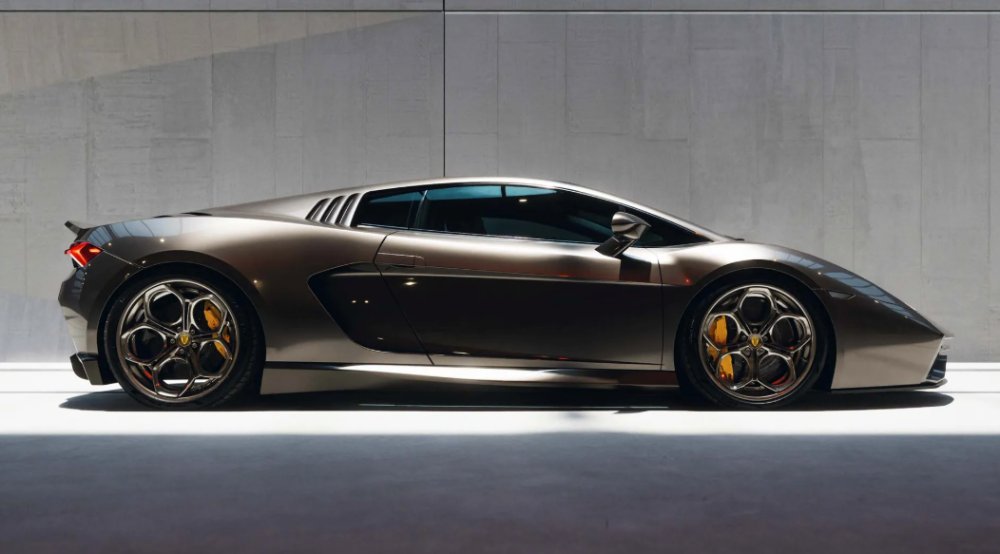
With stock Gallardos already potent, Turkic argues that the Etna’s performance targets demand equal attention to safety and control. “If you go over 700bhp with serious weight reduction, you’re going both ways – increasing power and lowering weight and centre of gravity, widening contact surface,” he says. “We want people to drive them, so we retained four-wheel drive.”
Etna will use MoTeC M1 management, PDM and Tedson Motors’ traction-control strategy, alongside enhanced braking via Bosch hardware. “It goes beyond restoration,” Turkic says. “It’s manufacturing, re-engineering to make it better in every aspect, in a design package that evokes emotion. The Gallardo is a beautiful concept, but for some reason it feels like a gem never fully polished. Maybe there were constraints at the time – laws, bumper impacts, minimum height, things such as that. We evaluated without limits to make lines flow – more aerodynamic, more iconic with holes, curves, vents. I tried to be respectful to Lamborghini heritage, with hints of Countach and other Lamborghinis. The goal is to pay tribute.”
Goran says that companies such as Tedson Motors, Singer and others in the reimagining sphere are the biggest brand ambassadors out there. “With Porsche there has been legal battling – some companies do it right, some don’t. But if you consider where Porsche was before the restomod industry, in terms of values and perception, I’d say Rob Dickinson and Singer did a lot for today’s perception. They did it respectfully and most of us do the same.” He believes that every buyer knows the difference between OEM Porsche and a restomod.
“The people who buy these cars understand that. Yes, there will be discussion online – people will love it, people will hate it, people will say these cars should not be touched. What I would say to them is that it’s deeper than that. We are probably bigger ambassadors of the brand than they are. We’ve done so much to ensure beautiful examples are untouched and significant models are untouched.”
More broadly, he sees restomods as key to the future of automotive passion in general – and references a Justin Timberlake film called In Time. “In that movie you have new-technology cars zooming around, but also old retro cars reappropriated for a different era,” Goran says. “I feel that products created from the 1950s and 1960s to late 1990s are products that will never be replicated – that’s the analogue era. We won’t have a situation where a car from 2025 is viewed the same way in 40 years. Those will end up like printers; after two years it’s obsolete, they don’t make parts, it’s worth nothing because the modules, digital elements, harnesses will be replaced by something better. You will be able to fix an atmospheric engine 100 years from today, but you won’t find a replacement battery module from 2025 in 2060.”
Goran believes the responsibility of a coachbuilder is to preserve the valuable aspects of those models and reappropriate them for today. “That may mean more power, more efficiency, lower weight and better aerodynamics. Some people say, ‘You still emit CO2’, but they ignore that we lowered weight, rolling resistance, improved aerodynamics, so it uses less fuel,” he says. “We also have to bring in synthetic fuel, e-fuel, which is growing. It’s a huge story. It’s important because good collectable cars have been one of the best investments over 30 or 40 years. Real estate, stocks, commodities rise and fall, but these cars appreciate. As there are more people, availability falls, scarcity rises. People will keep driving them even with stricter laws, but the key is synthetic fuel. The demographic we’re talking about can afford any fuel price. They just want to drive without guilt, CO2 neutrally.”
Goran believes the bespoke element is key. “Someone said, ‘New kids won’t care about those cars.’ I said, wrong, because coachbuilding means they continue being those cars. Children now look at Singer, Gunther, Tedson, RUF, Eccentrica and others, and say, ‘That’s amazing.’ When they grow up, they will want them, too,” he says. “The coachbuilder’s responsibility is to reinvent depending on the era. Maybe 50 or 100 years from now we’ll have different fuels and we’ll repurpose them again.”
He says that his main goal is to create a bespoke product a client can identify with and participate in designing. “Our development is 12 months. Child development is nine months. It’s similar. Clients get excited. They spec the car, they get pictures and videos during the build. Chassis welding, roll cages, carbonfibre bonding, fitting pieces, gaps, engine, colours, interiors, materials,” Goran says.
“I will never forget the New York Auto Show last year. A client came to see his car for the first time live. I met him at the entrance to give him a pass, and he was shaking. A 55-year-old guy who has everything. He said he was so excited. He came to see his ‘child’. It wasn’t just buying a product – he co-built, he collaborated, he was part of it. We did suspension, engine, colours, everything how he wanted. This is where the future of coachbuilding lies.
“All my clients say, ‘This car I will never sell’, because they built it. Other cars come and go. This one they participated in.”
Find out more about Tedson Motors here.