

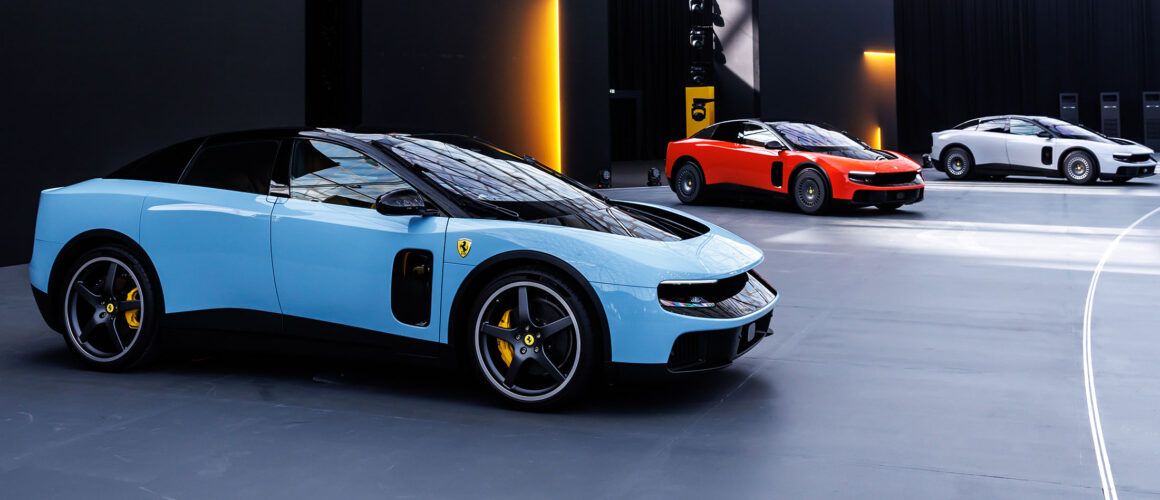
“Whenever we unveil the car there are going to be incredible discussions. We’re going to have some great lovers, and we’re going to have a lot of haters,” prophesied Emanuele Carando, Ferrari’s head of global product marketing, in a promo film produced prior to the recent reveal of the Ferrari Luce in Rome. Talk about no truer words…
Hideous… Should have been a sub-brand like Dino… Say hello to the Apple Leaf… It’s ‘giving’ Waymo… Ferrari’s Aztek moment… Teslarrari… Somehow worse than I could ever have imagined… Rip the Prancing Horse badges off that quick… The death of Ferrari… You know it needs a miracle when the Pope gets involved…
The haters have it, the haters have it.
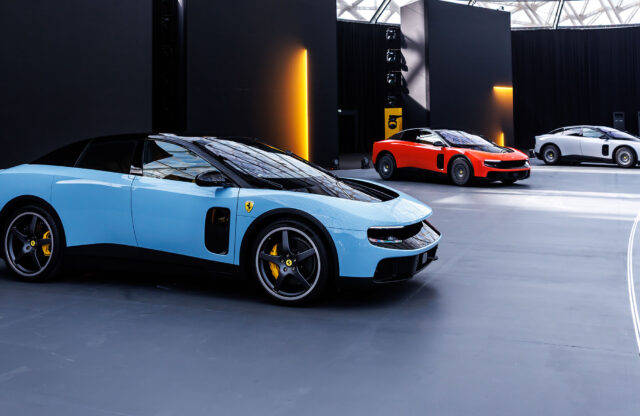
How much of this is just cancel culture group-think I wonder? Regardless, given the almost universal panning of the Luce, Ferrari’s first full EV, I’ve been processing my initial reaction to seeing a quintet of them displayed in an appropriately bright glass-roofed section of the Vela di Calatrava. Confined to the stepped viewing area, I could see only the front and sides at first; the rear would remain a mystery until a scheduled 30-minute slot some time later.
Of course, I’d read the 23-page press release the night before. It confirmed that creative collective LoveFrom, headed up by former Apple design chief Sir Jony Ive and Marc Newson, CBE – the latter an Apple Watch design contributor himself – had been responsible for the exterior as well as the interior. After 14 years of in-house design autonomy, that must have been quite a culture shock for Ferrari’s Centro Stile. I guess we will never know whether chief design officer Flavio Manzoni thought it a major slight, or a genuine opportunity to “invite a new perspective and cross-fertilisation, enabling a new design language to be introduced”.
Also contained within the release was a vague paragraph on the exterior that described a “uniquely pure and simple form” defined by “a glass house that extends below the belt line to the extremes of the car”. This, courtesy of “front and rear wings that float above and around the silhouette”.
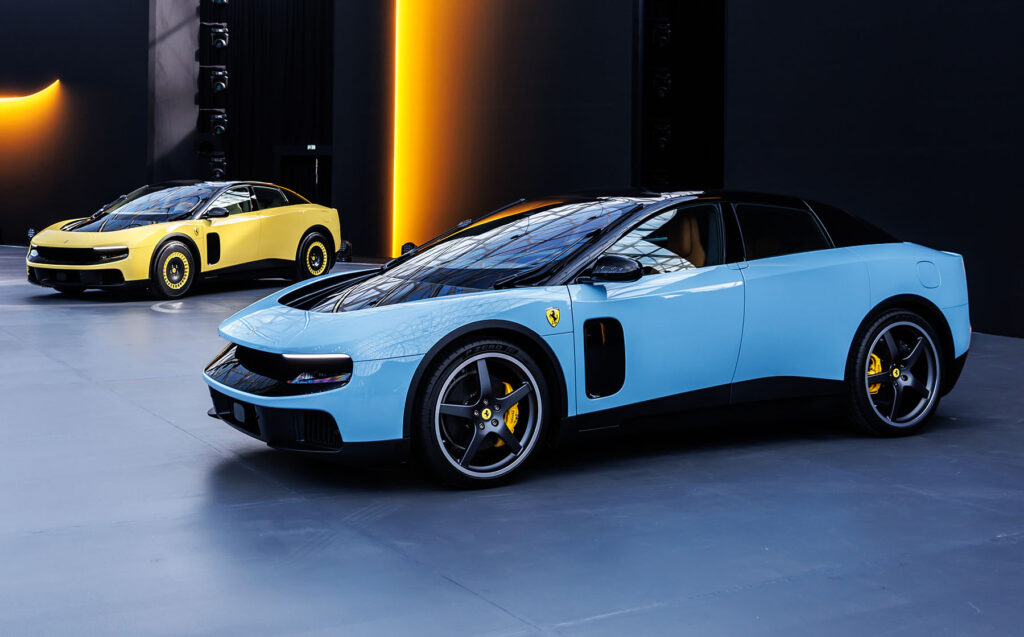
Intrigued, I’d hoped those words would equate to a shift away from the overly complex graphic modularity and aggression of the current crop of Ferraris, and reintroduce an aspect of beauty. That said, most enthusiasts don’t seem to mind the F80’s ‘raccoon face’, the flat angularity of its panels, shut lines and creases. To my eyes, all these elements disrupt the visual flow, none more so than the vertical black detail that just about slices the side profile of the 849 Testarossa in two. However, they fit in perfectly with the ‘disruptive design’ mantra that Manzoni has been championing for some time now.
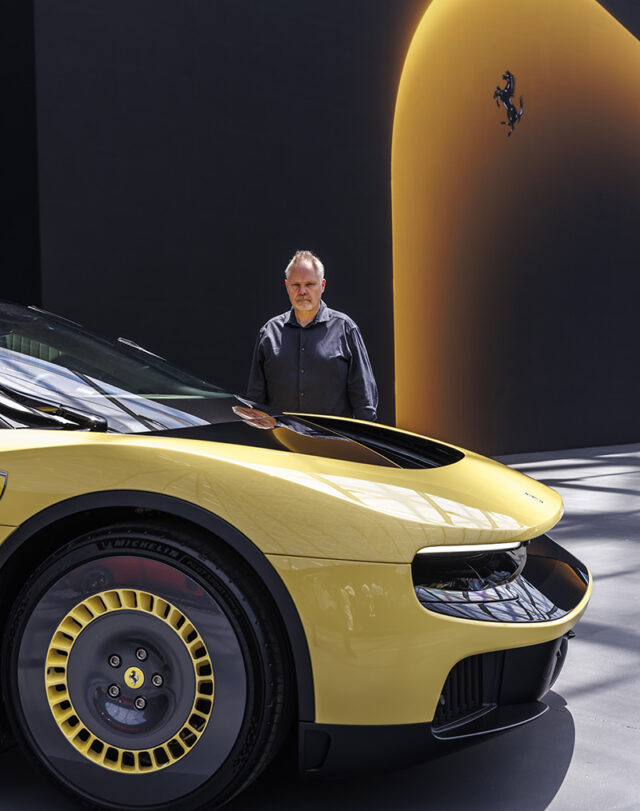
And so, seeing the Luce’s bold separation of glasshouse and super-clean body was a pleasant surprise to me. I said as much to Marc Newson during our media group round-table discussion. It got so quiet in the room you could hear a pixel pop, but it was genuine praise for what is a superbly designed product, with the emphasis on ‘product’. Of course, having once worked in the field of industrial design as a conceptual designer and 3D solid modeller, I was assessing it as a product rather than a car. Blame the Cupertino-style presentation complete with obligatory pastel colour options.
Hang on, though; isn’t a car in essence just a large, complex product? In that same promo film, Sir Jony says this of the Luce: “The car is an aggregation of hundreds of products… we felt strongly that you should have a sense that there was one singular, coherent design.”
Is something really new if it makes no impact, if it arrives without a shock?
The idea of coherent design was mentioned more than once by Newson, too. And it couldn’t be more polar opposite to Manzoni’s ‘disruptive’ talk. If you need a reason for why the Luce doesn’t look like any other recent Ferrari, look no further. Perhaps just the idea of an electric Ferrari was disruptive enough? Carando takes it a step further: “We didn’t want to develop a new electric vehicle, we wanted to develop a completely new Ferrari.”
Is something really new if it makes no impact, if it arrives without a shock?
To achieve that shock of the new, Ferrari essentially gave LoveFrom licence to create a clean-sheet Prancing Horse-badged concept car informed by a design language no model from Maranello has ever spoken before. The process was nowhere near as official back then, but there is precedent here in the alternative universe forms of Bertone’s Rainbow, Pininfarina’s Pinin, Fioravanti’s F100, Zagato’s FZ93 and others.
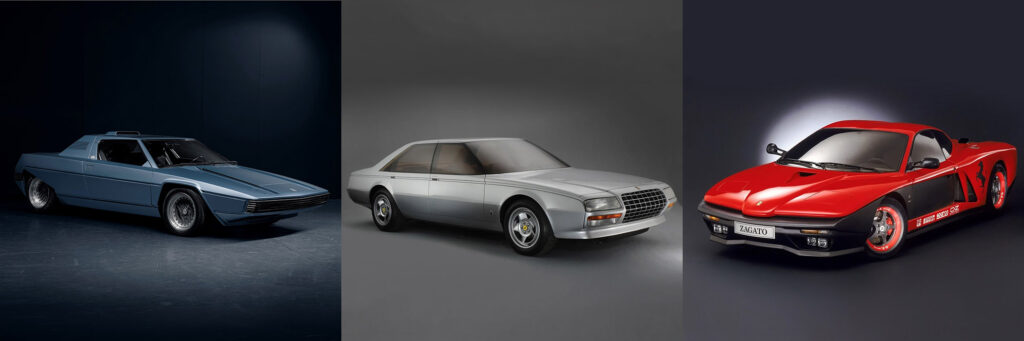
The difference is that the Luce is no one-off special destined for a short, sharp, shocked season on the motor show merry-go-round – it is the next-series Ferrari, in showroom specification. Trusting outsiders, albeit prolifically talented ones, to broaden the definition of what a Ferrari can be was always a risk, but Luce is the right product to take that risk on. But, have they been a little too bold, looked a little too far down the road? Not that the Luce looks super-futuristic, it just that it has radically pared back the surface complexity and advanced the functional aspects and usability well beyond what Ferrari’s current admirers are used to; beyond the point of MAYA. I’m assuming of course that the Most Advanced Yet [still] Acceptable principle continues to be taught in product-design schools these days.
“Product designers are not car designers,” has been a common refrain since the model’s launch. Strictly speaking, that is perfectly true, but it’s also a lazy argument. Ive and Newson are elite-level industrial designers capable of creating genre-defining products from toothbrushes and laptops to yachts, trains and, yes, even automobiles. Both are proper classic-Ferrari-owning car guys, too. Newson’s fabulous collection includes a Ferrari 225 S and a Bugatti Type 59, so he’s well versed in automotive beauty. In the case of the Luce’s interior and exterior, LoveFrom’s contribution was all encompassing. “There wasn’t a single thing that we didn’t design,” reveals Newson.
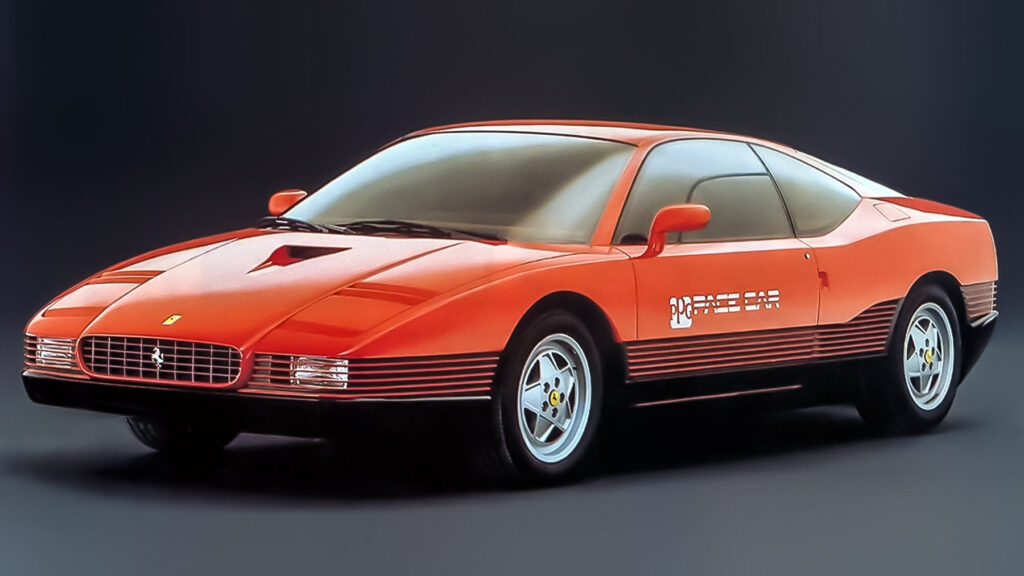
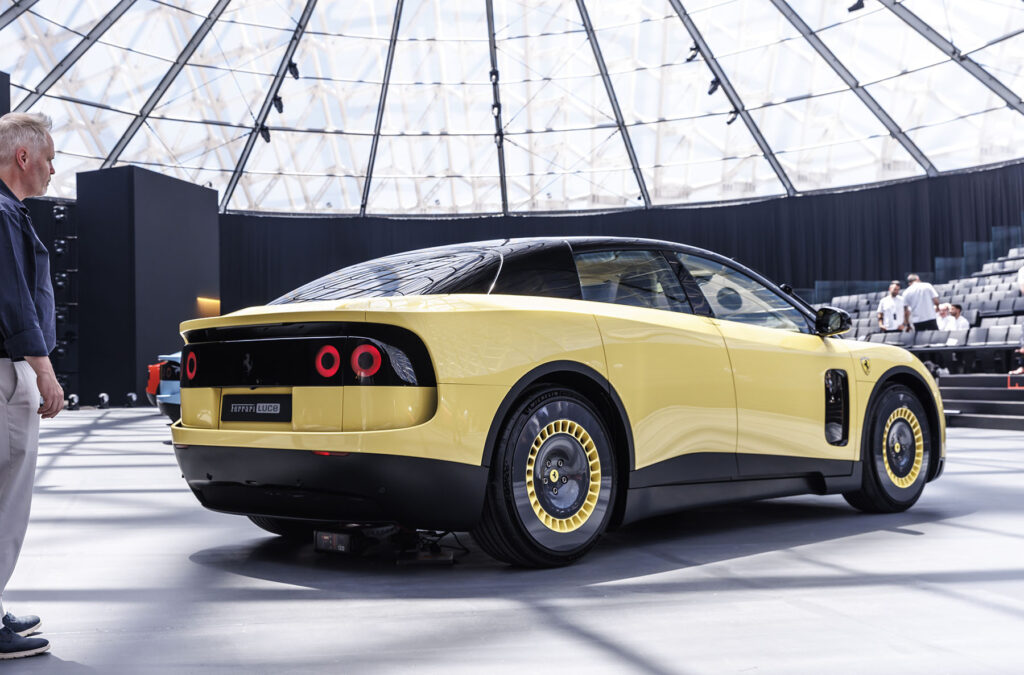
When my 30-minute one-on-one with the Luce arrived, I took another moment to absorb it all from a distance, thinking: “We haven’t seen a Ferrari as simply surfaced (above the side-strake graphics at least) and with such an overtly aerodynamic bias since the I.DE.A institute’s Mondial T PPG Pace Car.”
Tracking the shoulder line of the Luce around to the disappointingly amorphic rear end, I recalled reading, some 30 years ago now, renowned car designer David Hilton’s generous critical assessment of my rendered 3D car designs: “Quite promising, but there aren’t enough twisting elements.” He was right, of course. My 3D Studio-rendered AutoCad mesh models lacked the organic surfacing that allows light to dance across the curvaceous hips of a Dino or a 296. The surfaces lacked emotion and desire. And I reckon that is what has everyone so riled up about the new Ferrari, at least in part.
In the pursuit of aerodynamic ideals, slavish surface simplicity and 360° design coherency, the Luce’s exterior aesthetic has ended up so simple and coherent that it is short on emotion and character – a victim of absolutely nailing its own well defined brief. What’s more, being battery powered it is so intrinsically bereft of ‘jewellery’ that it doesn’t look as valuable as it should. An EV simply doesn’t require interest-enhancing elements such as NACA ducts, hot-air extraction vents, a Lexan engine cover or stainless-steel exhaust tips. This is especially true when specified with the all-function, no-form aero wheels that somehow contrive to make 24-inch rims appear no larger than 17-inchers. Sure, the techy suspension and drivetrain trickery developed solely in heartland Maranello are engineering gold, but the parts crafted out of San Fran are always visible. We all know beauty is more than skin deep, but you’d expect some of it to be on display.
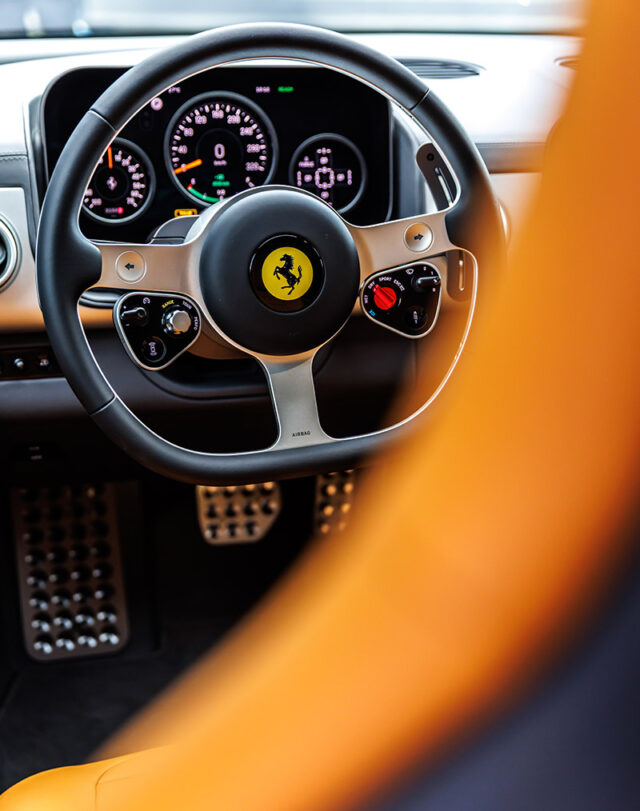
It’s a different story inside. By opting for authentic materials and considered, timeless design, the interior feels genuinely precious. LoveFrom has rejected the ever-larger touchscreens and cheap, buttonless cockpit plague for a set of joyously tactile interface elements that marry impeccable design to top-notch materials. Think machined-glass knobs, layered digital instruments with analogue needles sandwiched between, premium leathers and anodised aluminium for the steering wheel, pedals, dashboard panel, lush grab handles and more. As a result the Luce’s cabin is likely to still feel valuable in 30 years time. In the digital era, it’s a seismic moment not just for Ferrari but for car interiors in general.
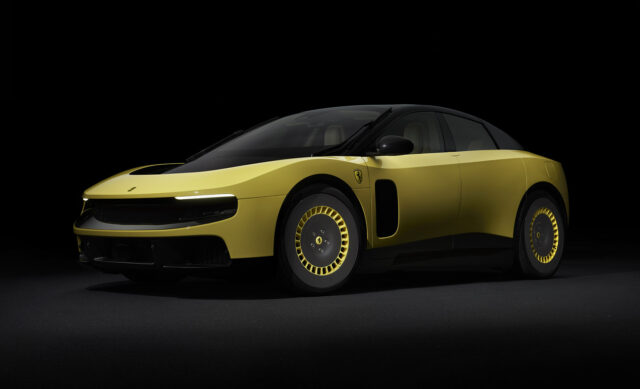
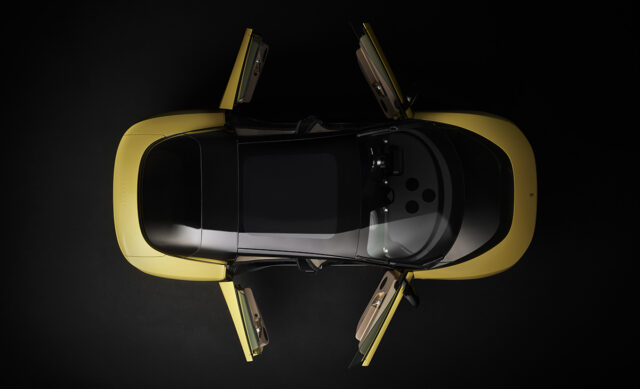
Unlike the 288 GTO, the Testarossa and the F40, the Luce will never end up on youngsters’ bedroom walls. Still, slating the design for that reason alone is genuinely naïve. Tasked with designing the most practical, usable, comfortable and aerodynamic Ferrari ever, minus the one core component around which all previous Prancing Horses have revolved – a powerful internal-combustion engine – it is only logical that the newcomer should break solidly in a visual sense as well.
LoveFrom had a blank-canvas opportunity to broaden Ferrari’s design palette. How awful if the Luce hadn’t moved the dial massively in any direction
LoveFrom had a blank-canvas opportunity to broaden Ferrari’s design palette. How awful if the Luce hadn’t moved the dial massively in any direction. And yet everyone with a keyboard seems to disagree, suggesting instead that the Luce should somehow look like every other current Ferrari. Mere hours after the embargo lifted, hundreds of AI-enabled instant Photoshop ‘fixes’ appeared, all seemingly morphing the Luce into a far sexier, low-slung two-door sports car. Not one solved the proportion challenge of the project’s ‘preset’ platform and packaging constraints, functional targets and homologation requirements.
Can you imagine how ungainly an F50 might have looked with room for five adults and 600 litres of luggage capacity? Really, Ferrari has had seven years to think about this, LoveFrom almost as long; YouTube wannabee designers, memesters and Chat GPT ‘experts’, you’ve had seven hours! Log off Discord, close your Midjourney, Vizcom or Nano Banana tabs, and go for a walk.
Could the rear be more sculptural? Absolutely. Would the car have benefited from more emotional surfacing and value-enhancing details? Highly likely. Should it have token heritage cue circular tail-lights? Probably not. A unique futuristic lighting signature would have felt more coherent. I could go on, but the fact is there are a million subtly different routes LoveFrom’s designers could have gone down. They, and Ferrari’s chief decision makers, chose this one.
In a fast-changing world at war with the art and joys of driving, cars are losing their soul by design. I hate to say it, but they are morphing into transportation products. As passionate motoring enthusiasts who recognise the F40 as Peak Ferrari, the Luce was not conceived with us in mind. It is built for a world most of us are increasingly unfamiliar with. From a purely visual viewpoint I don’t love the Luce, but I certainly don’t hate it, either. And that’s fine: at £440k, it was never designed for me or my bedroom wall.
The Luce opens the door to entirely new audiences. Ferrari insiders estimate that between 60 and 80 percent will be first-time Ferrari buyers – Silicon Valley’s tech million- and billionaires, hyper-flush early EV adopters and the pinnacle of the massive Chinese market. These are all buyers who bought zero-heritage Teslas, Lucids and Xiaomis, and are looking to trade up. They’re unlikely to care that the car doesn’t look like a traditional Ferrari or that it doesn’t have an engine description starting with a V. They care about the design statement, the exclusivity and the technology of a product that aligns with their stratospheric lifestyle aspirations and image. The Luce is all that [and promises to be brilliant to drive as well].
“Ferrari’s biggest mistake” may yet surprise the naysayers.
Find out more about the Ferrari Luce here.