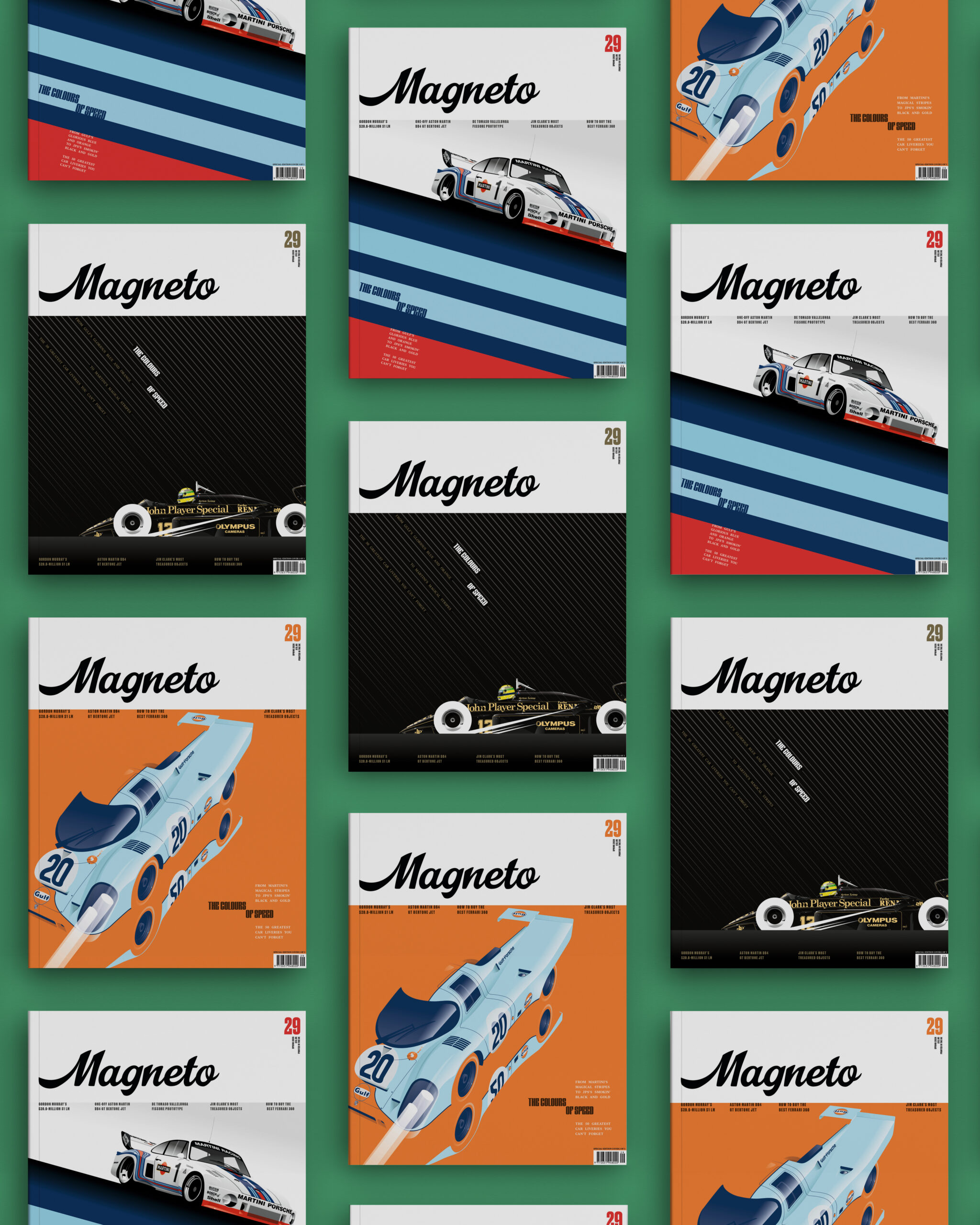
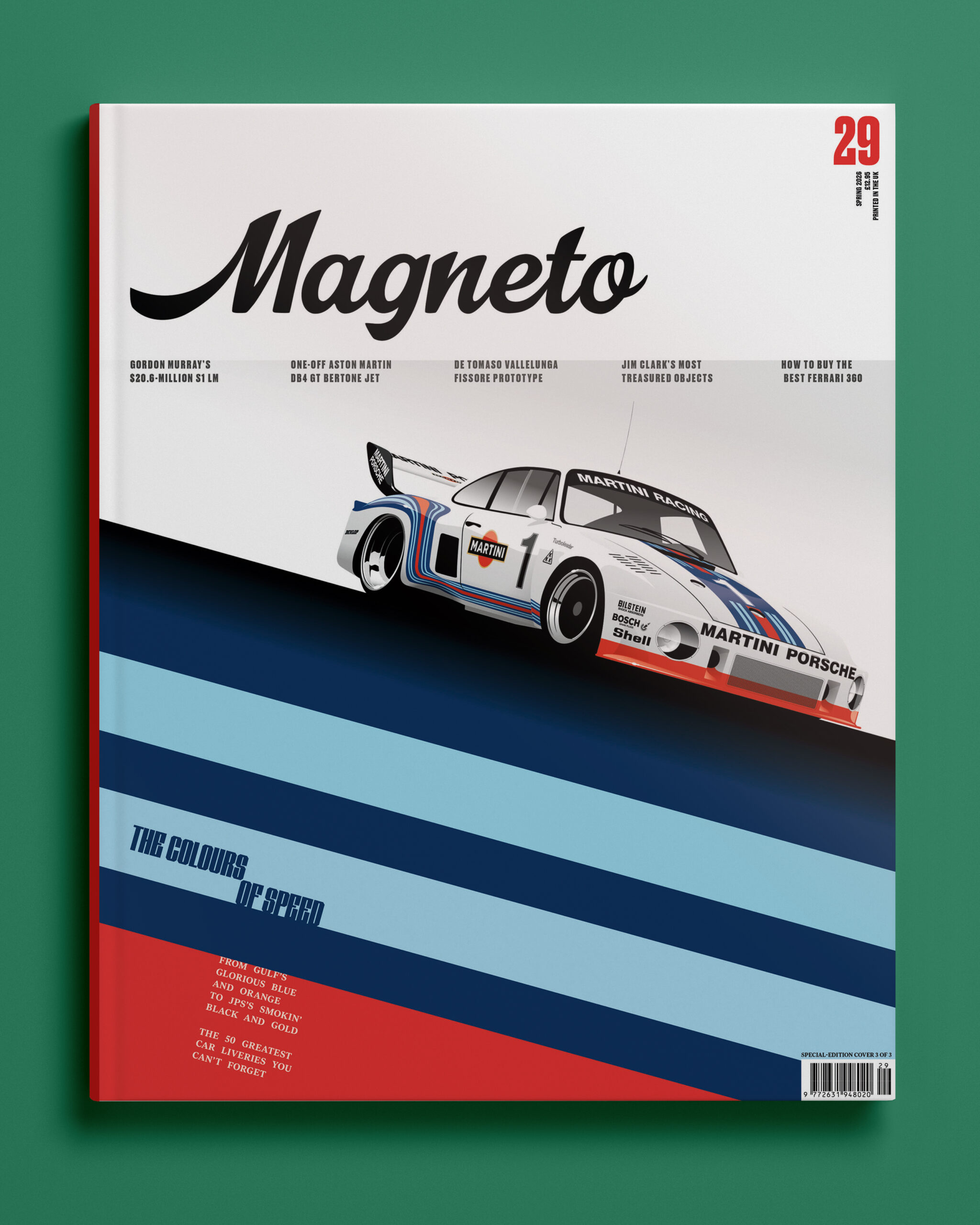
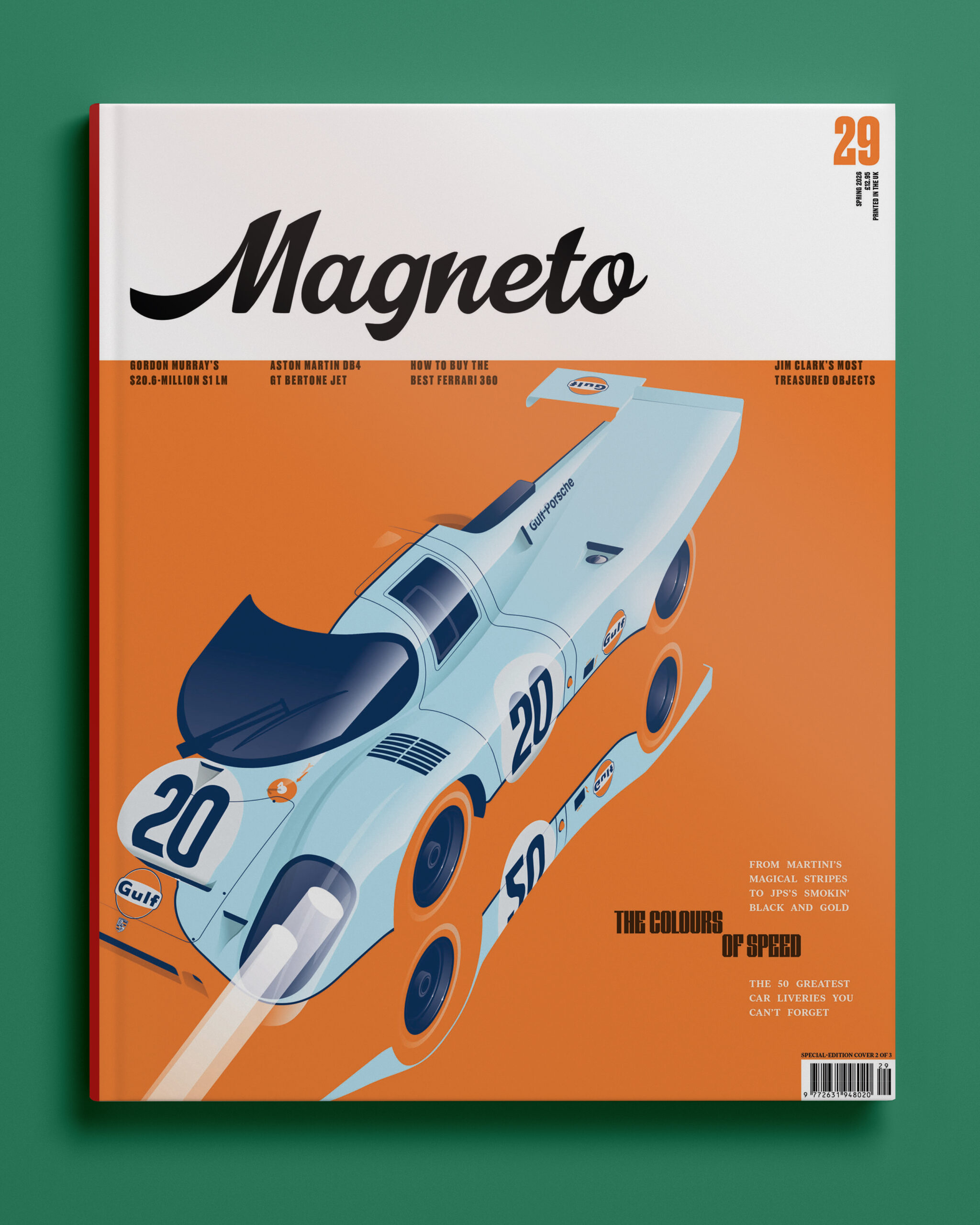
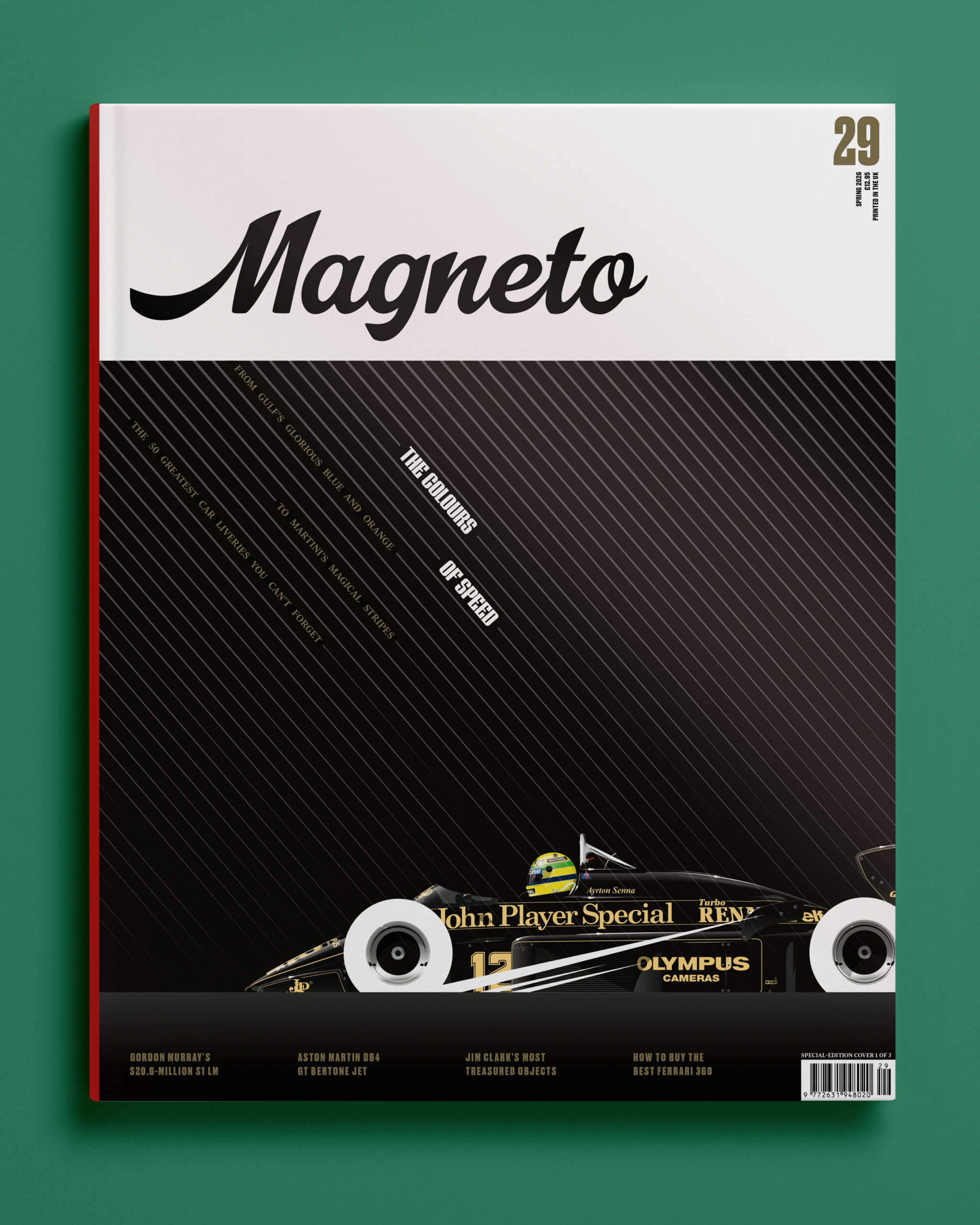
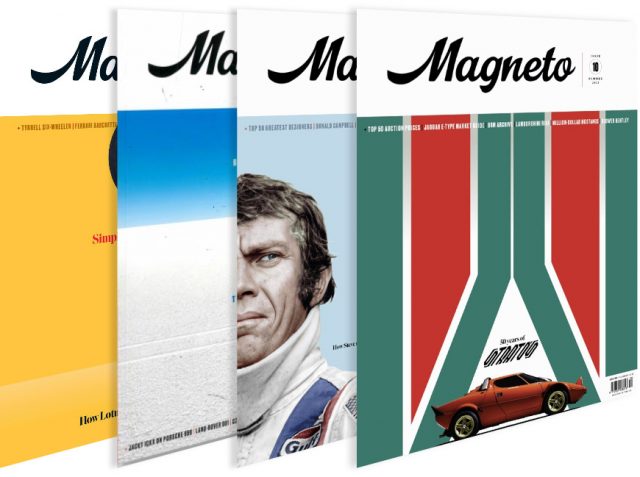
Magneto magazine issue 29
From £12.95
Magneto magazine issue 29
Inside Magneto magazine issue 29
Cover story: The 50 Greatest Motor Sport Liveries
1961 Aston Martin DB4GT Jet by Bertone
1924 Hispano-Suiza H6C ‘Boulogne’
De Tomaso Vallelunga prototype by Fissore
Jim Clark artefact collection
Master car designer Leonardo Fioravanti
1969 Chevrolet XP-800 Astro III
Ferrari 360 Modena market guide
-
Take a look what’s inside
Magneto magazine issue 29
Cover story: The Colours of Speed
Richard Heseltine attempts the emotional minefield of ranking the 50 most evocative motor sport liveries ever. From Gunston cigarette pack colours on a privateer Brabham via Jägermeister-branded BMWs to Lancia’s magical Martini stripes, these are the race car liveries you can’t forget. Illustrations by Ricardo Santos.
1961 Aston Martin DB4 GT Jet by Bertone
The highest number DB4GT chassis (DB4GT/0201/L) was dispatched to Bertone shortly before Christmas, 1960. A fabulous notchback coupé body was added. Designed principally by Giugiaro, the car was finished in light green with contrasting grey interior and was exhibited at the 1961 Geneva Salon. Its restoration was completed pre-2000 by Aston Martin Works Service after which it won ‘Best in Show’ at Villa D’Este in 2001.
Gordon Murray Special Vehicles S1 LM
One of the first two projects to emerge from Gordon Murray Special Vehicles, this custom-built commission inspired by McLaren’s 1995 Le Mans winning F1 GTR is powered by a 4.3-litre naturally aspirated V12 producing more than 700HP. Just five S1 LMs will be built, the first one already pre-sold for $20.63 million at auction in Las Vegas last year. Photography by Jamie Lipman
1924 Hispano-Suiza H6C ‘Boulogne’
Once owned by Lieutenant Commander Glen Kidston, this H6C is a masterpiece of pre-war engineering, combining luxury with high-performance racing pedigree. The fact that Kidston was a member of the iconic ‘Bentley Boys,’ a group of affluent British racers who elevated Bentley’s reputation in the 1920s, further enhances the historical significance of this car. His 1930 victory at the 24 Hours of Le Mans ties this Hispano-Suiza to one of the golden ages of motor sport. Now back in Kidston family ownership, and stunningly restored, this is the quite remarkable story of an exquisite motoring jewel.
Jim Clark Memorabilia
Remembering the late, great Jim Clark through a selection of his personal items selected from the broader collection of fellow Scot Dario Franchitti. Among the items superbly captured by photographer Rick Guest are Jim’s 1963 British Grand Prix winner’s trophy, Indy 500 Esso jacket, a pair of his heavily used red Grand Prix gloves, an original early-style race suit, his hand-written flight logs including a flight to Maranello and also the last fuel receipt and flight into Frankfurt, the pit board from his Indy 500 win, rocking chair, goggles and helmet
De Tomaso Vallelunga Prototype by Fissore
One of just five Fissore-bodied Vallelunga prototypes built in aluminium before the 55 Ghia-built glass fibre production versions emerged. Features the distinctive rear-hinged clamshell engine cover only seen on the prototypes. Comprehensively restored by Three Point Four of Barnsley, Yorkshire.
Leonardo Fioravanti profile
Like Gandini and Giugiaro, master Italian car designer Fioravanti was also born in 1938. He studied mechanical engineering, specialising in aerodynamics and car body design, then went to work at Pininfarina. Fioravanti designed eight Ferraris: the Dino 206 GT, P5, 365 GTB4 Daytona, P6, 365 GT4 BB Berlinetta Boxer, 365 GT4 2+2, 308 GTB/GTS and the 288 GTO. As Pininfarina design manager, Fioravanti oversaw styling of the Testarossa and F40, as well as the Cadillac Allante, assorted Peugeots, Lancias and Alfas, as well a series of seminal concept cars for his own design house, Fioravanti Srl. Interview by Massimo Delbò and photography by Piotr Degler.
1969 Chevrolet XP-800 Astro III
A sleek, two-passenger experimental concept car resembling an executive jet aircraft even to its tricycle-type wheel arrangement. First shown at the Chicago Automobile Show, the Astro III, designed for Chevrolet by General Motors Styling, was “intended to probe future possibilities for turbine-powered personal automotive travel.” Astro III was envisioned as a high performance vehicle suited for travel on restricted access or possibly systems-controlled interstate highways of the future. A fascinating look back at a significant concept car designed for the Jet Age. Written by David Rodríguez Sánchez.
Time to buy a Ferrari 360 Modena?
Richard Dredge gives a thorough assessment of the history, the nuts and bolts and the current market value proposition of this critically-acclaimed F355 successor.