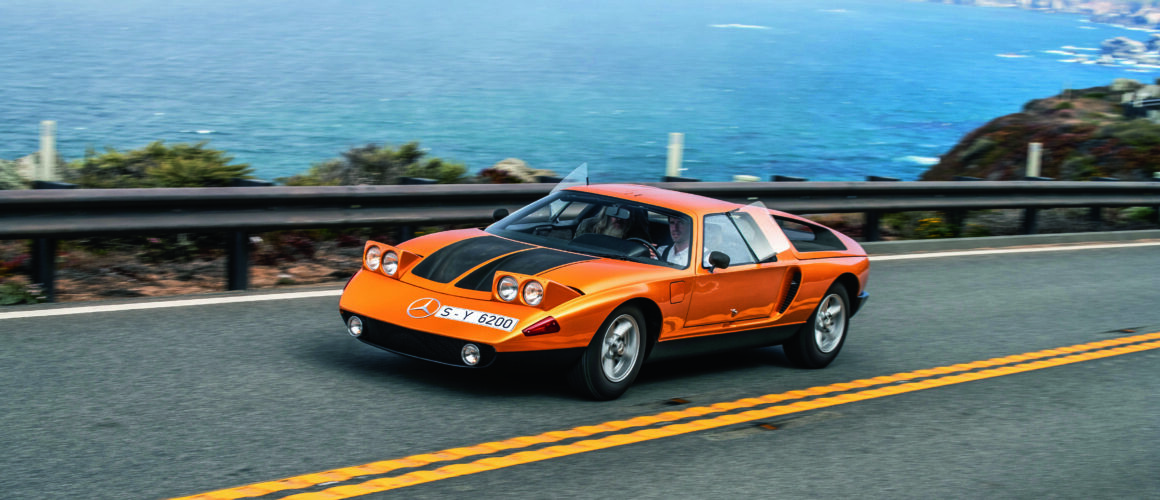
Since the C111 was unveiled at the 1969 Frankfurt Motor Show, none of the 17 prototypes Mercedes-Benz built has ever been offered for public sale. That changes on February 3, 2027, when a four-rotor Wankel C111-II goes under the hammer at RM Sotheby’s Paris auction. It’s the first time the company has sold one, and the proceeds will go towards modernising the Mercedes-Benz Museum in Stuttgart. Mercedes has also promised that no other C111 will be sold for at least 25 years.
What better excuse, then, to look back at the morning a missed flight put Magnus Walker in the passenger seat of a C111 on the Pebble Beach Tour d’Elegance, and the day after, when he got behind the wheel himself.
This article first appeared in Magneto issue 24.
Life is often about being in the right place at the right time. It’s not something a spreadsheet can help with. It’s more about fate, a meant-to-be type of thing, with maybe a little help of putting out the right type of frequency.
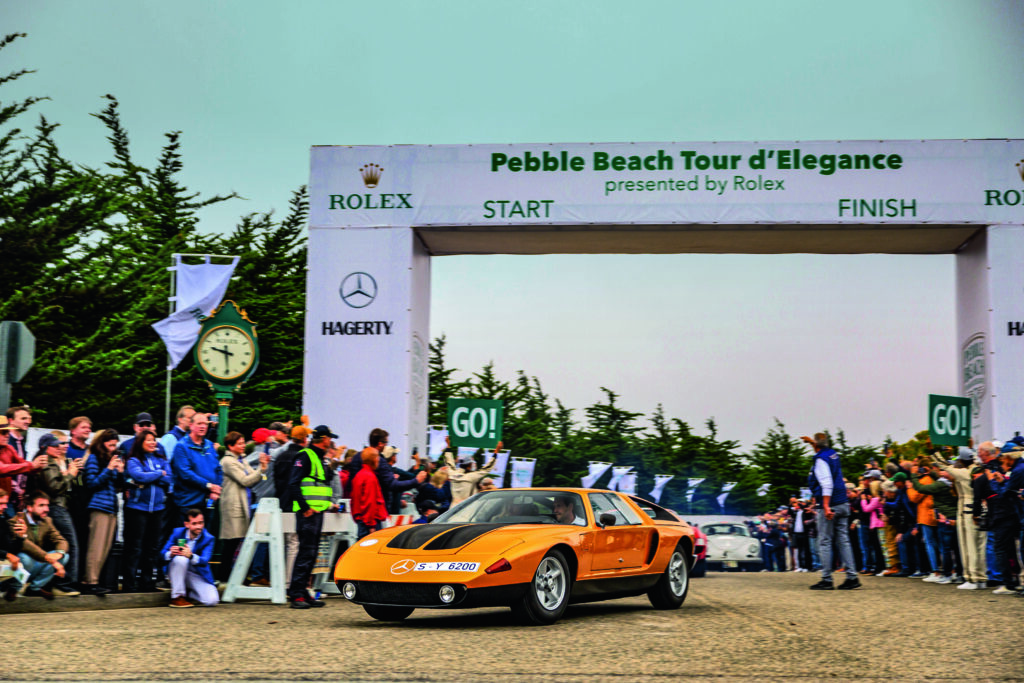
So, there I was, on a cold, damp, foggy morning outside the Gooding & Co. auction tent at the start of the Pebble Beach Tour d’Elegance, watching classic and vintage cars line up while organisers frantically moved them into the correct starting places.
This tour is open to all cars that will grace Sunday’s lawn at the concours d’elegance, to participate in the 70-mile drive down the PCH to Big Sur and back. The aim is to prove their roadworthiness – and show that even though they may have arrived at the event on a trailer, they’re not simply a bunch of trailer queens…
Much to my surprise, I spotted my buddy Michael from the Mercedes-Benz Museum standing next to an orange C111, right at the front of the starting line. I jokingly said to him: “I see you have my car ready.”
I admit I wasn’t quite ready for his reply: “Do you want to ride in it on the tour? The original designated passenger has missed his flight.”
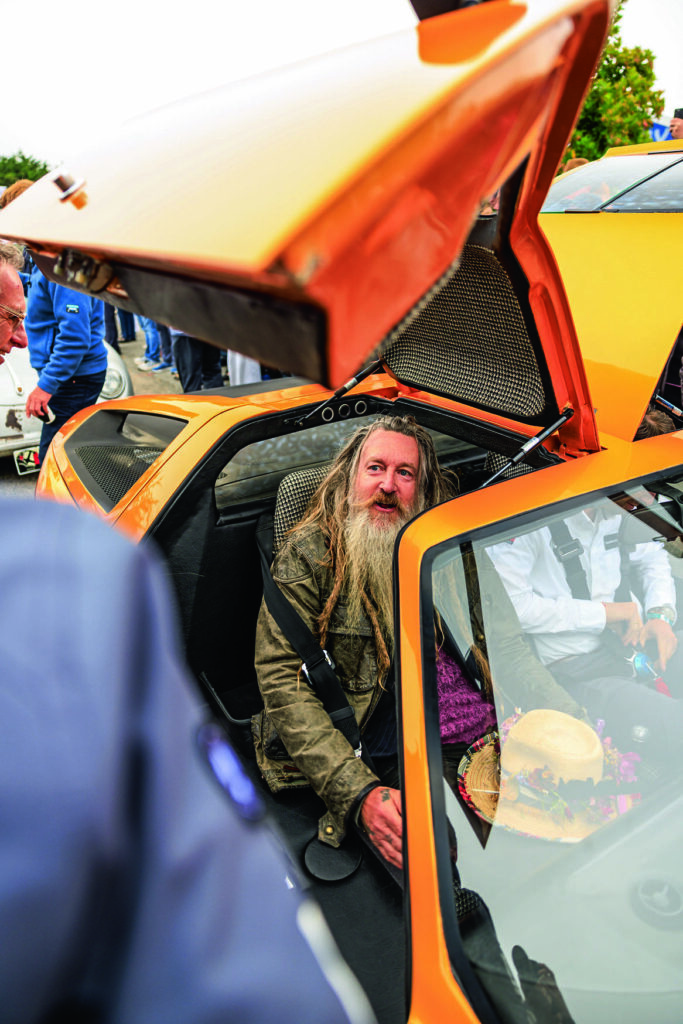
In an instant my day had gone from “What am I going to do next?” to “How did this just happen?” All the pre-planning with PR people would never have got me here at this point in time. Only fate, luck, friendship and a love of cars could, plus being in the right place at the perfect moment. After all, seeing an empty seat in the C111 just wouldn’t look right on the tour.
Now, I’m mostly a Porsche guy, but I often joke that I drive all cars from Stuttgart. I first visited the Mercedes-Benz Museum there in 2018 after a random message arrived in my Instagram account, inviting me over. (I had posted a photo of my good friend Ray’s 1963 Mercedes-Benz 220; I later found out Michael had sent the message, and we became fast friends.)
That invite led to my tour of the museum, where I first saw the 1970 C111 on display. Later that year, I drove a 300 SL with museum backing in the Silvretta Classic Rally in Austria. The following year, I accepted an invite from the museum to drive the same car in the 2019 Mille Miglia.
All of this eventually led to a 300km drive in the iconic 1954 W 194 for a film I was making, and yet another invite to drive the ‘Silberne Sau’ (‘Silver Pig’), the factory-built tribute to the ‘Rote Sau’ (‘Red Pig’) W 109. I was quickly learning that these Mercedes-Benz folk are quite generous with their cars.
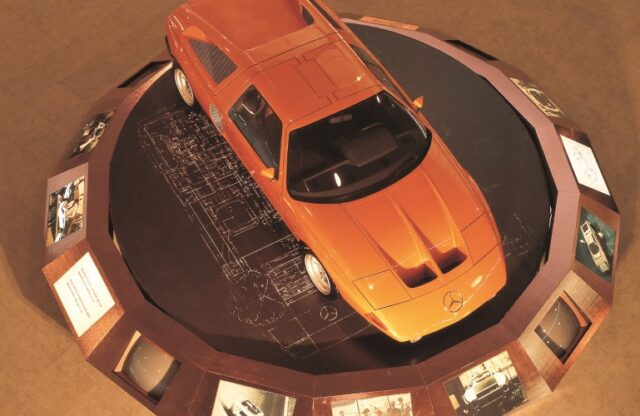
I didn’t realise at the time, but this was all leading up to my first encounter with the C111. It’s the first Mercedes design to feature gullwing doors after the W194 race cars and W198/300 SL.
These experimental development models were built between 1969 and 1979 in several bodystyle variations (I, II, III and IV), with III and IV being the final silver turbodiesel and V8 petrol-powered high-speed Nardò record-breakers. Earlier cars had three- and four-rotor Wankel engines that were smaller, lighter and smoother with less vibration, due to the motor’s one-directional rotation rather than a standard reciprocating unit. Mercedes also made at least one V8 C111-II. All were wrapped in this 1970s wedge-like body with mid-engine supercar design.
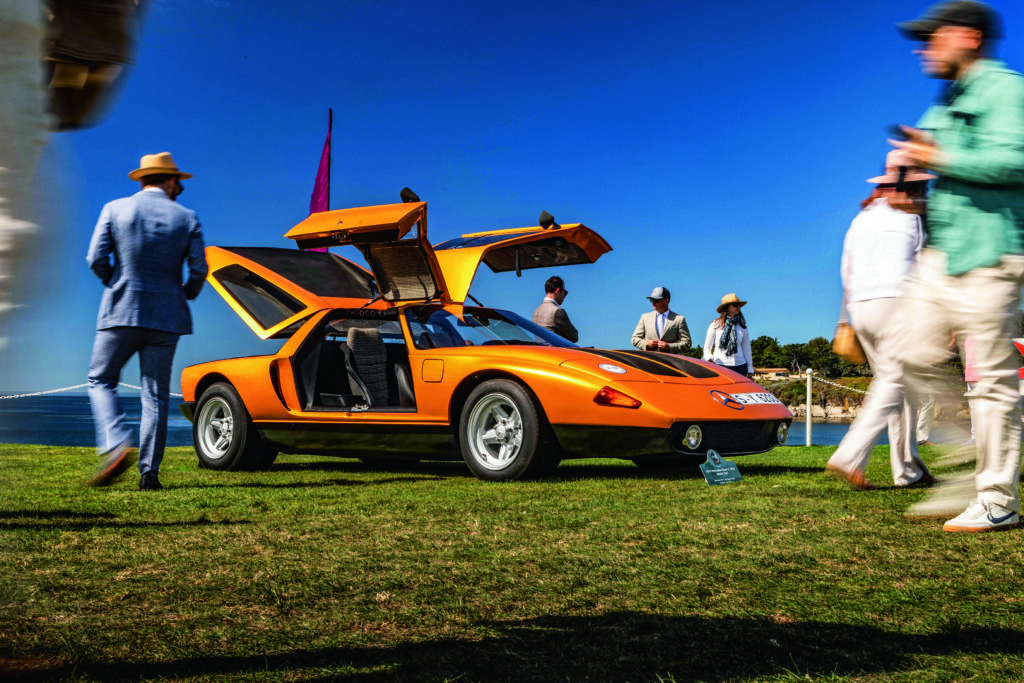
The C111 was never planned as a series car. It was a testbed for new technologies such as propulsion forms and lightweight components. Today, 13 of the 15 C111-IIs originally built are in the Mercedes-Benz collection.
In 2022, I got a little seat time in what was then the only running C111. It had been restored in 2014 as its 250bhp 3.5-litre V8 was deemed to be the most reliable and user-friendly version of the vehicle; the Wankels had proven to be somewhat delicate.
It was only hours before the car was loaded into a trailer to be transported to the Pebble Beach Concours, so I felt the pressure to take proper care of it as I drove a short distance around the Long Beach Airport next to the Mercedes-Benz Classic Center.
It was mid-August, and outside temperatures had peaked at 90°-plus that day. It felt like 200° inside the cabin. Much like a Berlin fetish club, the vinyl trim had its own unique aroma. The interior fit wasn’t great, and it felt cramped. Also, the doors were heavy and headroom was compromised. But none of that mattered.
The V8 was smooth and torquey; the clutch was light and simple to engage; the dogleg five-speed gearbox shifted easily. I drove the car for 15 minutes, and then it was gone, off to the world-famous Pebble Beach lawn. I wanted more.
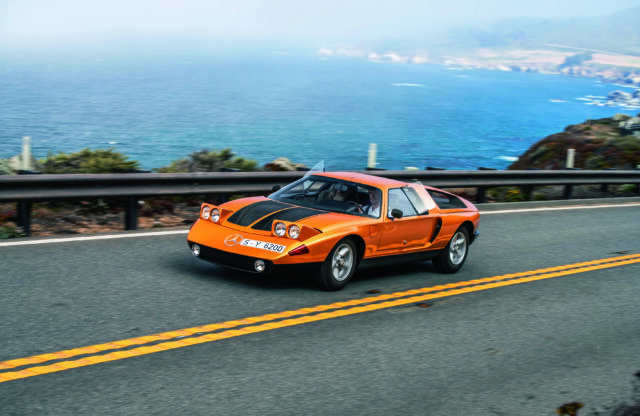
Which takes me back to that foggy morning in August ’24, when Michael offered me a taste of the C111 once again. I accepted the invite not knowing that the car had not been driven more than a few miles since 1975. This would be the first major outing for the only running four-rotor Wankel engine C111 post its full factory restoration.
Talk about a spot of good luck and being in the right place at the right time. Timing really is everything. With less than one minute before the 9:00am start, I slipped into the passenger seat, closed the door and instantly wished I’d taken off my jacket and jumper.
My driver for the next 70 miles and two hours was Patrik from Mercedes. We followed the police escort at less than 30mph, with the 350bhp four-rotor powerplant rarely getting over 3000rpm. We never got anywhere close to the 8000rpm red line.
The Wankel is high on revs and low on bottom-end torque. But none of this mattered as I rode shotgun across the famous arched concrete Bixby Bridge, lined with enthusiasts from all over the world looking to capture a glimpse of the cars as they roared by with the mist rolling in and out of frame.
The C111 piloted by Patrik didn’t miss a beat. It never ran hot and never stalled. I, on the other hand, was sweating to death with my multiple layers and jackets on. The rudimentary pivot windows could only provide inadequate ventilation.
Timing had got me into the passenger seat on this memorable drive. Fate would get me behind the wheel the next day on the runway at Salinas Airport, where I got to explore the upper limits of the rev band on old skinny tyres…
Once the gullwings are opened, getting into the fixed-back, vinyl seats is straightforward, and familiar in a vintage way that no modern supercar can match. The standard-looking and rather large stock Mercedes steering wheel is surprisingly unsporty for such a futuristic car that still seems fresh, stylish and ground-breaking more than five decades later.
The dogleg five-speed gearshift lever falls to hand in an ideal position. Legroom is good. Rear visibility is not so good. Closing the doors requires a strong pull of the vinyl strap and a sideways tilt of my head to avoid the panel closing down on my skull. This I learn quickly when my first rushed attempt results in a heavy knock on my noggin.
For my first drive in this Wankel C111, my co-pilot is a tech – let’s call him Fritz – who talks me through the driving procedure in a “don’t break it” German type of way. “Don’t slip the clutch, give it some gas but not too much, it’s easy to stall,” he says.
With a quick turn of the key to happiness, the 2.4-litre mechanical fuel-injection rotary engine springs into life. A short dab of the throttle shows its revvy nature.
The clutch is weighted nicely, and the travel is smooth and short up to the biting point. First gear on the dogleg is over to the left and down. Casually, I let out the clutch, give it some revs, and just like that we are underway drama-free, with no stalls, no slipping. Just nice ’n’ easy and surprisingly simple from a 1300kg 1970s supercar. Fritz doesn’t say a word. He just looks at me and smiles with a knowing look of approval.
On my first run around the airfield, I get up to fourth gear with ease. Downshifts are easy, although the pedals and large steering wheel make heel ’n’ toe-ing them a rewarding challenge to execute correctly.
On the next lap I’m up to fifth and enjoying pushing the car toward 7000rpm. I soon discover that power is best delivered with high-rev shifts. Short-shifting does you no favours because there’s not much low-down torque. Steering is light and direct. Brakes are firm and effective. Grip on the old rubber is not so good. After a few more laps and some time behind a camera car capturing footage for a film, it’s all over too soon.
Having driven both the V8 and the Wankel C111s on somewhat closed courses, it’s hard to tell the difference between them other than the fact that the V8 had more bottom-end torque. Both were comfortable, user-friendly, easy to drive and unintimidating. They provided just the right amount of entertainment, engagement and excitement that makes me long to take one on a proper drive on one of my favourite roads to get the full C111 experience. Who knows if that opportunity will ever arise.
I wish this car had made it into production. It would have been the perfect evolution of the thrill that the 300 SL gave us in the 1950s and the glimpse of the retro-futuristic dream Mercedes-Benz had planned for us in the 1970s. At least I’ll have the memories forever. And the photos.