

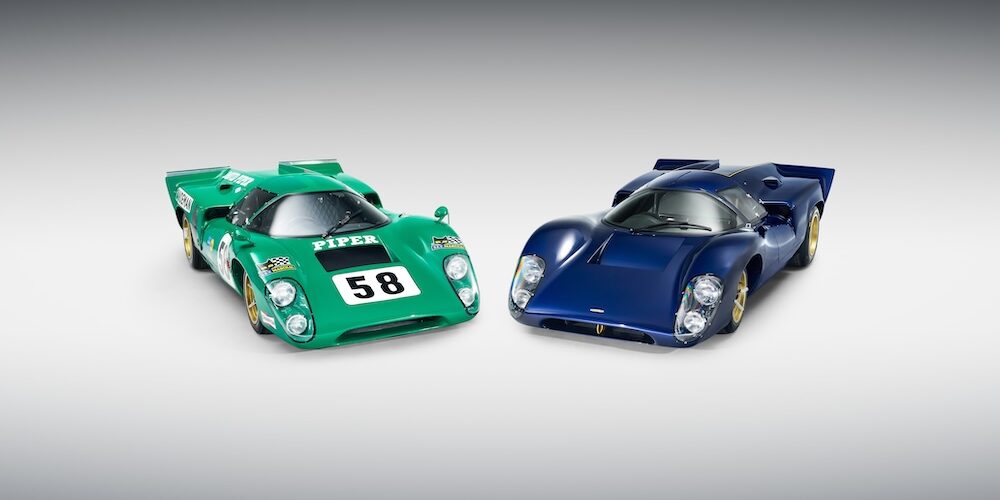
Lola Cars has launched two versions of the all-conquering T70, which famously became the race car of choice for privateers from its launch in 1965.
Just 16 examples of the new car, based on the last of the line Lola T70 Mk3b, will be built by the company, in either authentic historic racing eligible track form or as a slightly more civilised road car. Both stick closely to the original design, with the same chassis, suspension and bodywork, small block Chevrolet V8s and the famed Hewland ‘dog-box’ transaxle – albeit with a clever twist for the road car.
Both are being built using a patent-pending new composite bodywork material developed by Lola, which has a much lower carbon footprint than the original’s glassfibre or modern carbon fibre. It’s known as the Lola Natural Composite System (LNCS) and uses a unique combination of all-natural plant and basalt fibres with a fully renewable resin system derived from sugar
cane processing waste, resulting in a groundbreaking 100% ‘natural’ (petrochemical-free) bodywork system. Additionally, the extensive magnesium components are created using a new, more environmentally friendly process, and the entire carbon footprint of the car is documented.
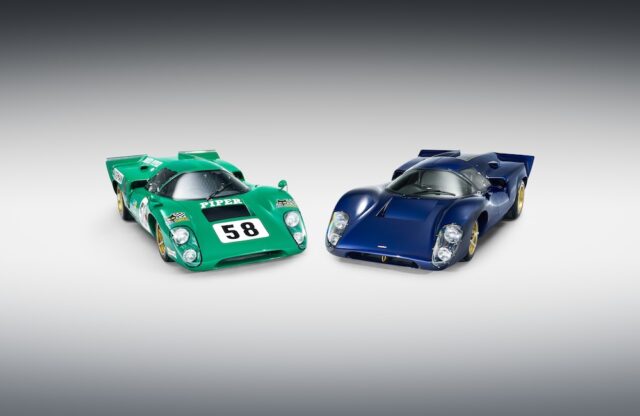
The new T70S race car (pictured above with the famous David Piper original) is an authentic continuation of the 1960s original, to the point that it has always be granted an HTP passport, allowing it to compete in Historic racing. The only changes made, other than the bodywork material, is to safety items such as the harness mounts and the roll cage, which on the original were shockingly flimsy. As with the original, it uses a 5.0 litre small block Chevrolet V8, which produces 530bhp for a top speed of 203mph and 0-60mph of 2.5 seconds, with a power-to-weight ratio of 616bhp per tonne.
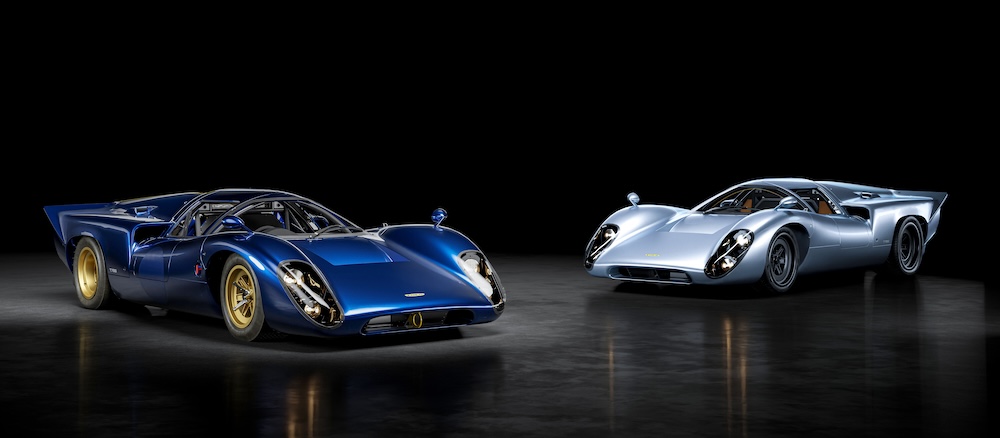
The T70S GT road car (above as a render in silver) uses a more modern 6.2-litre version of the Chevy V8, which produces 500bhp, enabling a top speed of 200mph and a 0-60mph of 2.9 seconds. Rather than carburettors it makes use of direct injection and is fitted with the required emissions equipment, but it looks mostly the same, right down to the trademark intake trumpets.
However, the most interesting difference between race and road versions is in the latter’s gear selection, which uses a shift-by-wire system to retain an H-pattern gearstick while taming the notoriously difficult Hewland – as Lola’s engineers point out, the only available new transmissions capable of handling the power tend to be paddle shift, and that wouldn’t be right for a T70.
Cleverly, the road car’s gearshift is said to still feel mechanical and the driver will still have control of the conventional clutch, but the electronics will discreetly match the speed, revs and gears to ensure that the sequential shift operates correctly.
Lola Cars was founded by Eric Broadley in 1958 and has gone to become the most successful manufacturer of customer race cars of all time, with more than 500 championship wins globally. Its most famous model, the T70, was originally introduced in 1965 and dominated the inaugural Can-Am Championship in 1966. It went on to become the popular among privateers taking on Ford, Porsche and Ferrari, and was also driven by the likes of John Surtees, Jackie Stewart and Mario Andretti. Its most famous win came in 1969 at the Daytona 24 Hours with Mark Donohue and Chuck Parsons for Team Penske, beating the factory Ford GT40s and Porsche 908s.
The company was reborn in 2022, buying up not just the rights to the name but also the archive of technical drawings and specifications, and re-established itself as a leader in design and engineering. It currently competes in the ABB FIA Formula E World Championship but is also known for its innovative engineering solutions, which it sells worldwide.
The prototype T70S heads to the US in April for further testing with Johnny Herbert, while the road car is expected to undergo firsts tests in late summer. More details on the Lola website.