

Leasing a car, whether it’s new or classic, can be the most efficient method of financing your high-value purchase. Steven Posner, CEO of Putnam Leasing, one of the biggest vehicle finance companies in the US, explains how and why it is done.
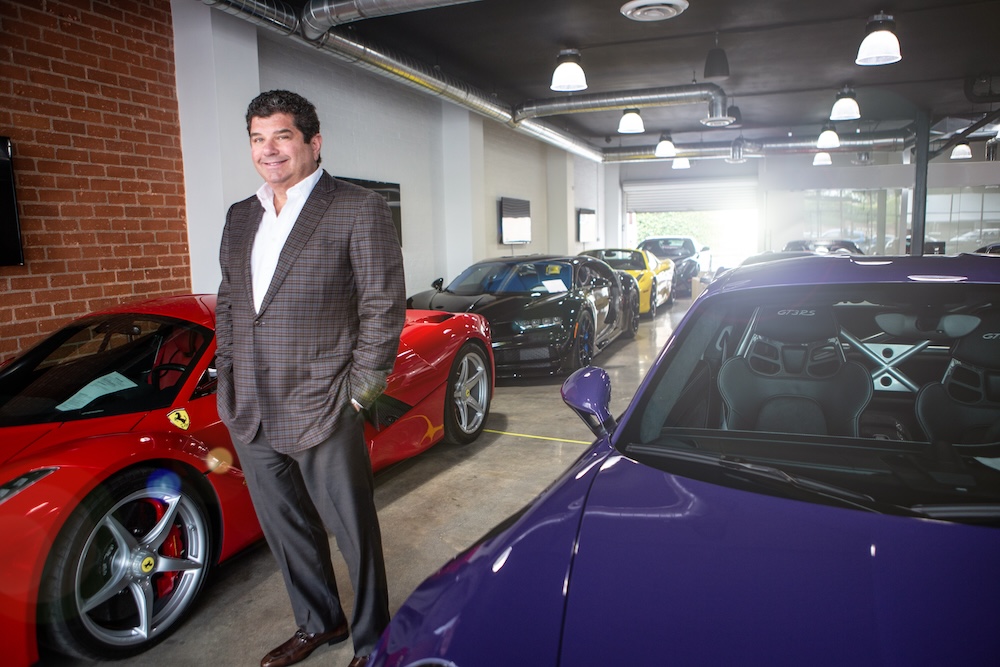
Who are you and what do you do?
I’ve been involved in the automotive leasing business since 1977 and at Putnam since 1989. Our company provides a method of financing collector cars in a less expensive manner than bank financing, based on the way that we structure the deals that we do.
How do you do that?
We write something called an open-end lease, which works like a balloon note loan. If you went to a bank and you wanted to borrow a million dollars against a car, you’d have to pay all the sales tax on the million dollars, and a bank would amortize a loan anywhere from five years to seven or eight years down to zero. We do something called a lease, where you borrow the same million dollars and, depending on which state you live in, you pay your sales tax incrementally and there’s a residual value or a balloon at the end. So, the amortization of the lease or the loan is based on what you finance and what the residual is, hence making your payment a lot lower, giving you the opportunity to buy more of a car for less of a payment.
Are there any other differences?
The one thing that differs in what we do is that we go to one of our lenders to borrow the money and lease you the car, which doesn’t show up on your personal credit. So, for the collector who wants to get a lot of cars, or the real estate guy who wants to buy buildings and doesn’t want to show the banks that they’re overly leveraged, it doesn’t show up on their credit. It’s up to that individual to be forthright with their lender, being that it’s a lease and it’s not really a loan, even though they are responsible for it.
What happens if they fail to make payments?
We do everything we can to help the person along because good people can experience financial issues and if arrangements can’t be made, we ask for the return of the car. Unfortunately, in some cases, we don’t get it but based on the kind of customers that we do business with, our default rate is extremely low.
Who are your typical car finance customers?
More and more customers in their late 30s and 40s are looking at classic car leasing, people who are really starting to make money and are focusing not only on cars, but on watches and collectable stuff, too – but mostly automobiles.
What sort of cars are you financing?
We lease all the exotics; Ferrari, Lamborghini, Porsche, etc., but the collectors that I deal with have really focused on the 1990s and early 2000 limited-production cars. There are some cars that a year ago sold for $350,000 and are almost a million today, which is very, very surprising. I’m optimistic that the market will stay strong but like everything else in the world, what comes up eventually comes down a bit. I don’t think it’s going to fall on its face, but I think eventually there’ll be a little bit of an adjustment, which is normal and helpful in any market.
How about the older classic cars?
The thing that we used to talk about years ago – and I’ve been doing this since the late 1970s – is what are the brass era cars from the 1920s and 1930s going to be worth in years to come. Even back then, the collectors were in their late 60s and 70s and 80s. What I’ve found is that the younger people are starting to appreciate the beauty behind those automobiles. We have quite a few customers in their 30s and 40s who are starting to acquire the Duesenbergs and the Auburns and cars like that.
What about the rest of the classic car market?
The Porsches, the older Mercedes, the one-off cars are great, but there’s very strong interest in everything. There is a buyer for every car that goes over the [auction] block. I’m still waiting to see a car go up on the block that no one puts their hand up for.
What has changed in the classic market over the years?
The market goes up and down. I’ve been around for four cycles – every 8-10 years the market corrects for one reason or another. The last big correction was 2008 and 2009, and that had nothing to do with the automobile market. I’ve seen it in the 1970s and the ‘80s and the ‘90s.
That doesn’t necessarily mean that there’s going to be another correction, but eventually what goes up comes down.
What’s your best car-buying advice?
Buy the best of what you’re looking for. Know what you’re going to spend in your mind, don’t get caught up in the hype or get into a bidding war with someone. You also have to bear in mind, when something goes up for auction and it’s a really special car, how hard is it going to be for you to find another one?
How about restorations?
If you buy a bargain and think you’re going to restore it, you can, but these [collector cars] are all toys. And if we remember, when we were kids, we got a new toy and we played with it right away and after six months or a year, we were tired of it. If you buy the best, when you get tired of it you’ll always have the best to sell. If you buy a car that needs work, bear in mind that by the time you get your car back two years later, you’re already over it, and you haven’t played with it yet.
If a financed car needs restoration, are all the costs down to the owner?
Yes. We provide the lease financing for the customer. If they need a recommendation and where to take their car, we have shops that we’ve dealt with throughout the United States, so we could tell them that this is the right guy for the car. I know for the brass era cars, for example, there are only a handful of people in the United States that do a wonderful job. We’re happy to recommend people to them.
Do you have a say in the condition of the car?
The greater portion of our business is through our dealer network. So, we basically rely on both the dealer we’re doing business with and the customer to make sure of the condition of the car. Obviously, if it’s a new car, that’s a no-brainer, but if it’s a pre-owned car, we’re trusting the dealer that we’ve vetted and we have history with to make sure it’s a car that someone would want with no stories behind it. We also do a lot of business at auctions. We were the leasing company for years for Gooding & Company and for Barrett-Jackson for 20-something years. When Christie’s took over Gooding, they had their own financing arm but we’ve now become the leasing arm for Broad Arrow auctions.
Can a leased car be taken out of the US?
There are a lot of customers who will want to take it to a race or on a rally, the Mille Miglia, events such as that. Before the car leaves, we have to make sure that the insurance that’s on the car is worldwide – Hagerty, AAC and Chubb are worldwide, for example – and they would have to post a bond or collateralise whatever the value of the car is, or the value of the lease is, with us until the car comes back. So if your idea is that you’re going to lease your $3 million Ferrari and take it all over the world, perhaps you should look at a different way to finance it.
And do you offer finance outside the US?
No – the lenders that we do business with, which is an array of about 11 or 12 banks, don’t loan outside of the United States. It’s hard enough to lease a car in the US.
Finally, why use Putnam Leasing?
We like to make things easy for customers. For us, speed is of the essence and what sets us apart is the people. They’re all car people. All of our salesmen have been with the company for the last 20-plus years. We have departments for everything, registration, insurance, etc. We make it easy for a customer, if they do have an issue or need help, they’re going to speak to one person in a department who’s been there a very long time, as opposed to pulling up an 800 number and being shuffled around here and there and everywhere, because we’ve pretty much seen everything.
More details on Putnam Leasing’s website.