


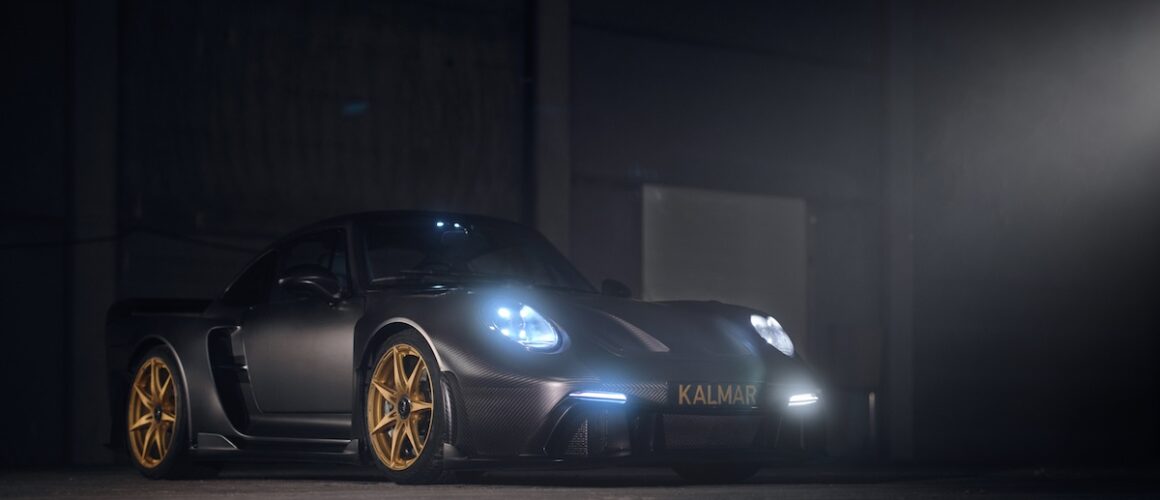
“We wanted to beat the 6min 57sec achieved by a Porsche 918 Spider at the Nürburgring Nordschleife,” says Jan Kalmar, originator of the Kalmar 9X9. “We’re quite confident we’re there.”
He’s talking about his latest creation, of which nine each will be built in three different specs, all of them wholly bespoke to customer requirements. The Kalmar 9X9 is very much a tribute to the Porsche 959. “We fail if we do not exceed what they achieved 40 years ago.” What it is not is a restomod. Instead, this is “the first retro hypercar that meets modern homologation requirements for the 27 EU member states”.
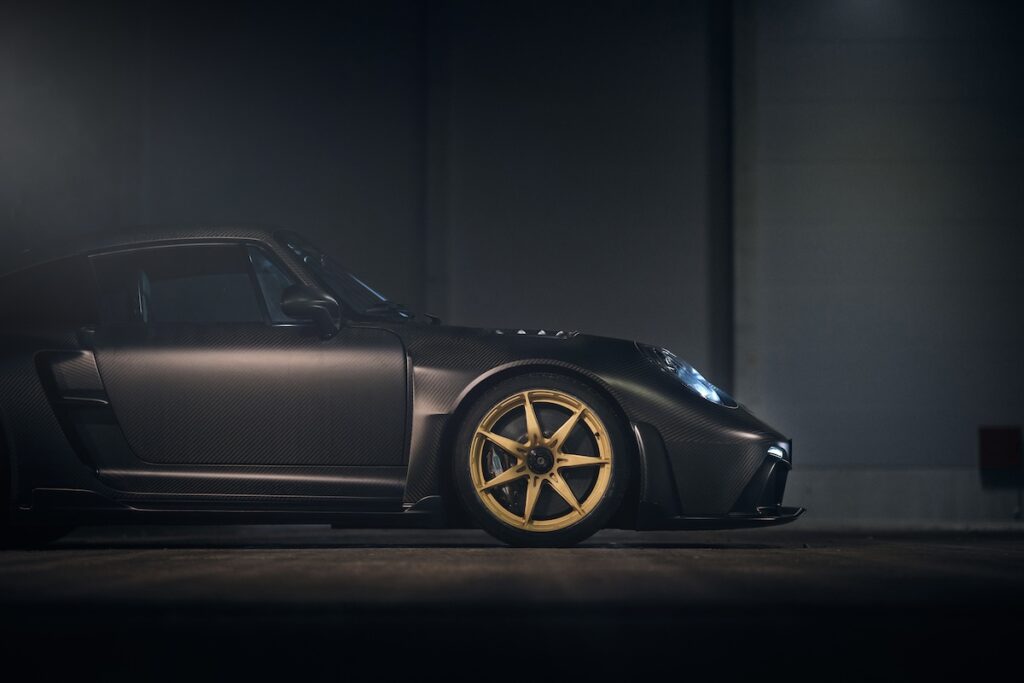
‘Kalmar may sound familiar thanks to Kalmar Beyond Adventure, Jan’s Kalmar off-road driving experience company that offers drifting on Arctic ice on one hand and trans-Africa safaris on the other, all in highly modified Porsches, built by Kalmar Automotive – which is in the restomod business, turning out tastefully modified 964- and 993-based cars at the rate of one per month. The Kalmar 9X9 you see here has taken one and a half years longer than intended to bring to fruition. Perhaps that is an indication of the depth of its engineering.
In essence this is a 993 (last of the air-cooled generation) with the mechanicals and electronic architecture of the 992 (the current 911). Yet things go rather further than simply fitting square pegs into a distinctly ovoid whole. The structure is all-new from the nose to the A-pillar and then again back from halfway down the B-pillar. Every external panel (and much of what you don’t see) is made from carbonfibre. The front suspension is all new, bespoke, entirely rethought and far reaching in its variance from 911 practice. And the interior looks vaguely 911 in terms of some shapes around the dashboard – but it’s unique to this car, even if the instrumentation might look familiar to a 992 driver.
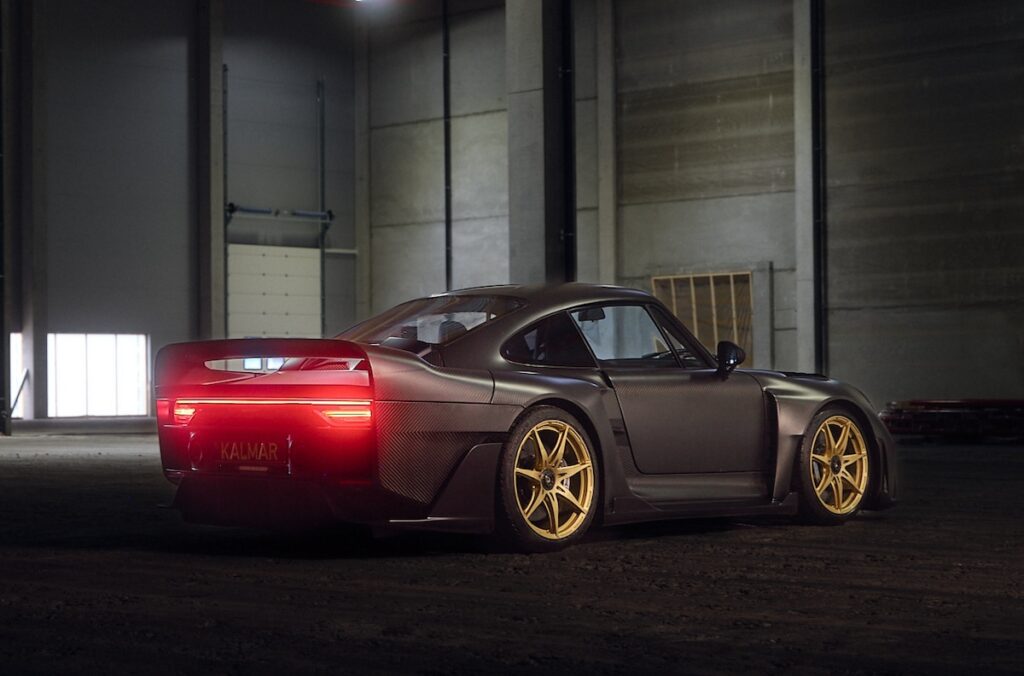
Carbonfibre means there’s significant lightness of weight: the heftiest Kalmar 9X9 features four-wheel drive and a (metric) 930bhp twin-turbo flat-six with PDK transmission, and weighs in at 1395kg. At the other end of the scale is our test car, which used to run the Turbo set-up but is now in Leichtbau (Lightweight) mode, with rear-wheel drive, a six-speed manual trans and a 515bhp version of the howling 9000rpm flat-six from a GT3. It weighs 1250kg. Between the two is the 650bhp, 1350kg 9X9 Sport. They each retail around the €2m mark, before some tastily priced options regarding paint and various finishes.
All the Kalmar 9X9s are good for an astonishing 1000kg of downforce: “In some ways too much,” says Jan. “Michelin was not happy.” Bear in mind that the tech-fest 959, with active four-wheel drive, variable-vane turbocharging, ride height adjustment and even live tyre pressure sensing, achieved no downforce at all. Should be fine on the Nordschleife, then, as test driver Dennis Lind has been finding.
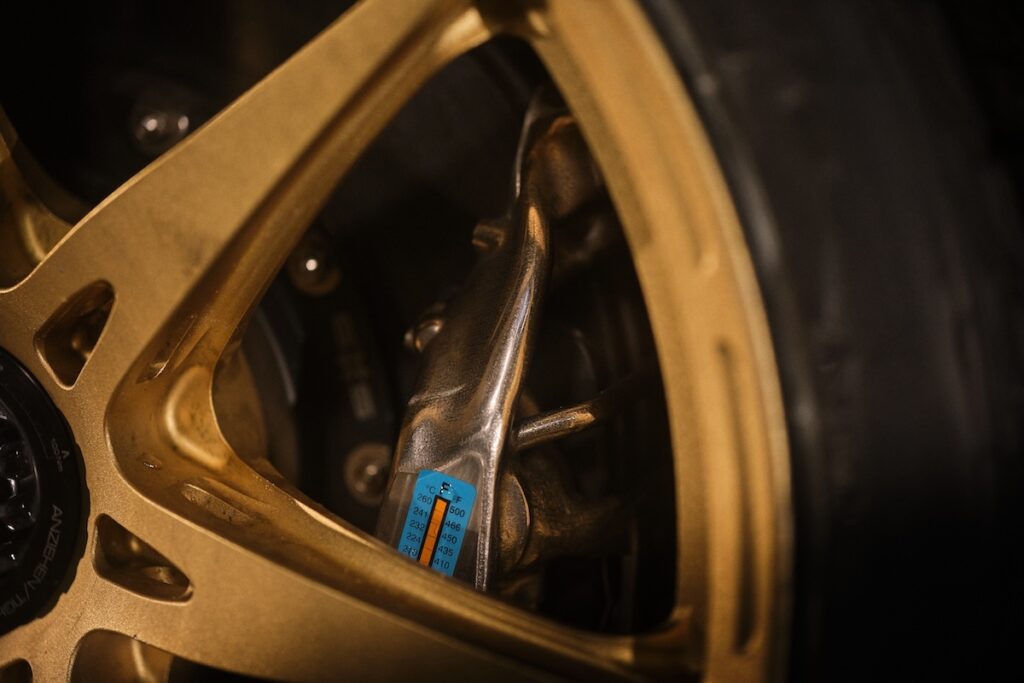
Mention of Michelin is telling. The company has developed tyres especially for the 9X9. All 27 of them. Likewise, Recaro has done the seats, TracTive the adaptive damping, Aerotak the aerodynamics and body design and Celeritech the exhaust system, while Carbo Brake has developed carbon-ceramic rotors with world-first 3D-printed single-piece titanium calipers. They cost £50,000 per corner. Assembly takes place in Turin, carried out by Danisi Engineering.
Equally tellingly, the Kalmar 9X9 is small. “I hate big, fat modern cars,” says Jan. During simulation testing, the need for greater downforce in pursuit of that ’Ring lap time meant a request to extend the wheelbase. So it’s 60mm longer than a 959’s yet fully 120mm shorter than a 992’s. There are no separate spoilers; the floor acts as a wing, making this basically a ground-effect car. Hence the vents in the wing-tops: when it’s hunkered down, pressure in the wheelarches needs to escape. As Peter Dumbreck discovered at Le Mans in 1999.
So where are we talking about the 9X9? At the Pistenklause in Tiergarten, about to head for a hot lap? Er, no. We’re chatting in the impressive My Garage facility, Denmark’s premier enthusiast destination (Jan is proudly Danish). And now it’s time to head out on local roads close to Vejle Fjord, which twist and turn and rise and fall not unlike English country lanes.
Have to admit, all the talk of savaging the ’Ring has made me somewhat pensive, especially given that this is the hardcore driver-focused version. It’s chilly, damp and heavily overcast outside; some of the corners out there look as though they could easily launch an incautious driver into the wintry fjord water. Yet Jan is clear that the 9X9 has to be enjoyable on the road; its track capabilities are simply an alternative realm.
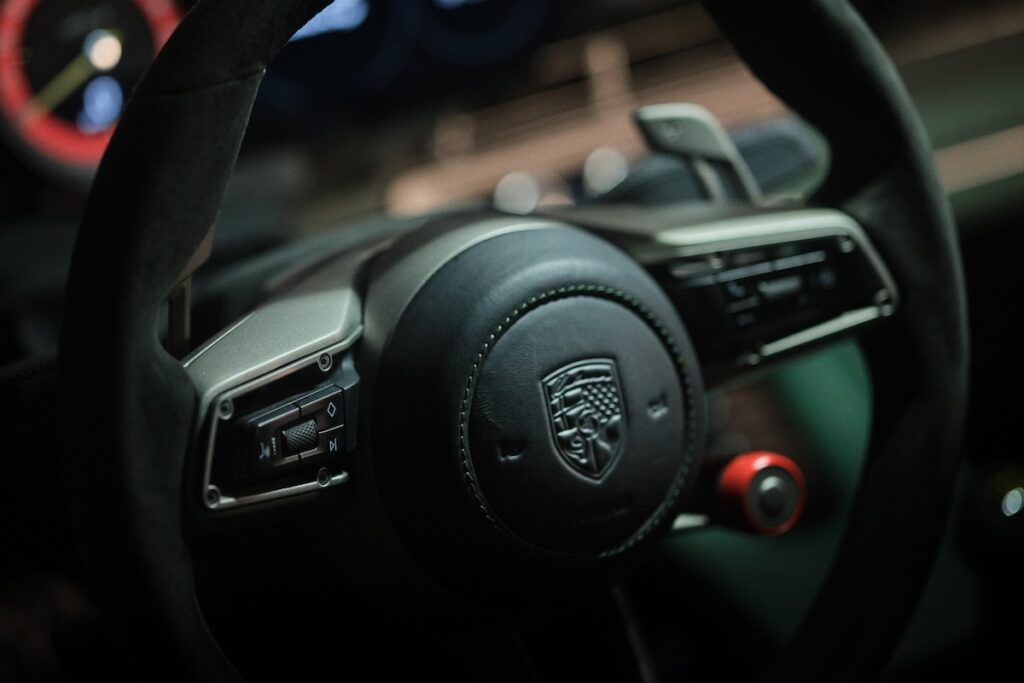
It’s easy to get in and get settled on the firm, sparse but immensely supportive Recaro Podiums (there are no rear seats). The usual 992 twist-knob handles starting and the lack of soundproofing is immediately evident in the low-rev burble and chunter of that glorious 4.0-litre engine. Pedals are floor-hinged, the clutch appropriate in its weighting, pulling away is easy, the steering feels just-so and becomes ever more impressive as you gain speed, distance and confidence.
Into the corners and you soon find that throwing the 9X9 around becomes second nature. It is immensely stable, there is no sense of pitching under heavy braking nor of the tail squatting under acceleration, thanks to a clever ‘third’ suspension unit at each end, mounted along the centre line and which extends the scope of each axle and raises the spring rating, thus acting as an extremely effective anti-dive and anti-squat provision. It’s the kind of practice you’ll find in LMP cars. Similarly ingenious is the interlinking of damping from side to side, in effect taking the place of an anti-roll bar. “Anti-roll bars add balance but cost grip,” says Jan.
There is real suppleness here, the ride is always firm but never harsh, which is remarkable given the 9X9’s relative lack of mass and its stated intent. Meanwhile, the steering is straight-talking to your fingertips and that flat-six bellows, yelps, wails and gives its all at your command. As it might in a GT3, but the point here is that the 9X9, despite the Porsche hardware throughout, feels different, very much its own car, largely due to that clever suspension. There’s none of the bobbing nose or that feeling of pendulous weight threatening to dominate.
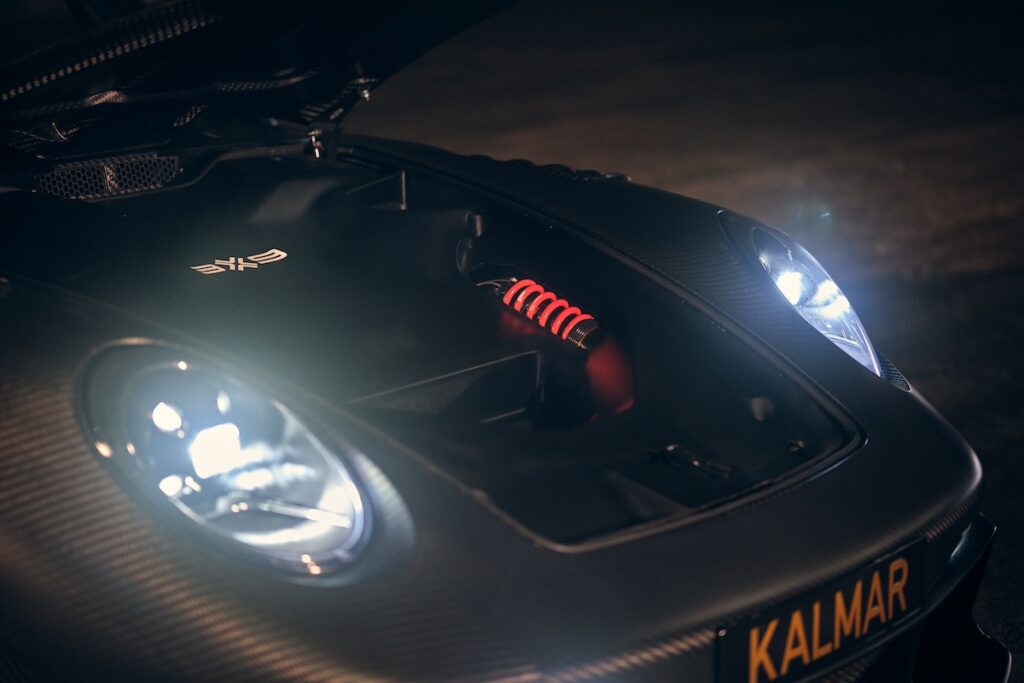
Instead, the 9X9 behave more like a mid-engined car, if one with unusually aggressive turn-in. The front suspension is via wishbones, but they act via pushrods on springs and dampers that are mounted longitudinally and outside the wheelbase. That adjusts the car’s weight distribution and extends its polar moment of inertia. All the fun (and more), but less in the way of heebie-jeebies should you run out of talent.
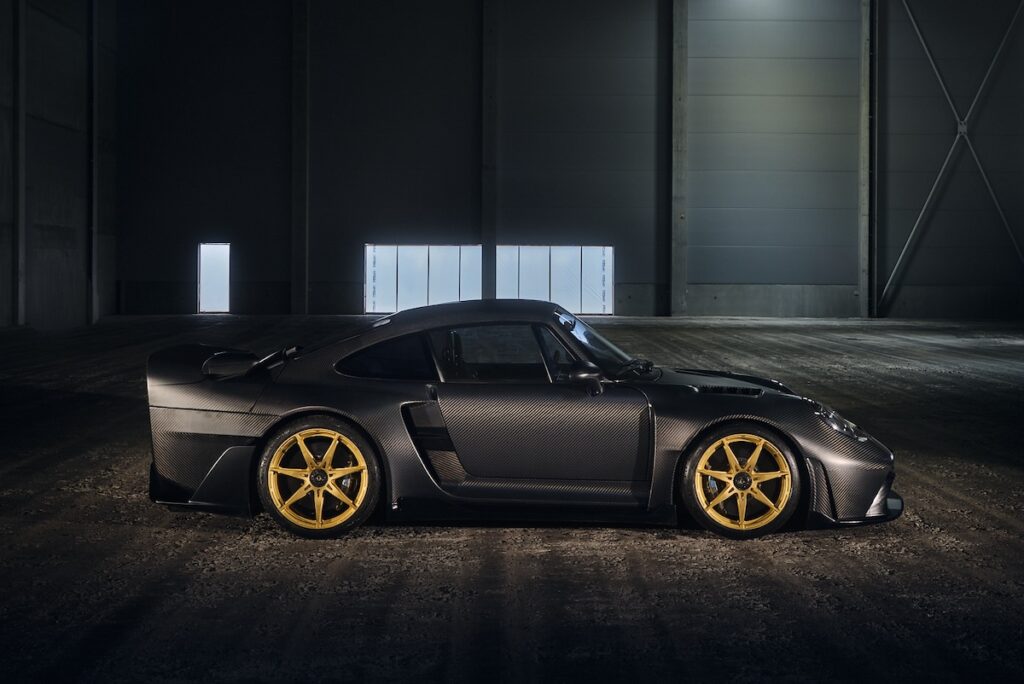
There’s a further change when you adjust the ride height to the lower setting. Doing so affects the suspension geometry, gaining camber and toe-in, as well as lowering the roll centre. The effect is subtle here, though noticeable; there’s more edge, more bite. Exactly what you’d want on a track, should you fancy a crack at that lap-time.
I recall we mentioned depth of engineering earlier. Hopefully I have illustrated exactly what that achieves. Yup, this is certainly more than a mere restomod. But what’s most impressive is how usable it is. This is a masterfully accomplished car.